The Critical EIP vs iPaaS EDI Architecture Decision: How to Evaluate Ecosystem Integration Platform Capabilities That Enable Multi-Enterprise Orchestration Beyond Traditional Document Exchange in 2026

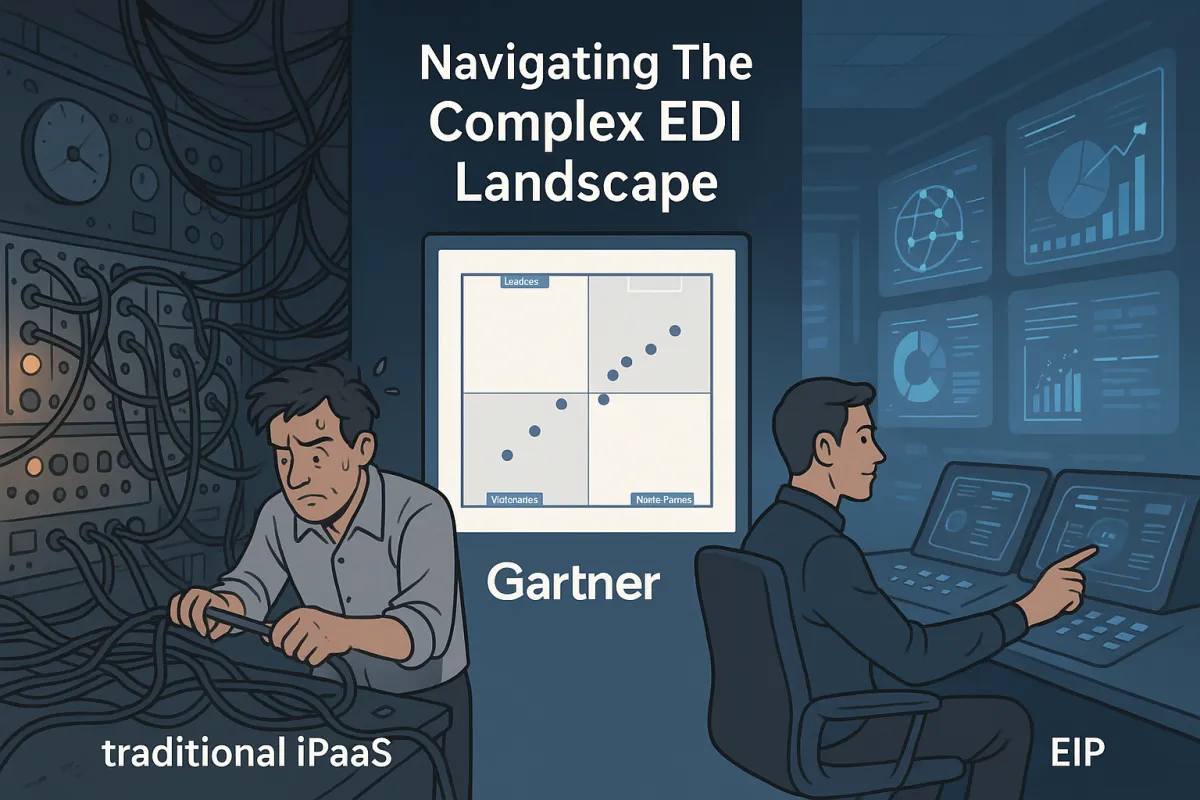
The EDI vendor selection landscape has reached a critical inflection point that most procurement teams are failing to recognize. The 2026 Gartner Magic Quadrant for Transportation Management Systems, published March 30, 2026, lands in the middle of the most aggressive vendor consolidation wave the industry has ever seen. WiseTech Global's completed $2.1 billion acquisition of E2open and Descartes' $115 million purchase of 3GTMS, marking the Canadian company's 32nd acquisition since 2016, signal a fundamental shift in how European shippers need to approach TMS procurement. The implications extend far beyond transportation management—this consolidation wave demonstrates why your ecosystem integration platform (EIP) vs iPaaS architecture decision will determine whether your supply chain technology stack thrives or becomes another integration failure statistic.
The Architecture Gap Crisis: Why Traditional iPaaS Falls Short for Modern Supply Chain Operations
Modern enterprise EDI platforms act as an execution layer, unifying EDI, APIs, and workflows to close the gap between visibility and action. Traditional iPaaS solutions, while excellent at connecting internal systems, weren't designed for the multi-enterprise coordination that supply chains demand today. The architectural limitations surface quickly when you scale beyond basic document exchange.
Large enterprises (organizations with 10,000 employees or more) use on average 660 apps, according to a 2025 report from SaaS management company Zylo. But here's what most teams discover too late: connecting 660 internal applications is a fundamentally different challenge than orchestrating processes across dozens of external trading partners who each operate their own technology stacks with their own constraints.
Consider what happened during the recent TMS vendor consolidation. 66% of technology projects end in partial or total failure, with 17% of large IT projects threatening company existence. Budget overruns hit 75% of European TMS implementations, and these statistics are worsening precisely as regulatory pressure forces mandatory digital transformation. The companies that avoided these failures shared one characteristic: they built EIP-style architectures that could adapt when their primary vendors got acquired or their requirements changed unexpectedly.
Technical Distinction: Document Exchange vs Execution Orchestration
The difference between traditional iPaaS and ecosystem integration platforms isn't just semantic—it's architectural. Modern enterprises are combining EDI + APIs + event-driven integration to enable faster, more flexible, and more scalable operations. Traditional EDI platforms were built to move documents between trading partners, but modern businesses operate across networks where data needs to trigger actions, update systems in real time, and keep processes aligned across multiple stakeholders.
Event-Driven Architecture: This design allows your system to respond in real-time to events or changes, improving responsiveness and agility. This real-time coordination capability becomes the foundation for supply chain orchestration platform architecture that can handle the complexity of modern multi-enterprise operations. Traditional iPaaS platforms excel at internal connectivity but lack the network orchestration capabilities that EIPs provide.
Transportation execution software implementations reveal this gap clearly. When you're coordinating shipments across multiple carriers, customs systems, and internal platforms, you need more than data movement—you need workflow orchestration that can adapt to exceptions, regulatory changes, and partner requirements in real time.
The EIP Evaluation Framework: 5 Critical Capabilities Traditional iPaaS Cannot Deliver
Evaluating EDI providers requires more than checking protocol support. EDI is no longer just about exchanging documents — it's about enabling execution across your entire supply chain. The platforms that survive the consolidation wave offer capabilities that traditional iPaaS architectures fundamentally cannot match.
Multi-Enterprise Process Coordination: EIPs orchestrate workflows across company boundaries, not just data flows. When a shipment exception occurs, the platform doesn't just notify—it triggers coordinated responses across shippers, carriers, and internal systems. Modern enterprise EDI platforms go further by combining EDI + APIs + event-driven workflows, enabling real-time orchestration, faster partner onboarding, and end-to-end visibility across the supply chain.
Real-Time Event Processing: Beyond moving data, EIPs process events to trigger actions across partner networks. This creates the foundation for supply chain orchestration platforms that can respond to disruptions, regulatory changes, or demand fluctuations automatically.
Network Effect Architecture: Traditional iPaaS don't create network effects because they're designed for bilateral integrations. EIPs leverage shared connectivity and standardized processes that improve as more participants join the network.
Visibility Across Trading Partner Ecosystems: Integration platforms accumulate hundreds of dependencies over time, and replacing one is rarely a simple migration - it is a rebuild. EIPs provide unified visibility across all these connections, while traditional iPaaS often create integration silos that become expensive to maintain.
Acquisition-Resistant Design: The TMS vendor consolidation demonstrates this perfectly. Companies undergoing integration often experience 12-18 months of reduced innovation while they harmonize platforms and teams. Post-acquisition integration timelines typically span 12-18 months, during which platform development stagnates and support quality deteriorates. EIPs with proper abstraction layers protect you from vendor consolidation disruption.
Cost Impact Analysis: Hidden TCO Differences
Total cost of ownership consistently represents the most underweighted factor in iPaaS evaluations. Software license is typically only 20–25% of total cost of ownership, with European shippers consistently underestimating TMS implementation costs by treating licensing like a simple software purchase rather than understanding it as a complex transformation affecting every carrier relationship.
The transport management software TCO differences compound over time. Traditional iPaaS require custom integration work for each trading partner relationship, while EIP architectures leverage standardized connection patterns that reduce per-partner integration costs. Modern API-first platforms like Orderful use transparent, predictable pricing with flat per-partner rates that eliminate surprise fees and reduce total cost of ownership by 40-60% compared to traditional managed services.
Carrier integration software costs escalate when you don't account for the maintenance overhead. Basic API integrations cost €5,000-€15,000, while complex ERP connections exceed €50,000, but here's the part that catches most teams off guard: a basic domestic shipper requires 10-15 integrations minimum, potentially totaling 1,000-1,500 hours of labor when you account for testing, certification, and ongoing maintenance.
TMS Vendor Integration Requirements: Why Architecture Choice Matters
The timing of architectural decisions has become more consequential given the vendor consolidation wave. WiseTech's acquisition of e2open for $3.30 per share in cash equating to an enterprise value of $2.1 billion marks the largest TMS industry acquisition to date, while Descartes Systems Group has acquired Columbus, Ohio-based 3Gtms for $115 million USD in cash. The deal marks Descartes' 32nd acquisition since 2016.
This consolidation creates specific integration architecture requirements. According to IRU's driver shortage survey, there were 444,000 vacant truck driver positions in Europe in 2025, and Europe's driver shortage is projected to triple by 2026 if no action is taken. As capacity constraints tighten, the ability to onboard new carriers quickly becomes a competitive advantage that traditional iPaaS architectures cannot deliver effectively.
Modern TMS platforms require EIP-style integration to handle the complexity of European cross-border operations. This includes established platforms like MercuryGate, Descartes, E2open, Manhattan Active, Oracle TM, and SAP TM alongside European specialists like Alpega, nShift, Transporeon, and modern alternatives including Cargoson that focus specifically on European cross-border operations. Each platform brings different connectivity requirements and data formats, making architectural flexibility essential.
Future-Proofing Integration Architecture
The hybrid approach minimizes disruption when vendors face acquisition. When evaluating consolidated vendors or acquisition targets, include contract language requiring vendor disclosure of platform integration timelines, feature deprecation schedules, and customer migration support. When two TMS platforms merge, customers inevitably face decisions about which system to standardize on, what features will be deprecated, and how long dual support will continue.
Data portability requirements become insurance against vendor lock-in. EIP architectures with proper abstraction layers allow you to switch freight management software integration patterns without rebuilding your entire technology stack. This becomes increasingly important as market consolidation reduces your negotiating leverage.
Multi-carrier shipping software architecture decisions made today determine your options when the next acquisition wave hits. This creates a procurement window running through Q1 2026—after which your leverage disappears as regulatory pressure forces decisions. Companies that haven't initiated TMS selection processes by mid-2026 will find significantly fewer viable options as vendors focus resources on existing customer compliance rather than new client acquisition.
Vendor Selection Criteria: EIP Capability Assessment Checklist
Your vendor evaluation framework needs to address the reality that many providers handle specific use cases well, but limitations surface as integration requirements expand beyond their architectural design. The key distinction lies in whether platforms support multi-partner operations or just bilateral connections.
When evaluating vendors, distinguish between traditional EDI providers and modern integration platforms. SPS Commerce can be effective for companies focused on retailer compliance and outsourced integration. However, its managed, network-driven model can introduce limitations in visibility, control, and flexibility, particularly for organizations that need to adapt quickly or support more complex, multi-channel operations.
For enterprise-grade capabilities, consider platforms like Cargoson alongside established players such as Cleo, IBM Sterling, and OpenText. For most organizations, Cleo Integration Cloud is the best overall EDI solution in 2026 because it supports EDI, APIs, and file-based integrations in one platform, with the flexibility to scale as partner and workflow complexity grows. For suppliers that need more flexibility beyond compliance — such as API integrations, custom workflows, or broader partner orchestration — Cleo Integration Cloud is often a stronger fit.
Transportation management system procurement requires evaluation criteria that account for both current needs and future scaling requirements. The platforms that offer EIP capabilities include event-driven processing, real-time visibility, and unified partner onboarding workflows rather than just document translation services.
Implementation Risk Mitigation
Implementation success depends heavily on architectural choices made during vendor selection. 66% of technology projects end in partial or total failure, while 17% of large IT projects go so badly, they threaten the very existence of the company. When your TMS vendor becomes an acquisition target, you inherit these integration risks without directly managing the project.
Successful implementations share common characteristics: they prioritize architectural flexibility over feature checklists, include acquisition protection clauses in contracts, and plan for multi-vendor scenarios from day one. The companies that avoided major integration failures during recent vendor consolidations had built abstraction layers that allowed them to adapt quickly when their vendors' priorities shifted.
The 2026 Decision Timeline: Market Forces Requiring Immediate Action
The procurement mathematics remain unforgiving when you consider the convergence of regulatory deadlines and vendor consolidation. By 9 July 2027, the eFTI Regulation will apply in full, requiring Member State authorities to accept information shared electronically via certified eFTI platforms, while CBAM obligations take effect from 1 January 2026, with the first annual declaration and certificate surrender due by 30 September 2027 for all 2026 imports. As of January 2026, eFTI platforms and service providers can start preparing for operations, while by December 2026, the Commission plans to adopt the remaining eFTI implementing specifications providing detailed functional and technical requirements for IT systems and certification rules.
WiseTech's $2.1 billion acquisition of e2open adds extensive cloud-based networks and customer reach with very little product overlap globally. More importantly for European buyers, this expands WiseTech beyond its traditional logistics service provider focus into global and domestic trade including transportation for buyers, importers, exporters, shippers, manufacturers and brand owners. This strategic shift creates uncertainty about development priorities during the critical regulatory compliance period.
The window for securing favorable procurement terms continues to narrow. WiseTech's acquisition of e2open for $2.1 billion marks the largest TMS industry acquisition to date, while Descartes' acquisition of 3GTMS for $115 million marks the 32nd acquisition since 2016. This creates a fundamentally different procurement environment where fewer vendors control more market share, reducing your negotiating leverage and pricing transparency.
Your transportation management system procurement strategy must account for this timeline compression. Vendors claiming regulatory readiness need to demonstrate functional integration during 2026, not merely promise compliance by July 2027 deadlines. The architectural decisions you make now—choosing EIP capabilities over traditional iPaaS limitations—will determine whether your integration stack can adapt to the regulatory and competitive pressures ahead.
The ecosystem integration platform vs iPaaS decision represents more than a technology choice. It determines whether your supply chain technology architecture can execute effectively in a world where data doesn't just move between systems—it orchestrates actions across entire trading partner networks. The companies that recognize this architectural distinction early will have significant competitive advantages as market consolidation eliminates alternative options.