The Critical PEPPOL-TMS Integration Rush: How Transportation Management System Vendors Are Scrambling to Add E-Invoicing Compliance Before Belgium's January 2026 Mandate Triggers the European Domino Effect


Belgium's January 2026 mandate requiring all B2B invoices to be issued electronically through Peppol has created an unexpected ripple effect across transportation management system vendors. While you might think this affects only Belgian companies, foreign companies doing business with Belgian organizations will also be affected, as Belgian trading partners require Peppol-compliant invoicing. With France implementing requirements in September 2026 and Germany following with a phased rollout in 2027-2028, TMS providers are scrambling to build e-invoicing capabilities before the European domino effect begins.
The Belgium January 2026 Catalyst: Why One Small Country Is Driving Global TMS Architecture Changes
Belgium's decision to mandate e-invoicing based on EN 16931 as the legal standard and using Peppol as the primary delivery channel represents more than a local compliance requirement. From January 1st, 2026, all taxable persons established in Belgium must issue and receive structured e-invoices for B2B transactions, with PDF invoices sent by email no longer being compliant.
The financial penalties for non-compliance aren't trivial. The penalty framework is tiered and increases with repeated non-compliance, with administrative fines for entities that do not have the technical capabilities to issue and receive structured electronic invoices. However, Belgium has officially confirmed a three-month tolerance period following the January 1st, 2026 go-live date, but this window is conditional and only companies that can prove they've already started their compliance journey will benefit from it.
This creates a compelling business case for TMS vendors. Every operator – whether you run a fleet of 5 trucks or 500 – will need a way to send invoices electronically through a Peppol Access Point. Many legacy TMS or accounting tools weren't built with modern e-invoicing in mind, and retrofitting compliance can be expensive, slow, and complex.
The European Domino Effect: France September 2026, Germany 2027-2028 Timeline
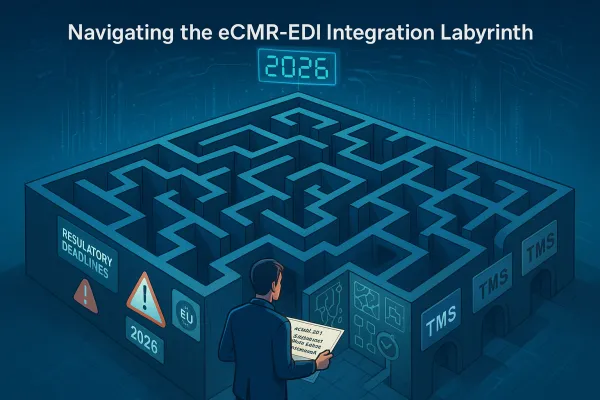
Belgium launches mandatory B2B e-invoicing on January 1, 2026, followed by France beginning its phased approach on September 1, 2026 where all businesses must be capable of receiving e-invoices electronically. France implements structured B2B e-invoicing (including Peppol support) beginning in September 2026, with full adoption by 2027, while Germany makes e-invoicing mandatory for receiving as of January 2025 and issuing by 2028.
The challenge for TMS vendors? France's e-invoicing mandate represents one of Europe's most ambitious digital transformation projects, affecting millions of businesses, while Belgium's implementation leverages the proven Peppol network infrastructure. Each country has slightly different technical requirements, forcing vendors to build flexible architectures rather than one-size-fits-all solutions.
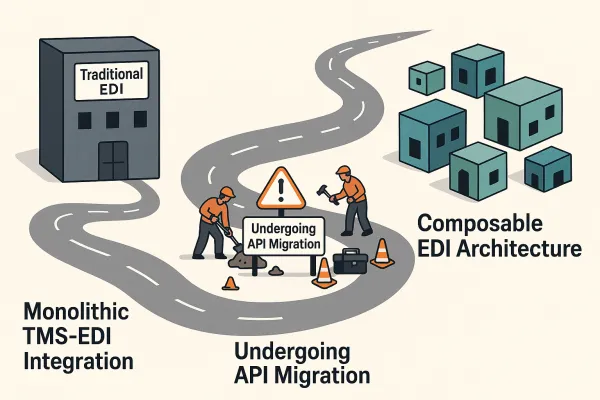
The Technical Integration Challenge: Why Traditional EDI-TMS Architecture Can't Handle PEPPOL
The fundamental issue isn't just adding another document format. Structured formats use XML or JSON-based standards such as PEPPOL BIS, UBL, UN/CEFACT CII, or Factur-X/ZUGFeRD, enabling machines to read and process invoice data automatically, with dedicated transport networks facilitating exchange through interoperable rails like the PEPPOL network.
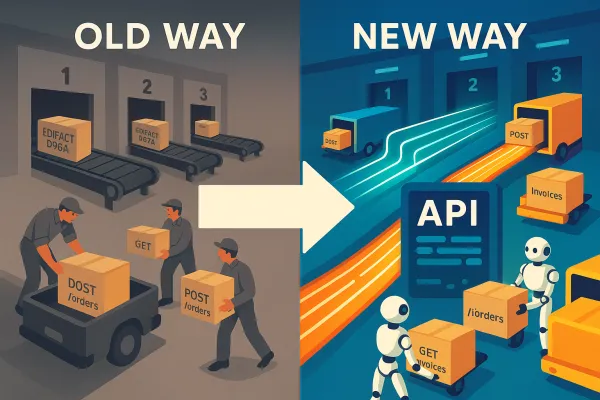
Traditional TMS-EDI integrations were designed for point-to-point connections with carriers using standardized message formats like EDIFACT or X12. Peppol resolves the main issue of lack of interoperability by enabling companies to "connect once and transact with anyone" on the network, irrespective of their location, sector, or software, offering a standard set of guidelines and requirements that removes the need for separate, customized integrations.
The Peppol 4-Corner Model acts as the network's architectural blueprint, operating like a postal system where the sender sends a document to their chosen Access Point, which then safely routes it to the recipient's Access Point, eliminating the need for direct bilateral connections.
The Access Point Provider Selection Crisis
TMS vendors face a make-or-buy decision around Peppol connectivity. Descartes is a Certified Peppol Access Point with decades of experience, while Tradeshift has been a Certified Peppol Access Point since 2014 and Babelway is a Certified Peppol Access Point since 2014, powering Belgium's official Mercurius platform.
Most TMS providers aren't becoming access points themselves. Instead, they're partnering with certified providers or building API integrations to existing platforms. This creates dependencies and potential single points of failure that traditional EDI implementations avoided through direct carrier connections.
TMS Vendor Response Analysis: Who's Ready and Who's Scrambling
The major enterprise TMS platforms are taking different approaches to PEPPOL integration. Leading vendors such as SAP and Oracle offer integrated supply chain software suites that support complex global operations, while rising enterprise demand is accelerating adoption of advanced solutions from providers such as o9 Solutions and Blue Yonder.
Blue Yonder TMS is fully compatible with SAP ERP, which has made it a preferred choice among companies that rely on SAP, with one of Blue Yonder TMS's many advantages being the ease of data exchange for its Transportation Management System. Blue Yonder offers out-of-the-box integration and synchronization with SAP ERP Central Component, SAP Enterprise Warehouse Management, and other SAP modules.
PeppolNavigator Enterprise offers seamless integration with existing ERP systems including SAP, Oracle, Microsoft Dynamics, IFS Connect, and Business Central, ensuring compliance with Belgium's mandatory e-invoicing requirements from January 2026. As a vendor-independent platform, they're not affiliated with any ERP provider, meaning no forced upgrades, vendor lock-in, or need to replace existing ERP systems.
European TMS providers like Cargoson have positioned themselves advantageously by focusing on the European market from the start. While traditional enterprise vendors retrofit PEPPOL capabilities onto existing architectures, cloud-native TMS platforms can build e-invoicing compliance directly into their core workflows.
Transportation-specific platforms like Qargo have been built from the ground up to make e-invoicing effortless, with Peppol not being an add-on or patch but part of their platform architecture, connecting directly to the Peppol network so invoices are automatically sent in the correct format.
The Multi-Modal Challenge: Freight vs. Parcel E-Invoicing Requirements
Transport operations involve multiple invoice types across different service providers. Transport workflows often involve complex invoices, rate changes, and surcharges, requiring direct integration between TMS and accounting systems to automate carrier invoice matching, approvals, and ledger entries, reducing reconciliation time and eliminating manual errors.
The challenge extends beyond primary carrier invoicing. Freight operations typically involve subcontractor payments, customs broker fees, fuel surcharges, and ancillary service charges. Each requires proper PEPPOL formatting and routing through access points. Many legacy TMS or accounting tools weren't built with modern e-invoicing in mind, and retrofitting compliance can be expensive, slow, and complex.
The 90-Day Evaluation Framework: Critical TMS-PEPPOL Assessment Criteria
Supply chain teams have limited time to evaluate TMS vendor PEPPOL readiness before the Belgium deadline. Here's what to assess during vendor demonstrations:
Native vs. Bolt-On Integration: If your TMS or invoicing setup isn't Peppol-ready, compliance can sound complicated, but solutions built from the ground up make e-invoicing effortless, with Peppol being part of platform architecture rather than an add-on. Ask vendors to demonstrate live PEPPOL invoice generation during the demo, not just screen mockups.
Multi-Country Compliance Roadmap: Different Peppol requirements across EU jurisdictions require multi-currency support and varying tax compliance requirements for international operations. Vendors should articulate their timeline for France 2026 and Germany 2027-2028 compliance beyond Belgium.
Carrier Integration Impact: Integrating a TMS can come with challenges requiring careful planning to ensure success, as any disruptions in data flow can disrupt workflows, hinder operations, and lead to costly setbacks. Evaluate how PEPPOL implementation affects existing carrier EDI connections and API integrations.
The Hidden Integration Costs: Beyond Software Licensing
The true cost of TMS-PEPPOL integration extends far beyond software fees. For most companies, integration involves integrating with external carrier partners to transmit load tenders and receive tracking messages, but the "heavy lift" usually involves interaction between internal systems and TMS software.
A big chunk of time saved with transportation management systems comes from freight invoice audit and reconciliation, but if the TMS integrates with OMS or accounting software, teams must share input on GL coding rules, tolerance limits for auto-approval, and vendor codes.
Consider these often-overlooked implementation costs: staff training on new invoice workflows, parallel testing with Belgium trading partners, access point provider setup fees, and ongoing compliance monitoring. Transportation and logistics management require substantial paperwork for B2B transactions, regulatory compliance, and auditing, requiring sufficient administrative features to support documentation and financial reporting.
The January 2026 Deadline Reality: Implementation Planning for Supply Chain Teams
With Belgium's deadline approaching, procurement teams need realistic timelines. If organizations want a smooth rollout and zero risk of penalties, compliance projects must officially start before January 1st, as companies cannot rely on last-minute vendor onboarding or internal approvals in 2026.
Cloud-based TMS implementation typically takes 1-4 weeks compared to 6-18 months for traditional on-premise systems, with solutions like Cargoson having shippers managing freight within days of signing up. However, PEPPOL compliance adds complexity requiring access point setup, trading partner testing, and internal process changes.
The three-month tolerance period offers some flexibility, but it appears to apply to businesses that can demonstrate their compliance journey has already begun before the deadline – this isn't about rushing to go live but taking a sensible first step now to complete implementation calmly in Q1 with peace of mind.
Smart procurement teams are using December 2025 to finalize vendor selection and begin access point setup. To secure the buffer, companies must demonstrate they've started their compliance journey before January 1st, 2026 – this is the moment to choose your compliance partner, launch your internal project, and ensure Belgian entities are positioned for a smooth transition.
The Belgium PEPPOL mandate represents more than a local compliance requirement. It's the first domino in a European-wide transformation of B2B invoicing that will fundamentally change how TMS platforms handle financial document exchange. Vendors that treat this as a bolt-on compliance feature rather than a core architectural requirement risk falling behind as the European rollout accelerates. Companies choosing TMS platforms today aren't just selecting transportation software – they're choosing partners for the next decade of digital tax transformation.