The Critical Shift from Batch to Real-Time EDI Processing: Implementation Roadmap and Cost-Benefit Analysis for Supply Chain Excellence in 2025

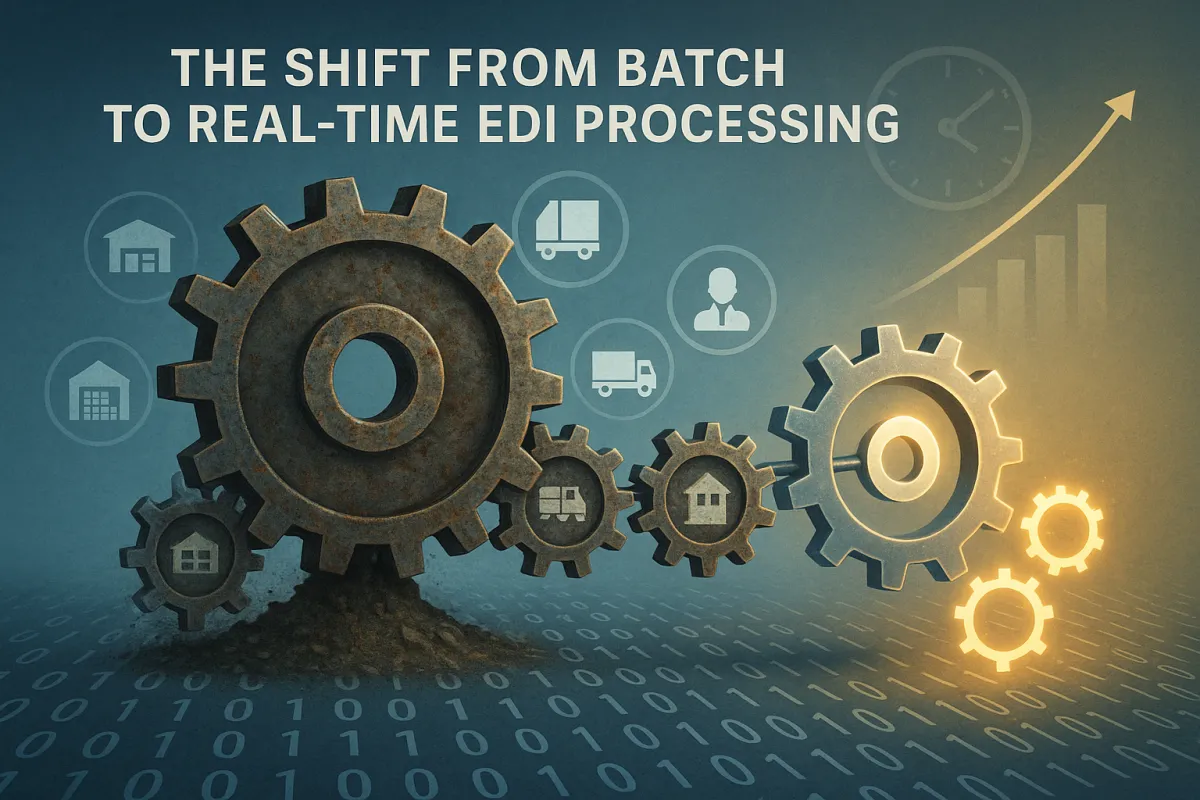
Your traditional batch EDI system processes documents every 30 minutes to two hours. Today's supply chains run on real-time data, not batch uploads or overnight reports. Unfortunately, many legacy EDI systems operate with delays. This slows down operations, makes it harder to respond to changes, and limits visibility across the ecosystem. Meanwhile, your competitors using real-time EDI processing get updates in seconds.
This timing gap isn't just inconvenient—EDI performance bottlenecks cost companies an average of $62,000 per day in delayed shipments and processing errors. New businesses are moving away from batch-based EDI and toward real-time API-based EDI architectures. This mix of EDI innovations lets businesses keep the structure and rules of EDI while also using the speed and flexibility of APIs. This is especially true in retail and logistics, where having up-to-date information on shipment, inventory, and billing is quite important.
The Batch Processing Bottleneck Crisis
Your 30-minute batch processing window seemed reasonable five years ago. Now it's a competitive disadvantage. In 2025, real-time data exchange will become a must-have for businesses. Traditional EDI systems often relied on batch processing, which could delay data updates. With real-time EDI, you can get up-to-the-minute information on orders, shipments, and inventory. Real-time data exchange allows you to make informed decisions faster. This capability is beneficial for industries where timing is everything, such as logistics and supply chain management.
Traditional EDI frequently depends on batch processing, which restricts data transfer to set communication windows and can delay information exchange compared to real-time solutions. When a customer places an urgent order, batch processing means your suppliers won't see it for up to two hours. Your warehouse management system can't react to shipping delays until the next batch runs. Purchase orders sit in processing queues while inventory levels drop.
The biggest disadvantage of batch processing is the latency between the time the data is created vs the time it's processed and ultimately used. This is often daily or down to every few hours with increasing costs to handle sub 1 hour. This is why batch data processing is often referred to as working with stale data.
Compare this to companies using platforms like Cargoson, MercuryGate, or Descartes that offer real-time capabilities. We have direct EDI/API connections with major carriers, ensuring seamless bookings and real-time tracking. These systems process transactions in seconds, not hours.
Real-Time EDI Architecture Requirements
Making the switch to real-time EDI processing requires more than just faster servers. Integrating EDI systems into cloud-native environments is no longer optional; it's a necessity. Cloud-native platforms promise scalability, flexibility, and real-time data processing. They seamlessly integrate with other cloud services, facilitating efficient EDI transactions from anywhere while ensuring robust security.
Your infrastructure needs include cloud-native messaging systems that can handle thousands of concurrent transactions, API gateways that manage real-time data flows, and monitoring systems that track processing speeds and identify bottlenecks instantly. Cloud EDI solutions are replacing old on-premise systems since they are faster to set up, cost less, and can grow with your business.
According to IBM, while "EDI is ideally suited for batch processing of mission-critical transactions like financial documents and periodic updates, APIs enable real-time data exchange for proactive decision-making to drive competitive advantage."
TMS Integration Challenges
Here's where things get complex. The first challenge of EDI inside an ERP, TMS, or WMS is that it will be tightly tied to the ERP. When an enterprise grows and is looking to implement a new ERP or TMS, the switch will impact EDI with its trading partners. The average company that performs EDI has anywhere from 100-200 partners, and 400-500 maps—all of which will be impacted by the switch. This is a huge challenge and workload to tackle for any company.
Integrating EDI with TMS can be technically challenging, especially for organizations with outdated systems or limited IT resources. Businesses may need to invest in middleware solutions to bridge the gap between legacy systems and modern EDI requirements. Legacy Systems: Older systems may not support the latest EDI standards, requiring significant upgrades. Integration Costs: The initial investment for integration can be substantial, although it is often recouped through long-term savings.
The time it takes to set up TMS EDI can vary depending on a variety of factors, such as the complexity of the integration, the number of transaction sets being implemented, and the availability of resources from both the TMS and EDI providers. Typically, the setup process can take several weeks to several months to complete.
Implementation Cost Analysis
Let's talk real numbers. The cost drivers for setting up and operating an in-house EDI solution are software licenses, dedicated hardware, maintenance, and personnel. Using EDI in your business processes requires a substantial initial investment. You have to invest in hardware, software, and systems that follow regulatory standards. If you use a third-party EDI network provider, you also need to pay for those services.
But the hidden costs are larger. EDI software and hardware don't come cheap. Licensing fees, infrastructure costs, and IT staff to keep everything running, it adds up fast. As business grows, these costs tend to rise. Even more expensive is the cost of inefficiency, delays in order processing, disputes from miscommunications, and lost revenue from failed transactions. Many businesses keep spending just to maintain the status quo, rather than modernize and improve.
A mid-sized manufacturer typically spends $150,000-300,000 annually on legacy EDI infrastructure. Real-time cloud-based solutions like those from Cleo, TrueCommerce, or Cargoson can reduce these costs by 40-60% while improving performance. Managed EDI services allowed the costs for EDI to be reduced by 50 percent, since there was only one electronic transfer point for communication with all partners.
ROI comes from reduced processing delays, fewer failed transactions, and faster partner onboarding. Your suppliers wait four to six weeks just to get onboarded with traditional EDI vendors, and in practice, the theoretical 1-2 week timeline often stretches to 1-2 months or longer. While you lose potential revenue every day those partnerships remain inactive.
Hybrid Batch-to-Real-Time Migration Strategy
You don't have to rip out your entire EDI infrastructure overnight. Logistics providers may want to consider implementing an API + EDI approach. This way they can access the real-time data and updates that API integration supplies, while simultaneously achieving the security, stability, and greater processing power that EDI provides. Furthermore, an API + EDI approach gives logistics providers greater integration compatibility with trading partners since they are supporting more integration methods.
Start with your most time-sensitive transactions. Move critical shipment status updates and inventory alerts to real-time processing first. Keep your batch processing for less urgent document types like invoices and purchase order acknowledgments. Some relationships might require real-time data exchanges, while others might be on a daily or weekly batch basis.
Use APIs for real-time capabilities: EDI and API are complementary technologies that work best together. API integration augments EDI and gives deeper context to B2B integrations with your digital ecosystem, while EDI helps enable downstream business processes and data orchestration.
Modern platforms including Transporeon, nShift, and Cargoson support this hybrid approach. Implement a best-of-breed EDI solution that sits independently from your TMS and ERP systems. Platforms like MercuryGate, Descartes, and Cargoson offer robust middleware that can communicate with multiple core systems simultaneously. Look for prebuilt TMS document flows and templates for common documents like 204s and 210s to shorten implementation time and improve reliability.
Monitoring and Performance Optimization
A file fails, but you're not told why, or worse, you find out after your customer does. There's no intuitive dashboard to track status, no alerting system to flag issues in real time, and no way to pinpoint whether the failure happened during mapping, routing, or partner communication. This lack of visibility forces teams to dig through logs or wait on support, which slows resolution and frustrates both IT and business users. Without proactive alerts or drill-down insights, you're always reacting, never ahead of the issue.
Real-time EDI processing changes this completely. Set up real-time monitoring tools that can alert you to transaction errors or delays as they occur. This allows for immediate intervention to resolve issues before they impact business operations.
AI can be employed to identify and correct errors in EDI data. By leveraging machine learning algorithms, AI systems can detect anomalies and inconsistencies in real-time, ensuring that the data exchanged between partners is accurate and reliable. Deploy machine learning algorithms that learn from historical correction patterns. After processing thousands of transactions, these systems can predict and auto-correct common data entry errors with 90%+ accuracy.
Performance metrics become actionable with real-time visibility. Track processing speeds, error rates, and partner response times. Establish a regular schedule for conducting comprehensive audits of your EDI system's performance. These audits should examine all aspects of the system, including data accuracy, transaction speed, and compliance with both internal standards and external regulations. Compare your system's performance against industry standards or benchmarks to evaluate its efficiency.
Future-Proofing Your Real-Time EDI Investment
The future of EDI is hybrid, flexible, and API-ready. If you're thinking about upgrading your EDI technology, now's the time to explore options that won't disrupt your operations—but will prepare you for what's next.
Choose platforms that support multiple integration methods. Cargoson has developed API/EDI integrations with all major global and regional carriers, yet all small local carriers can be easily added. Look for solutions that can handle everything from traditional X12 and EDIFACT to modern JSON APIs and blockchain-based transactions.
AI and EDI, while initially unrelated, are two prominent technologies in today's business world. As we see artificial intelligence continuing to break into nearly every sector of business, there is no doubt artificial intelligence (AI) can and will be integrated with electronic data interchange (EDI) to enhance B2B processes. Overall, it is clear that AI has the potential to transform EDI into a more powerful and efficient tool for B2B communication and collaboration.
This has sparked growing interest in EDI modernization—a shift toward more flexible, API-driven cloud platforms that maintain the strengths of traditional EDI while eliminating its weaknesses. Instead, the future lies in hybrid cloud EDI software that enables gradual migration without requiring partners to change everything at once.
Your next EDI platform should integrate seamlessly with emerging technologies. Consider providers that already work with AI-powered data validation, blockchain for secure transactions, and IoT devices for real-time tracking. The companies succeeding with real-time EDI processing in 2025 aren't just solving today's problems—they're building foundations for tomorrow's supply chain innovations.
Don't wait for your current batch processing delays to become unbearable. Often playing the role of the intermediary, freight brokers will stand a far better chance if their TMS systems utilize both API and EDI integrations. In doing so, they will make the best use of both worlds, API being the interface and EDI providing an engine. Start your real-time transformation with your most critical trading partners and expand from there.