The Critical TMS Vendor PDF-EDI Integration Assessment: How to Evaluate Hybrid Document Processing Capabilities That Eliminate Manual Order Entry and Bridge Non-EDI Trading Partners Without Breaking Transportation Workflows in 2026

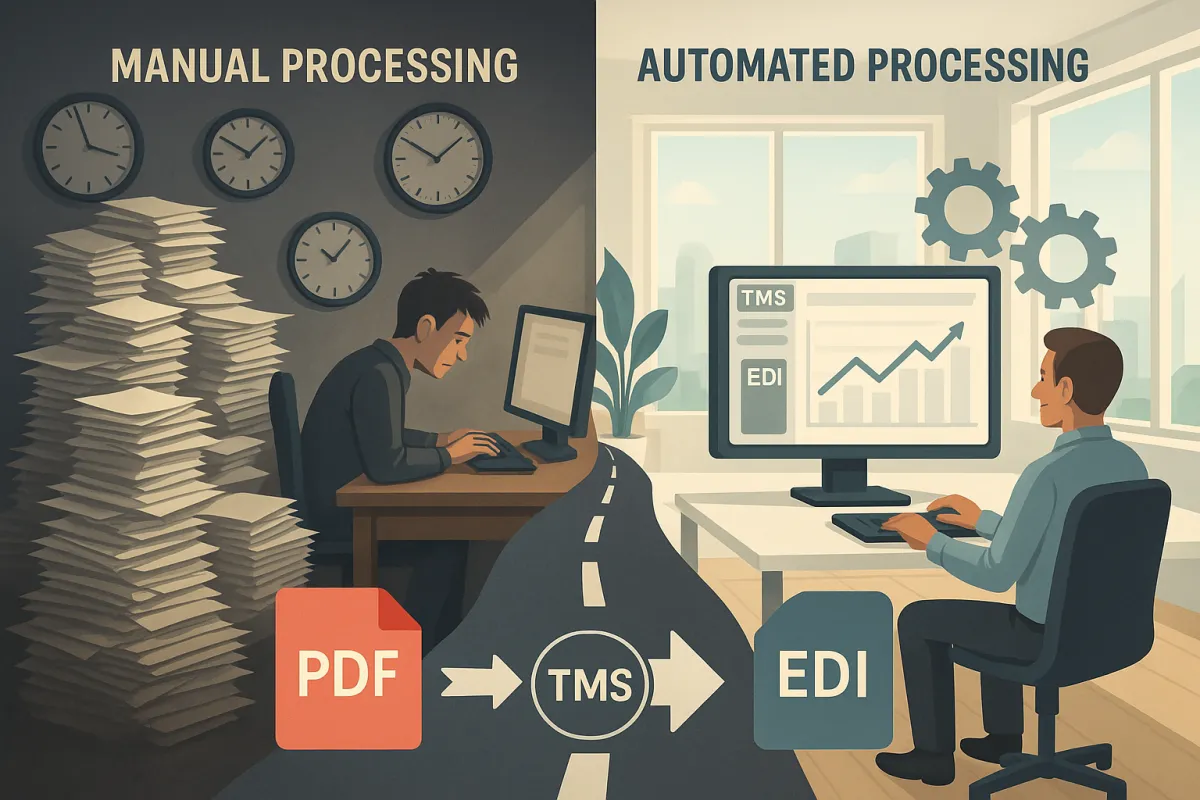
When your procurement team evaluated TMS vendors last year, they probably overlooked a critical capability gap that's costing you thousands in manual processing costs. Manually entering shipment details, invoices, and purchase orders increases the risk of human errors, leading to incorrect shipments and billing discrepancies.
Most TMS software selection focuses on structured EDI connectivity, but your actual order flow tells a different story. Between 30-40% of transportation orders still arrive as PDF documents from suppliers who haven't implemented EDI, creating automation gaps that force your team back to manual data entry just when you thought you'd solved the problem.
The Mixed Document Processing Crisis in Transportation Management
Your TMS handles EDI beautifully – integrating EDI with TMS creates a powerful solution that enhances visibility and control throughout the supply chain. But when a PDF order hits your inbox, that elegant automation breaks down. You're back to manual entry, duplicate data validation, and the errors that come with human processing.
The financial impact adds up quickly. Without automation, businesses struggle with delayed data exchanges between carriers, suppliers, and warehouses. A mid-sized manufacturer processing 200 PDF orders monthly spends roughly 15 minutes per document on manual entry – that's 50 hours of staff time monthly, or $3,000-4,000 in labor costs before you factor in error correction and delays.
Traditional TMS vendors haven't prioritized this gap because their core customer base demanded EDI compliance first. But for non-EDI business partners this solution can also include integration methods via Email, PDFs, Excel, flat files, etc for those without EDI capabilities. For non-EDI business partners this solution can also include integration methods via Email, PDFs, Excel, flat files, etc for those without EDI capabilities.
Why Your TMS Vendor Selection Must Include Hybrid Processing Evaluation
Integrating EDI with TMS enhances operational efficiency, data accuracy, and customer service. But when PDF documents break your automation chain, you lose those benefits precisely where you need them most – in handling non-EDI trading partners who represent growth opportunities.
Consider the real cost comparison: EDI order processing takes 2-3 minutes of system time. PDF orders require 15-20 minutes of manual processing, plus validation time. When order volumes spike during busy seasons, that processing time difference becomes a bottleneck that delays shipments and frustrates customers.
Modern solutions address this through hybrid EDI integration approaches that leverage solutions via web portals, OCR, etc to translate and communicate data between business partners. Instead of viewing PDF orders as a separate workflow, advanced TMS platforms treat them as another data input that feeds the same automation engine handling your EDI transactions.
The Hidden Costs of PDF Processing Gaps
Manual PDF handling creates three cost layers most procurement teams miss during vendor evaluation. Direct labor costs for data entry represent just the surface. Error correction adds another 20-30% to processing time when manual entries require validation and correction.
Scalability limits create the biggest hidden cost. During peak shipping periods, PDF processing becomes a constraint that forces you to choose between delayed order processing and temporary staff expansion. Neither option delivers sustainable operations.
The Complete TMS Vendor PDF-EDI Capability Assessment Framework
For shippers and logistics companies evaluating TMS platforms in 2026 and beyond, AI capability should not be an afterthought in your requirements document. It should be one of the top three evaluation criteria alongside core functionality and total cost of ownership.
Your assessment framework needs five evaluation dimensions: document recognition accuracy, ERP integration depth, real-time processing capability, validation workflow sophistication, and vendor platform stability. Each dimension requires specific testing scenarios with your actual document types.
Start with document recognition accuracy testing. Request processing samples from your top three PDF order formats. Measure field extraction accuracy, processing speed, and error rates. Being lighter weight than most models in the category, Mistral OCR performs significantly faster than its peers, processing up to 2000 pages per minute on a single node. The ability to rapidly process documents ensures continuous learning and improvement even for high-throughput environments.
Technical Integration Requirements
ERP connectivity determines whether PDF automation actually reduces your workload or just moves manual work to a different system. API-based integration allows real-time connectivity but may lack standardization across all trading partners. Your evaluation should test both file-based and API integration methods to understand which approach handles your specific order volumes and complexity.
Real-time processing capability separates modern platforms from legacy solutions trying to add PDF support as an afterthought. Test batch processing times versus real-time document routing. Can the system handle multiple PDF orders simultaneously without creating processing queues?
AI-Powered Document Recognition Capabilities
Traditional OCR approaches fail with complex order documents because they rely on fixed template recognition. Modern solutions use AI fingerprinting that adapts to layout variations and learns from processing patterns. Unlike other models, Mistral OCR comprehends each element of documents—media, text, tables, equations—with unprecedented accuracy and cognition.
Test the system's learning capability with your actual document formats. Does it improve accuracy over time as it processes more orders from the same suppliers? Can it handle format changes without requiring manual template adjustments?
Look for vendors incorporating established platforms like Cargoson, alongside traditional providers like Transporeon, MercuryGate, and Descartes. Each approaches PDF processing differently, so your testing should reveal which methodology works best for your specific document types.
Vendor Demonstration and Testing Requirements
Structure your proof-of-concept testing around real scenarios, not vendor demo documents. Provide your actual PDF order formats, including the problematic ones with non-standard layouts or multiple languages. When you are evaluating TMS platforms, ask specifically about their ability to support AI agent creation for operational workflows. Can you build custom agents that automate specific repetitive processes? How configurable are they? What level of technical skill is required to set them up? Do they learn and improve from your operational patterns over time? The vendors who have a clear answer to these questions are the ones thinking about AI the right way.
Set specific performance benchmarks: 95%+ field extraction accuracy, processing time under 3 minutes per document, error correction workflow that takes less time than manual entry. If a vendor can't meet these thresholds during testing, they won't deliver operational value in production.
Test integration speed with your existing systems. How long does it take to route processed order data to your ERP? Can the system handle your peak order volumes without creating backlogs?
Implementation Strategy for Hybrid Processing Success
European shippers who act decisively within the next 90 days—with proper frameworks that account for both capacity and consolidation scenarios—position themselves to navigate 2026's perfect storm successfully. Your implementation should start with pilot testing using 20-30% of your PDF order volume to validate processing accuracy and integration workflows.
Plan for 90-120 days implementation timeline when adding PDF processing to existing TMS platforms. This includes 30 days for document format analysis, 45 days for integration testing, and 30 days for user training and process refinement.
Partner alignment matters more than technology configuration. Educate suppliers about format standards that improve processing accuracy. Simple changes like consistent field positioning or standardized terminology can significantly improve automation success rates.
Future-Proofing Your Mixed Format Strategy
Meanwhile, your traditional EDI connections become liability anchors when regulatory requirements change monthly and carrier onboarding delays compound operational risks. Here's your systematic approach to transitioning from legacy EDI to API-first TMS integrations before the regulatory deadlines eliminate your flexibility.
Plan your hybrid processing strategy as a bridge toward full API connectivity, not a permanent solution. While PDF processing solves immediate automation gaps, your long-term strategy should guide trading partners toward structured data exchange through APIs or modern EDI standards.
Consider vendors positioning for this transition. Platforms offering both robust PDF processing and API-first architectures give you flexibility to evolve your trading partner connectivity without platform changes. While EDI is leading in terms of connecting technologies used in TMS deployment, API connectivity is increasing, especially among parcel and LTL freight carriers. It's, therefore, unlikely that APIs will fully replace EDI as the standard means for connection in the next several years.
Your procurement decision should balance immediate PDF processing needs with future API migration capabilities. The vendors who understand this transition – and can demonstrate both current hybrid processing and future API evolution – position you for sustainable competitive advantage as trading partner connectivity standards continue evolving.