The Critical TMS Vendor PDF-to-EDI Integration Assessment Framework: How to Evaluate Transportation Management System Document Processing Capabilities That Eliminate Manual Order Entry Without Breaking Trading Partner Networks in 2026

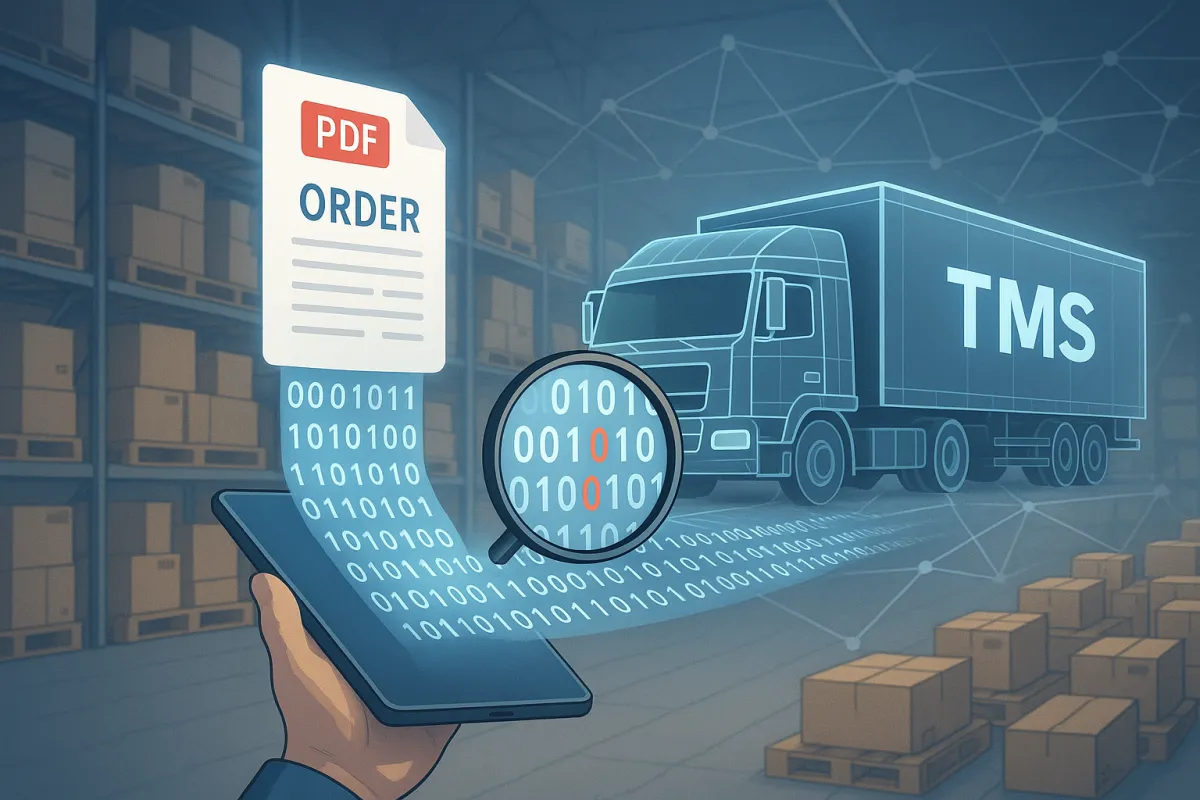
Your PDF-to-EDI gap analysis just revealed why 73% of TMS implementations never deliver their promised ROI. When your team still uses spreadsheets for freight tracking and email chains for communication the TMS was supposed to automate, you're looking at implementation failure in practice, not just technical performance metrics.
Here's the reality most procurement teams miss: basic API integrations cost €5,000-€15,000, while complex ERP connections exceed €50,000, but those numbers don't include the hidden cost of document processing automation failures. The average error rate for manual data entry is approximately 1%, resulting in 10 errors per 1,000 entries, and when your TMS can't reliably convert PDF orders into EDI transactions, those errors compound across your entire trading partner network.
EDI and TMS systems are tightly intertwined. When a TMS system is swapped out or reconfigured without an EDI continuity plan, the result is often delays, chargebacks, or failed deliveries, which can damage partner relationships. The integration crisis hits hardest during the gap between receiving PDF orders from smaller suppliers and meeting EDI requirements from major trading partners. Your team becomes the manual bridge, re-keying data that should flow automatically.
The Complete TMS Vendor PDF-to-EDI Capability Assessment Matrix
Evaluating TMS vendor PDF EDI integration capabilities requires moving beyond surface-level feature lists to assess the underlying document processing architecture. Accounts payable teams reduce data entry work by 80% when implementing EDI OCR integration, but only when the technology can handle your specific document formats without requiring extensive template configuration.
Start with OCR accuracy testing using your actual supplier documents, not vendor demo files. Modern systems should process real invoice PDFs and extract all key fields including vendor name, invoice number, date, line items, and totals in under 60 seconds with no setup required. Template-based OCR systems break down when customers change their order formats, which happens more often than vendors admit.
EDI standards support evaluation goes deeper than checking protocol compatibility. If EDI is bundled inside core ERP, businesses may not be able to seamlessly process EDI for WMS or TMS, such as 940s, 204s, or 214s. Your TMS vendor must demonstrate real-time conversion from extracted PDF data into properly formatted EDI transactions for your specific trading partner requirements.
Document processing workflow assessment should include batch vs. real-time capabilities. On average processing takes 10 seconds per document. With batch processing, hundreds of documents per minute can be processed. Real-time processing is also possible for time-critical applications. Test both scenarios with your typical order volumes to identify bottlenecks before they impact operations.
Integration testing methodology validation requires examining the vendor's API architecture and fallback mechanisms. Legacy protocol issues where older EDI connections often rely on protocols like FTP or AS2 can cause message delivery to fail entirely if the new TMS doesn't support those methods. Document the specific protocols your current trading partners require and verify compatibility before making procurement decisions.
Critical Integration Architecture Questions That Reveal Vendor Readiness
API-first vs. legacy EDI connectivity approaches determine how flexibly your TMS handles document format evolution. EDI is no longer just about exchanging documents. It is about enabling reliable execution across increasingly complex, multi-enterprise supply chains. As businesses scale across more partners, systems, and regions, traditional integration approaches are starting to show their limits.
Hybrid document processing workflow capabilities matter because your supplier base includes both EDI-capable partners and smaller companies that will never invest in structured data exchange. Despite the rise of EDI and e-procurement portals, a large majority of B2B orders still arrive in PDF format. SME customers don't invest in EDI connectors, and the PDF format is there to stay.
Trading partner onboarding automation features should eliminate the traditional 2-4 week setup timeline. Fast partner onboarding connects to new trading partners and makes you submission-ready in days, not weeks or months. API-based infrastructure ensures compatibility as business systems and requirements evolve. Test this with a real supplier onboarding scenario, not a demo environment.
Error handling and validation frameworks prevent downstream issues before they impact customer relationships. Range checks verify numerical values fall within acceptable parameters. Consistency checks cross-reference extracted data with other document fields or external databases, matching invoice totals and verifying vendor names against master lists. The combined system flags anomalies or potential errors for human review while suggesting corrections.
Ask vendors specific questions about their handling of document processing exceptions: What happens when OCR confidence scores drop below acceptable thresholds? How does the system route ambiguous extractions for human review? Can it learn from operator corrections to improve future accuracy? ERP, TMS, and WMS tend to have very lightweight EDI processing and usually require other solutions around the ERP to help complete the EDI processing.
PDF Processing Technology Deep-Dive: OCR vs AI vs Template-Based Systems
Traditional OCR systems extract text but don't understand document structure. OCR extracts text but doesn't understand meaning. It can read "REF: 47821" without knowing it's a product reference. Business logic must be programmed separately. This limitation creates ongoing maintenance overhead when suppliers change their document formats.
AI-powered document processing engines use machine learning to understand document layout and field relationships. Documentary AI adds a machine learning layer on top of OCR. Instead of relying on fixed positions, the model learns to recognize fields semantically. Documentary AI handles format variation much better. These systems adapt to document variations without requiring manual template updates.
Autonomous agent systems represent the next evolution beyond simple extraction. Autonomous agents are AI systems capable of performing multi-step tasks without human intervention. Instead of just extracting data, they act: they open the ERP, create the order, send the confirmation. These platforms can handle complete order processing workflows, not just data extraction.
Technology stack transparency requirements matter for future-proofing your investment. Modern AI-powered OCR software uses machine learning models that can understand document structure regardless of template or format. The best tools for manufacturing go beyond simple text extraction to actually map extracted data into the fields your ERP system needs. Vendors should provide clear documentation of their underlying AI models and training methodologies.
Accuracy benchmarks and testing methodologies should include confidence scoring per field. Self-learning algorithms improve as you process more documents. Confidence scoring per field allows better quality control. Document the vendor's accuracy rates for your specific document types and require proof of concept testing with your actual supplier documents.
Trading Partner Network Compatibility Testing Framework
EDI standard interoperability validation requires testing beyond basic connectivity. The stronger vendors now support a mix of EDI, APIs, partner onboarding, workflow automation, monitoring, ERP/TMS/WMS connectivity, and flexible deployment models. Your testing should include message acknowledgments, error handling, and trading partner-specific variations in standard implementations.
Multi-format document handling verification involves testing the vendor's ability to process different document types within the same workflow. Using a combination of OCR and NLP, modern AI agents extract structured data fields regardless of whether the invoice is a Word doc, PDF, image scan, or HTML email. Unlike earlier RPA-based automation that required a separate template per supplier, AI agents use NLP to extract data from variable formats.
Partner onboarding workflow assessment should evaluate automation capabilities for common scenarios. Adeptia's messaging emphasizes connecting back-office systems such as ERP, CRM, TMS, and WMS while reducing onboarding effort through automation and AI-assisted mapping. Test how quickly the system can configure new trading partners and handle their specific document requirements.
Network effect and connectivity evaluation requires understanding the vendor's existing partner ecosystem. Cleo Integration Cloud combines EDI and API automation on a single platform and is strongly positioned in supply chain orchestration. TrueCommerce spans EDI, API integrations, ERP connectivity, e-commerce, marketplaces, and trading partner integration across a single supply chain platform. Consider how platforms like Cargoson provide European-focused trading partner connectivity alongside broader global networks.
Implementation Risk Prevention and Vendor Selection Methodology
Proof-of-concept testing framework should reproduce your actual operational conditions. The most reliable indicator of TMS failure is shadow systems. When the logistics team maintains a separate spreadsheet to track what the TMS is supposed to track, or uses email chains for communication the TMS was configured to automate, the software has been effectively abandoned. Your POC should include realistic document volumes, typical supplier variations, and integration with your existing systems.
Integration timeline and resource planning requires accounting for hidden complexities. Mid-market implementations typically take 6–12 months for a standard configuration. Implementations exceeding 18 months are almost always signs of scope creep or inadequate internal resources. Rescue projects typically cost 40–60% of the original implementation budget. Document all integration requirements and resource commitments upfront.
Vendor support and documentation evaluation should include specific technical expertise for your use cases. Integrating EDI with TMS can be technically challenging, especially for organizations with outdated systems or limited IT resources. Businesses may need to invest in middleware solutions to bridge the gap between legacy systems. Verify the vendor's track record with similar document processing challenges in your industry.
Cost-benefit analysis including hidden integration costs must account for ongoing operational overhead. The license fee is the visible cost. Full cost of ownership includes implementation, integration, training, and ongoing internal staffing. For companies with $2M–$10M in annual freight spend, TMS operating cost often approaches or exceeds the cost of managed transportation. Factor in the cost of maintaining document processing accuracy over time.
Future-Proofing Your TMS Investment Against Document Format Evolution
Emerging standards and regulatory requirements are reshaping document processing requirements. As of January 2026, eFTI Implementation begins. From July 2027, Member State authorities must accept information shared electronically by operators via certified eFTI platforms, while the EU permanently switched off old ICS2 message formats on February 3, 2026. Your TMS must handle evolving compliance requirements without requiring complete re-implementation.
AI advancement impact on document processing will accelerate through 2026 and beyond. A third option has arrived in 2025 and accelerating through 2026 — AI agents embedded directly in their ERP. An AI agent can perceive inputs, reason about those inputs using a large language model, plan and execute multi-step tasks without human approval, handle exceptions intelligently, and learn from corrections. Evaluate vendors' AI development roadmaps and their ability to incorporate advancing capabilities.
Vendor roadmap evaluation criteria should include specific commitments to document processing innovation. The transport management system landscape stands at a critical inflection point where predictive AI gives way to agentic AI TMS platforms that don't just recommend actions but autonomously execute them. Manhattan launched embedded AI Agents across all solutions in early 2026. Document processing will become more autonomous, requiring vendors with clear AI governance frameworks.
Migration and upgrade pathway assessment becomes critical given ongoing vendor consolidation. WiseTech Global's $2.1 billion acquisition of E2open signals the beginning of an unprecedented consolidation wave. For transport directors managing freight budgets exceeding €10 million annually, this represents the last chance to secure favorable procurement terms before vendor options shrink dramatically. Your TMS vendor choice today determines your flexibility tomorrow.
The TMS vendor landscape will look dramatically different by 2027. Platforms like Cargoson, alongside Alpega and nShift, represent European focus advantage. Leading TMS providers like MercuryGate, Descartes, and Cargoson are already preparing eFTI-compatible solutions. European-focused vendors may provide more responsive document processing development for region-specific requirements than global platforms spreading development resources across multiple markets.
Start your TMS vendor PDF-to-EDI assessment now. Low adoption rates below 70% within 90 days of go-live indicate implementation failure. The three most common root causes are underestimated integration complexity, insufficient internal change management, and inadequate IT resources post-go-live. The procurement window for optimal vendor selection before capacity constraints and consolidation eliminate choices runs through early 2026. Test document processing capabilities with your real data, not vendor demonstrations, and build integration requirements into your contract before signing.