The Critical X12 008060 Migration Planning Framework: How to Navigate Standards Transition, Eliminate Legacy VAN Cost Traps, and Build Future-Proof EDI Architecture Before Industry Adoption Deadlines Create Implementation Chaos

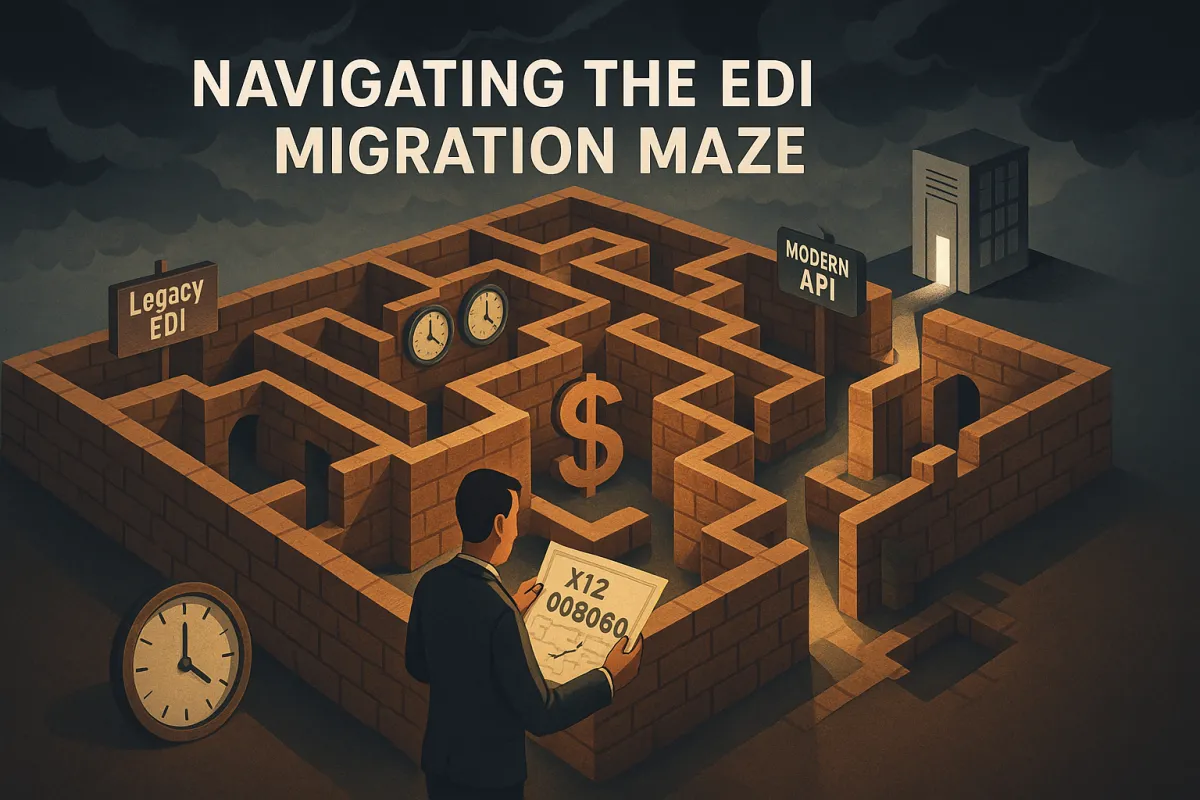
The X12 008060 standards transition window is closing fast, with version 008060 published in February 2025 and implementation guides for all HIPAA-mandated transactions completed by late 2025. Yet CMS still mandates Version 5010 as the adopted standard, creating a gap the industry continues to discuss. While committees debate adoption timelines, legacy VAN processing fees including setup charges ($500-$5,000), per-message fees ($0.05-$0.50), and overage charges are being eliminated by modern providers offering 40-80% cost savings.
This disconnected landscape forces EDI managers into reactive planning when proactive migration strategies could save thousands monthly while building architecture that survives upcoming regulatory changes and vendor consolidation. WiseTech Global's $2.1 billion acquisition of E2open and Descartes Systems Group's $115 million acquisition of 3GTMS signal the most significant vendor consolidation wave in TMS market history.
The X12 008060 Standards Gap Crisis: Why the Industry Transition Window Is Closing Fast
HHS has proposed adopting the X12 275 transaction set for health care attachments and upgrading the X12 278 (prior authorization) from Version 5010 to Version 6020, with a final rule expected in 2026. Additionally, CMS is migrating to a new HIPAA Eligibility Transaction System (HETS) trading partner management system in May 2026, requiring active enrollment per NPI.
The gap creates immediate planning challenges. X12 has indicated that webinars and on-demand training offerings will begin in 2026, providing deeper guidance on assessing and adopting the 008060 implementation instructions. Yet trading partners demand certainty about version support timelines, forcing companies to maintain dual-version capabilities during the transition period.
Notice the pattern across major EDI platforms? IBM Sterling, SPS Commerce, and TrueCommerce are building parallel processing capabilities to handle both legacy 005010 and new 008060 versions simultaneously. Cargoson alongside other modern platforms takes a different approach - building version-agnostic processing that adapts automatically to partner requirements without manual configuration changes.
The Hidden Cost Impact of Delayed Migration Planning
For small businesses and healthcare providers, modern cloud EDI starts at $199–$499/month with no setup fees, while traditional EDI vendors typically charge $500–$3,000/month with additional per-transaction and per-partner fees. The math gets worse when migration delays force emergency implementations.
One healthcare IT director I spoke with calculated their migration delay cost at $47,000 over eight months. They stayed with a legacy provider charging $0.20 per message for processing 10,000 documents monthly, paying $2,000/month just for transmission, while modern providers offered unlimited processing for $800 monthly. The emergency migration timeline added consultant fees and parallel system costs that doubled the transition expense.
Many traditional providers charge $2,000-$5,000 annually per trading partner on top of transaction fees. Add five new retail partners? That could mean $10,000-$25,000 in additional annual costs before you even exchange a single document.
The Complete VAN Cost Assessment Framework for 008060 Migration
Your current VAN invoice likely contains fees that no longer have technical justification. Modern reality: Automation has eliminated the technical justification for setup fees. Nexus VAN charges $0 for setup and onboarding. Yet many companies continue paying legacy fee structures because they haven't audited their true costs.
Most legacy EDI VAN pricing models were built around layered fee structures. Common charges include: Per-document or per-transaction fees, Mailbox or connection fees, Trading partner setup and onboarding charges, Overage penalties tied to arbitrary volume thresholds, Mapping or testing fees for new integrations.
The assessment framework starts with documenting every line item on your last six months of VAN invoices. Look for charges labeled as "connectivity fees," "mailbox rentals," or "data transmission surcharges." VAN Connectivity Fees: $500-$2,000 monthly for VAN mailbox setup, ongoing connectivity, and data transmission infrastructure. Trading Partner Onboarding: $750-$2,500 per partner for setup, mapping, and testing.
Compare these against transparent pricing from Cleo, OpenText, and Orderful, which Cargoson joins in offering flat-rate models. We measure your EDI data exchange by the kilo-character, ensuring you only pay for what you use. Unlike some VANs, we never round up the size of your documents, so you are billed accurately for the exact data you transmit, and nothing more.
The VAN Vendor Lock-In Prevention Strategy
Charges for moving your EDI setup from one VAN to another, plus fees for ensuring documents meet trading partner specifications typically cost $1,000-$10,000+ for migration; $200-$500 per trading partner for compliance mapping. These fees lock customers into expensive contracts because switching becomes prohibitively costly.
Sound familiar? You're not alone. Organizations that transition away from layered billing often discover two things: Their historical invoices included avoidable fees. Their budgeting process becomes significantly simpler. While cost savings vary by organization, the operational benefit is consistent: fewer surprises, cleaner forecasting, and easier expansion planning.
Build migration cost analysis into every vendor evaluation. Request detailed breakdowns of termination fees, data export charges, and partner transition costs before signing contracts. Zero migration fee providers eliminate switching barriers, giving you leverage during renewal negotiations.
Building 008060-Ready Integration Architecture
Your integration architecture must support seamless standards transitions without manual reconfiguration for each trading partner. X12 has issued a formal recommendation to NCVHS outlining how the 008060 EDI standard and its corresponding XML representation should be treated as permitted syntaxes.
This dual-format approach requires platforms that handle version detection automatically. When Partner A sends 005010 transactions while Partner B uses 008060 guides, your system should process both without creating separate integration paths for each version.
TMS integration considerations become critical during this transition. Platforms like Cargoson, alongside MercuryGate and nShift, are building multi-version support that adapts processing rules based on incoming transaction headers. This eliminates the need for parallel systems during transition periods.
The technical implementation focuses on envelope detection and dynamic validation. Your EDI platform should read the ST01 transaction set identifier and GS08 version fields to determine processing rules automatically, routing 005010 transactions through legacy validation while applying 008060 business rules to newer versions.
Testing and Validation Protocols for Dual-Version Support
Parallel testing during transition requires sandbox environments that simulate both legacy and new standard scenarios. Create test scenarios where the same business transaction (like a 837 healthcare claim) processes through both 005010 and 008060 validation simultaneously.
Document validation procedures that verify data integrity across version transitions. When Partner X upgrades from 005010 to 008060, your validation protocols should catch any data elements that changed business rules between versions. This prevents rejected transactions during partner upgrade windows.
Build rollback procedures for failed migrations. If Partner Y's 008060 implementation fails validation, your system should automatically revert to 005010 processing without manual intervention. This safety net prevents transaction processing delays during bumpy migration periods.
Future-Proofing Your EDI Investment Against Vendor Consolidation
The vendor landscape looks dramatically different today than 18 months ago. When companies undergoing integration often experience 12-18 months of reduced innovation while they harmonize platforms and teams, your EDI connections become legacy infrastructure managed by distracted engineering teams.
Vendor consolidation creates specific risks for EDI implementations. Roadmap uncertainty, support resource dilution, and integration complexity increases when vendors merge development teams. Your vendor selection criteria must account for acquisition probability and post-merger integration disruption.
Independent platforms offer consolidation protection advantages. Cargoson represents this category alongside other focused EDI specialists that remain acquisition-resistant due to specialized market positioning. These platforms maintain development focus and customer support levels that mega-vendors often compromise during integration periods.
Evaluate vendor financial stability and ownership structure during selection processes. Private equity ownership often signals eventual sale preparation, while publicly traded companies face quarterly pressure that affects long-term R&D investment. Independent vendors with stable ownership provide more predictable development trajectories.
The Hybrid EDI-API Strategy for Long-Term Flexibility
Hybrid EDI/API has moved from emerging trend to mainstream architecture by 2025–2026. European shippers use 'hybrid EDI' where legacy EDI is maintained for reliability while new API lanes are added for agility.
Your architecture should expose EDI data through REST endpoints while maintaining traditional EDI processing for established partners. This approach lets internal teams build dashboard applications and analytics tools against EDI data without disrupting existing partner connections.
Some add a middleware gateway. This cloud service takes in an API call and quietly converts it to X12 or EDIFACT (and back again) so every partner sees its preferred format. This hybrid approach lets you modernize internally while maintaining compatibility with traditional carrier systems. It's, therefore, unlikely that APIs will fully replace EDI as the standard means for connection in the next several years.
Implementation Timeline and Risk Mitigation Framework
Your migration timeline must align with regulatory milestones, not internal IT schedules. CMS is migrating to a new HIPAA Eligibility Transaction System (HETS) trading partner management system in May 2026, requiring active enrollment per NPI. This creates a fixed deadline for healthcare EDI implementations.
Phase 1 (Immediate): Complete VAN cost assessment and vendor selection by Q1 2026. The procurement window for securing optimal TMS platforms before vendor consolidation eliminates choices runs through Q1 2026, after which your leverage disappears as regulatory pressure forces decisions.
Phase 2 (Q2-Q3 2026): Implement dual-version processing capabilities and begin partner migration testing. Focus on critical trading partners first, building confidence through low-risk implementations before migrating high-volume connections.
Phase 3 (Q4 2026-Q1 2027): Execute full migration for remaining partners while maintaining parallel processing capabilities. Build contingency plans for partners who delay their own 008060 migrations beyond industry timelines.
Risk mitigation requires multiple vendor relationships and escape clause negotiations. Avoid single-vendor dependencies during this transition period. Contract terms should include performance guarantees around version support and migration assistance. Budget 15-20% additional time for unexpected partner migration delays.
The measurement frameworks you build during this transition determine competitive advantage post-2026. Companies that treat EDI migration as pure cost optimization miss the strategic value. Those who build flexible, future-ready architecture position themselves for success when the next standards transition arrives.