The EDI Test Automation Implementation Crisis: How to Overcome 7 Critical Barriers That Block 95% Efficiency Gains in Supply Chain Validation

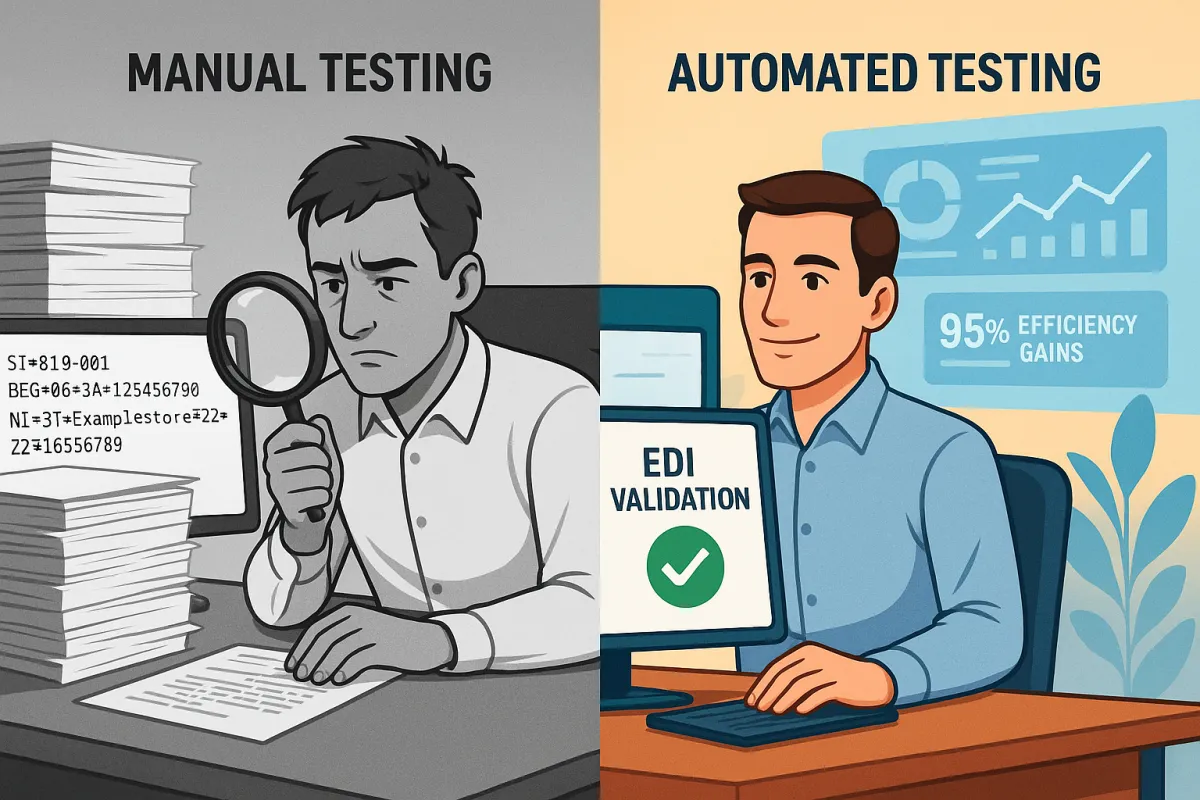
A sobering reality hits every EDI manager when they realize testing a single workflow can take hours or even days if performed manually, while competitors achieve efficiency improvements of up to 95%, where moderately complex EDI tests that would take an hour or more to conduct manually can be executed in 5 or 10 minutes. This stark performance gap isn't just about speed - it's about survival in today's supply chain environment where businesses face the sheer volume of EDI transactions, with testing each one manually being time-consuming and prone to errors.
Yet despite these compelling numbers, only very few companies have full-fledged capability to test EDI-based applications effectively. Seven critical barriers consistently prevent organizations from implementing successful EDI test automation, leaving them trapped in manual validation cycles that drain resources and slow innovation. Here's how to overcome each one and unlock those 95% efficiency gains.
Barrier 1: File Drop Simulation - The Trigger Problem
EDI processes typically kick off when a file lands in a designated folder. Recreating this "file drop" scenario in a testing environment can be tricky. It's not enough to simply have the file present; the testing process needs to mimic the automated trigger that initiates the EDI process. This challenge trips up more automation projects than any other single issue.
The core problem lies in event-driven architecture simulation. Your production system monitors directories using file system watchers, but testing environments often lack this sophisticated triggering mechanism. This often involves working with your automation tools to simulate the file system events that signal a new file arrival.
Three proven approaches solve this barrier:
Event-driven simulation frameworks that recreate file system events rather than simply placing files. Tools like Apache Camel or MuleSoft can generate proper file system notifications that mirror production behavior.
Mock service integration where your testing framework includes lightweight services that can trigger EDI workflows on command. This approach works particularly well when integrating with transportation management systems like Cargoson, FreightPOP, or Manhattan Active, where you need to simulate carrier file drops from multiple sources.
Containerized test environments using Docker or Kubernetes that include full directory monitoring capabilities. This creates the most realistic simulation but requires more infrastructure investment.
Barrier 2: Hierarchical Data Structure Validation - The Complexity Challenge
This often involves managing hierarchical and complex data sets and perform multi-layer testing or validation of each transaction. The nested segments, loops, and conditional fields in EDI standards like X12 and EDIFACT create validation nightmares that defeat traditional testing approaches.
Consider a typical 850 Purchase Order with header segments, line item loops, and conditional shipping instructions. Manual validation requires checking segment positioning, element data types, and cross-segment dependencies - a process that requires a subject-matter expert's (SME) intervention to know the dependencies and compliance guidelines.
The solution involves automated schema validation engines that understand EDI hierarchies. Modern frameworks like IBM Sterling B2B Integrator or SPS Commerce's validation engine can parse complex structures and validate them against configurable rules. For organizations building custom solutions, JSON Schema validation adapted for EDI structures provides a flexible foundation.
Key implementation steps include creating reusable validation templates for common document types, implementing conditional validation rules that activate based on segment content, and building automated reporting that pinpoints exactly where hierarchical validation failures occur.
Barrier 3: Volume and Scale Management - The Performance Wall
The growing volume of EDI slows down the validation process. When you're processing millions of transactions annually, traditional testing approaches break down completely. Healthcare organizations processing over 40 million medical claims per year can't afford the luxury of individual transaction testing.
Volume testing requires fundamentally different approaches than functional testing. You need load generation tools that can create realistic EDI transaction patterns, not just high-volume file creation. The difference matters because real EDI traffic includes timing variations, different document types, and partner-specific formatting quirks.
Successful volume testing strategies include batch processing frameworks that can validate thousands of transactions simultaneously, statistical sampling approaches that validate representative subsets rather than every transaction, and performance baseline establishment that identifies when volume increases start causing degradation.
Organizations using major EDI providers like TrueCommerce, SPS Commerce, or Cleo typically implement hybrid approaches where the provider handles basic volume validation while custom testing focuses on business-specific scenarios.
Barrier 4: Format Translation and Partner Compatibility - The Standards Maze
Translating EDI files from one or multiple trading partner's format to a standard format that is used by the receiver is one of the biggest challenges. Every major trading partner has subtle variations in how they implement standards, creating a spider web of compatibility requirements that manual testing cannot efficiently handle.
The challenge intensifies in transportation and logistics where different carriers like FedEx, UPS, and DHL each have specific EDI requirements, while transportation management platforms like Cargoson, nShift, and ShippyPro each handle these variations differently.
Automated format translation testing requires mapping validation frameworks that can verify transformations between different EDI dialects. This includes verifying that data elements map correctly, conditional logic translates properly, and no information is lost during conversion.
Advanced organizations implement partner-specific test suites that validate not just format compliance but also business rule adherence. For example, some partners require specific segment sequences or have unique validation requirements that aren't captured in standard EDI documentation.
Barrier 5: Error Detection and Exception Handling - The Black Box Problem
When errors occur in EDI transactions, they are often difficult to trace. Error messages can be vague, logs may be incomplete, and some systems offer little feedback for troubleshooting. This opacity makes automated error detection particularly challenging because you can't automate what you can't reliably identify.
Traditional EDI error handling focuses on syntax validation - checking that segments are properly formatted and elements contain valid data types. But real-world errors often involve business logic violations that don't trigger standard EDI error codes.
Comprehensive automated error detection requires multi-layer validation including syntax checking with detailed error location reporting, business rule validation that goes beyond EDI standards, cross-transaction consistency checking that identifies patterns across multiple documents, and real-time monitoring integration that can identify errors as they occur rather than during batch processing.
Modern implementations integrate with monitoring tools like Splunk or DataDog to provide real-time error visibility and automated alert generation.
Barrier 6: Test Environment Setup and Maintenance - The Infrastructure Challenge
Creating test environments that accurately simulate production EDI processing requires significant infrastructure investment and ongoing maintenance. Set up the necessary testing environments that mirror the production environment as closely as possible. This includes EDI, communication protocols, and relevant systems integration.
The challenge extends beyond basic infrastructure to include partner connection simulation, security protocol replication, and integration with internal systems like ERP platforms. When your EDI testing needs to validate connections with dozens of trading partners, maintaining separate test environments becomes exponentially complex.
Cloud-based testing environments offer compelling advantages for EDI testing. Platforms like AWS or Azure can provide on-demand infrastructure that includes EDI-specific services, automated environment provisioning that can recreate production configurations quickly, and cost-effective scaling that accommodates varying testing loads.
Container-based approaches using Kubernetes provide another solution, especially for organizations with complex integration requirements involving multiple transportation management systems or carrier connections.
Barrier 7: Skills Gap and Tool Selection - The Expertise Problem
EDI testing requires knowledge of both healthcare workflows and technical EDI standards. Many in-house teams lack the bandwidth or experience to handle this complexity effectively. This skills gap becomes particularly acute when implementing automation because it requires both EDI expertise and test automation capabilities.
The tool selection landscape compounds this challenge. Options range from enterprise platforms like IBM Sterling B2B Integrator to specialized testing tools like Parasoft SOAtest to custom frameworks built on open-source components. Each approach requires different skills and offers different capabilities.
Successful organizations typically adopt a hybrid approach combining commercial tools for standard EDI testing with custom automation for business-specific scenarios. This strategy reduces the skills gap while maintaining flexibility for unique requirements.
Training investments should focus on cross-functional skills that combine EDI knowledge with automation capabilities rather than trying to make EDI specialists into automation experts or vice versa.
Implementation Roadmap: From Manual Testing to 95% Efficiency
Converting these solutions into practical implementation requires a phased approach that builds capability incrementally while delivering quick wins.
Phase 1: Foundation Building (Months 1-2) focuses on establishing automated file drop simulation and basic hierarchical validation. Start with your highest-volume, most standardized transactions to demonstrate quick value.
Phase 2: Scale and Integration (Months 3-4) expands to volume testing and format translation automation. This phase typically delivers the most dramatic efficiency gains as you eliminate manual bulk testing procedures.
Phase 3: Advanced Capabilities (Months 5-6) implements sophisticated error detection and maintains comprehensive test environments. Organizations often achieve the full 95% efficiency improvement during this phase.
Success metrics should include processing time reduction (targeting the 5-10 minute automation versus hour-plus manual testing standard), error detection accuracy measured by production issues caught during testing, and partner onboarding speed measured by certification completion time.
The ROI calculation becomes compelling when you consider that 45% of integration experts say partner onboarding takes between one week and one month, with 42% reporting over a month. Automated EDI testing can reduce these timeframes by 70-80% while improving accuracy and compliance.
Organizations that successfully overcome these seven barriers consistently report not just efficiency gains but improved partner relationships, faster go-to-market timing for new integrations, and significantly reduced support overhead. The 95% efficiency improvement isn't just a performance metric - it's a competitive advantage that transforms EDI from a compliance burden into a business enabler.