The Global EDI Message Standardization Roadmap: How to Prepare for EDIFACT-X12-PEPPOL Convergence and Ensure Cross-Border Compliance by 2026

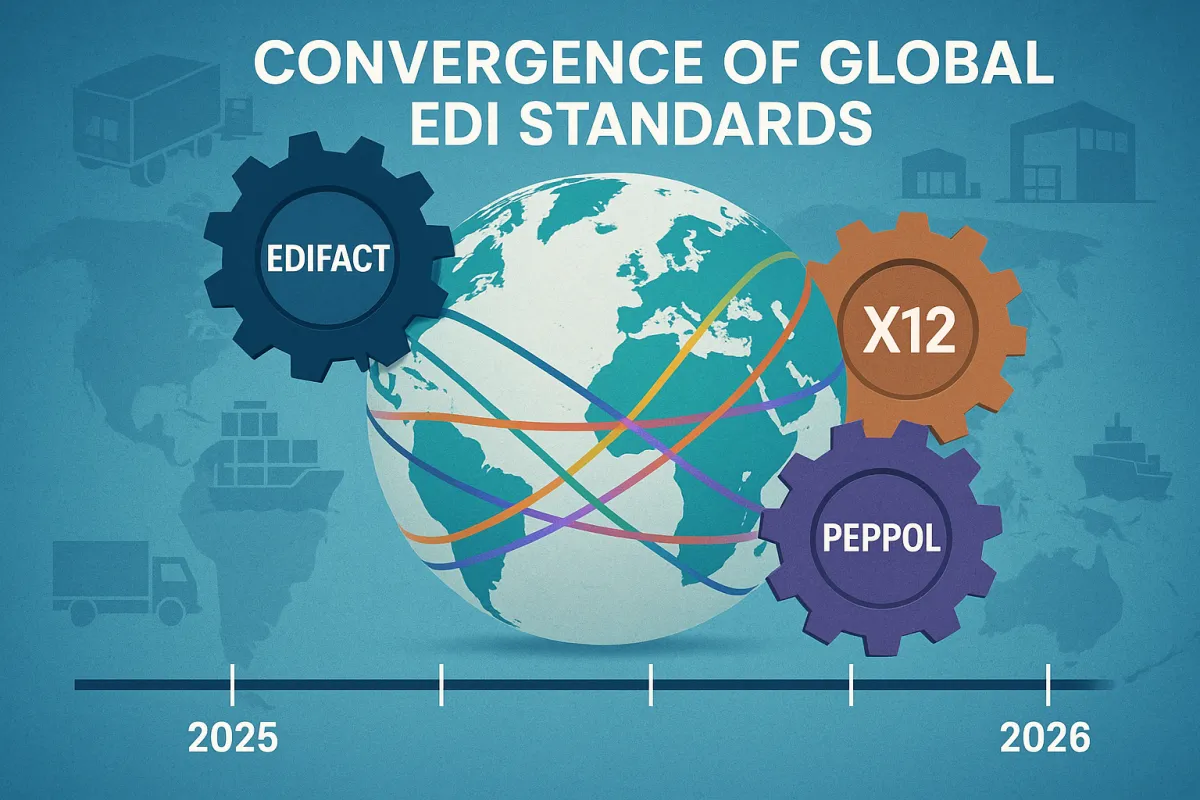
Supply chain professionals managing cross-border operations are facing mounting pressure from regulatory changes that will reshape EDI requirements by 2026. There is an industry trend towards interoperability, with X12 committees collaborating with other standards bodies (such as GS1, HL7, OASIS) on crosswalks and mapping guides. While this isn't creating a single unified standard, the convergence of regulatory requirements across EDIFACT, X12, and PEPPOL networks is forcing companies to rethink their EDI architecture.
The reality: No one attempt to unify standards has ever been completely successful. But that doesn't mean you can ignore what's happening. Three major forces are creating a de facto standardization push that will impact every multi-regional supply chain operation by 2026.
The Critical EDI Standardization Convergence Happening Now
Adopted in March 2025, ViDA aims to simplify cross-border trade, reduce fraud, and harmonize e-invoicing and digital reporting across all EU member states. This isn't just another regulatory change. The VAT in the Digital Age (ViDA) Directive, officially adopted on March 11 2025 by the Council of the EU, is the biggest VAT reform since the EU single market.
The PEPPOL network is expanding rapidly beyond its original invoicing mandate. The primary implementation of Peppol as at 16 March 2025 had 1,426,623 participant organisations from 98 countries registered to receive procurement documents. This isn't just European anymore - Outside Europe, Peppol can be used in Canada, Japan, Australia, Mexico or Singapore.
Companies using traditional EDI setups are hitting a wall. Global companies sometimes juggle multiple standards, complicating training and software needs. The cost of maintaining separate X12 connections for North American partners, EDIFACT for European suppliers, and now PEPPOL for government compliance is becoming unsustainable.
Why Legacy Single-Standard Approaches Are Failing
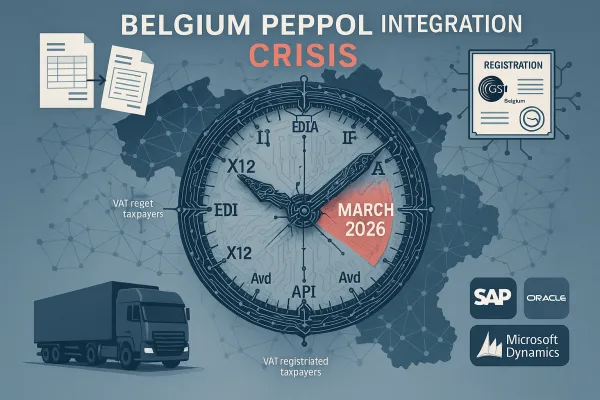
Here's a scenario most supply chain teams recognize: Your US-based company operates with X12 standards for domestic suppliers. You expand into European markets and need EDIFACT support for local partners. Now Belgium mandates PEPPOL for B2B transactions starting January 1, 2026, implementing a mandatory Electronic Invoice model for all B2B transactions based on the Peppol BIS 3.0 standard.
The integration complexity multiplies fast. Each standard requires different message structures, validation rules, and transmission protocols. North American based brands that develop relationships with European trading partners will likely find themselves having to use both X12 for the domestic market and EDIFACT for the international efforts. The same works in reverse: European brands expanding into North America will likely have to use X12 for those relationships.
Leading EDI providers like Cleo, OpenText, and Cargoson are addressing this by building multi-standard support into their platforms, but many companies are still operating with point solutions that can't scale across regions.
The Three-Pillar Framework: EDIFACT, X12, and PEPPOL Integration Strategy
The strategic approach isn't to pick one standard and hope for the best. It's to build an architecture that can handle all three simultaneously while preparing for the regulatory deadlines ahead.
U.S. companies that need to trade internationally may need bidirectional translators between X12 invoices (810) and peppol UBL invoices. The solution lies in message mapping strategies that can transform data between formats without losing semantic meaning.
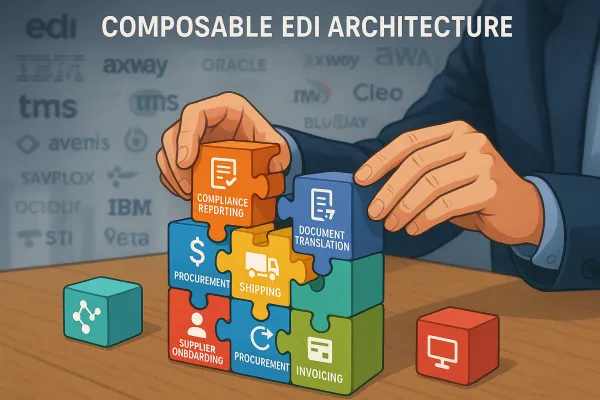
Your technical architecture needs three core components: a central message hub that can receive data in any format, transformation engines that can convert between standards, and routing logic that sends messages via the appropriate protocol. Think of it as building a universal translator for business documents.
PEPPOL Network Expansion Beyond Invoicing - What Supply Chain Teams Need to Know
Peppol offers a wide range of supported document types, going far beyond e-invoices. Purchase orders, shipping notices, and logistics documents are joining the network. This expansion matters because it's creating a parallel infrastructure to traditional EDI networks.
More countries, such as France and Spain, are finalizing plans to enforce Peppol-based or Peppol-compatible systems between 2025 and 2026. The timeline is accelerating. The decree highlights Peppol as a critical component of Belgium's future near real-time e-Reporting system, planned for implementation in 2028, aligned with the ViDA initiative.
Supply chain teams need to understand that PEPPOL isn't just another messaging standard. It's becoming the government-mandated infrastructure for business document exchange across multiple countries. Your existing EDI partnerships will need to accommodate this reality.
The 2025-2026 Compliance Timeline: Critical Milestones and Deadlines
The regulatory timeline is compressed and unforgiving. Starting January 1, 2026, B2B e-invoicing will become mandatory for all taxpayers established in Belgium. Large and mid-sized companies must comply with the e-invoicing and e-reporting requirements from September 1, 2026. Small companies and micro-enterprises must comply from September 1, 2027 in France.
Germany has its own timeline: January 2025 (Mandatory receiving for all businesses) January 2027 (Mandatory sending for >€800k turnover) January 2028 (Mandatory sending for all businesses). Notice the pattern: receiving capabilities come first, then sending obligations roll out by company size.
Poland is moving faster than expected. February 1, 2026: Obligation for companies with revenue exceeding 200 million PLN. April 1, 2026: Obligation for all other companies.
Cost-Benefit Analysis: Single vs Multi-Standard Implementation
The ROI calculation isn't straightforward because the costs of non-compliance can be severe. Companies maintaining separate EDI systems for different standards face higher operational overhead, more complex testing requirements, and increased risk of integration failures.
A unified approach requires higher upfront investment but delivers operational savings through consolidated infrastructure, standardized processes, and reduced technical debt. The hidden cost most companies miss: staff training and retention becomes much easier when your team works with one system instead of three.
Technical Implementation Roadmap for Multi-Standard EDI Architecture
Your technical roadmap needs to account for both current requirements and future regulatory changes. Start with a message hub architecture that can ingest documents in any format. There's even discussion of adopting JSON-based payloads that transport X12 data elements, which means your architecture needs to be format-agnostic.
The core components include: API endpoints that can receive data from your ERP systems, transformation services that can convert between X12, EDIFACT, and UBL formats, and routing engines that can deliver messages via AS2, SFTP, or PEPPOL access points depending on recipient requirements.
Integration with modern transport management systems requires careful consideration. Major TMS vendors like MercuryGate, Descartes, and nShift have different levels of multi-standard support. Cargoson's platform provides native support for all three standards, which simplifies implementation for companies managing complex shipping operations across regions.
Integration with Modern Transport Management Systems
Transport management software needs to accommodate the reality that your US carriers use X12 856 advance shipping notices while your European logistics partners expect EDIFACT DESADV messages for the same information. The unified approach means your TMS can generate one internal message that gets transformed and routed appropriately.
Future-proofing your transportation spend management systems means choosing solutions that can adapt to regulatory changes without requiring complete system overhauls. Look for TMS platforms that support configurable message transformations rather than hard-coded integrations.
Risk Mitigation Strategies for the Transition Period
The biggest risk during the transition isn't technical failure - it's operational disruption. Your fallback procedures need to account for the fact that different standards have different error handling mechanisms. X12 functional acknowledgments work differently from EDIFACT CONTRL messages, which work differently from PEPPOL delivery receipts.
Build contingency plans that assume regulatory timelines will change. The enforcement dates may be adjusted by one quarter if necessary, considering the significance of these changes for businesses. But don't count on delays - prepare as if the original deadlines will hold.
Testing frameworks need to validate not just message accuracy but also performance under load. When Belgium's 1.4 million businesses start sending PEPPOL messages on January 1, 2026, network congestion could cause delivery delays that impact your supply chain operations.
Trading Partner Onboarding in a Multi-Standard Environment
Your partner onboarding process needs automated standard detection. When a new supplier provides their EDI details, your system should automatically identify whether they're using X12, EDIFACT, or PEPPOL and configure the appropriate message transformations.
Streamlined onboarding means providing partners with a single integration point regardless of their preferred standard. They send you an order in their native format, and your system handles the translation to whatever your internal systems expect.
Building Your 2025 Action Plan: Immediate Next Steps
Start with an audit of your current EDI relationships. Map out which partners use which standards, identify gaps where you'll need new capabilities, and prioritize based on regulatory deadlines in your key markets.
Q1 2025: Complete your multi-standard architecture design and begin vendor selection. Focus on solutions that can grow with changing requirements rather than just meeting today's needs.
Q2 2025: Begin pilot implementations with key partners in each standard. Test not just happy path scenarios but also error conditions and high-volume periods.
Q3 2025: Scale your implementation across your partner network, starting with partners in countries with early mandatory deadlines.
Q4 2025: Complete testing and staff training. Belgium's mandatory B2B e-invoicing regulation takes effect on January 1, 2026, which means your systems need to be live and stable before year-end.
The companies that will thrive through this transition are those that view EDI standardization convergence as an opportunity to modernize their operations rather than just another compliance burden. The investment you make now in flexible, future-ready EDI infrastructure will pay dividends as global trade continues to digitize.