The Hidden Cost Crisis in Legacy EDI Migration: Complete Cloud vs On-Premise ROI Analysis Framework for 2025 Supply Chain Decisions

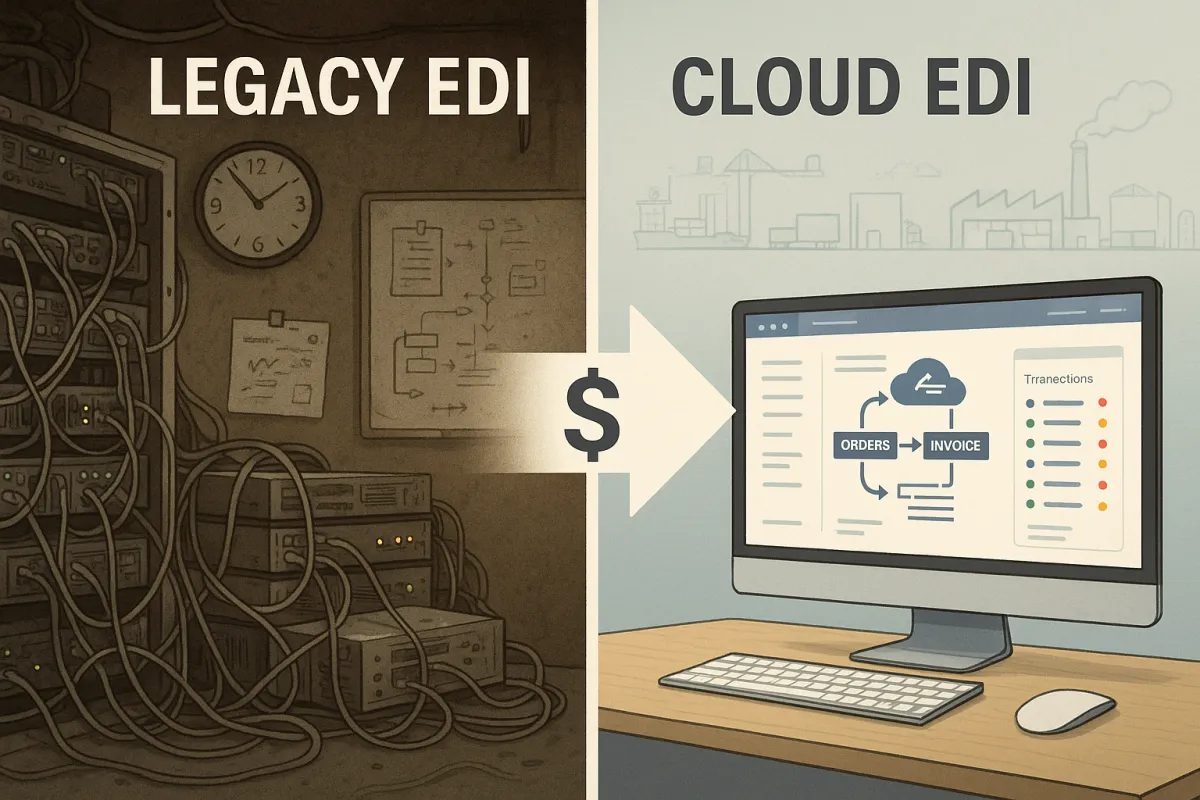
Your on-premise EDI system that runs on Windows Server 2012 keeps throwing errors at 2 AM. The legacy developer who built it retired last year, and your IT team avoids touching it unless absolutely necessary. Sound familiar? According to a recent survey by Gartner, 85% of businesses are expected to fully embrace cloud software solutions by the end of 2024, and large enterprises in highly regulated industries with global operations and legacy systems will need careful planning and support from an experienced EDI provider.
Here's what most people miss when they calculate cloud EDI migration costs: they focus on subscription fees but ignore the escalating maintenance nightmare of legacy systems. A manufacturing client I spoke with last month was spending $180,000 annually just keeping their 15-year-old EDI infrastructure running. That's before counting the sleepless nights when trading partner connections failed.
The Legacy EDI Cost Crisis Exposed
Legacy EDI systems are bleeding money in ways you might not realize. As many organisations discover when attempting to build in-house teams, EDI management requires increasingly rare and in-demand skill sets. It's also important to keep in mind not only your internal EDI skills, but those of your suppliers and customers.
The real costs hit you in three ways. First, hardware replacement cycles that keep getting more expensive as vendor support disappears. Second, the growing skills gap. EDI management requires increasingly rare and in-demand skill sets, and finding someone who understands both EDIFACT message structures and your custom mapping logic gets harder each year. Third, the security updates that never seem to end, each requiring hours of testing to ensure they don't break your carefully tuned integrations.
A logistics company running legacy transport management software alongside their EDI system discovered this the hard way. Their on-premise setup required constant manual intervention for partner onboarding, taking weeks to establish new connections. Companies like Cargoson, MercuryGate, and Transporeon address these challenges with modern cloud-native platforms that reduce setup time to days instead of weeks.
On-prem EDI also lacks automation, requiring manual data entry that can introduce human error into critical business transactions. That's why on-prem EDI is really most viable for small organizations with few orders and trading partners. As soon as your organization starts to grow and become more complex, your in-house software may turn into a major growing pain.
The Complete Cost Breakdown: On-Premise vs Cloud EDI
The hidden on-premise costs add up faster than you think. Migrating to cloud EDI offers significant cost savings compared to traditional on-premises systems. With no upfront hardware or software expenses (subscription model) and the vendor handling maintenance and upgrades, you eliminate several major expense categories.
On-premise EDI systems require dedicated server hardware, backup systems, and network infrastructure. This setup requires internal resources including a server, a network, an EDI software package license and in-house support staff including EDI-knowledgeable IT personnel. Add in energy costs for cooling and power, and you're looking at $50,000-$100,000 annually for mid-sized operations.
Cloud EDI flips this model. With no upfront hardware or software expenses (subscription model) and the vendor handling maintenance and upgrades, cloud EDI allows for predictable budgeting and lower total cost of ownership. Your monthly costs become predictable, typically ranging from $500-$5,000 per month depending on transaction volume and complexity.
Here's where freight management software costs become relevant. When you're migrating transport management systems, the integration costs multiply. Legacy TMS platforms often require custom API development to connect with cloud EDI systems, while modern platforms like Cargoson offer built-in EDI connectivity that reduces integration complexity.
Yes, you'll have ongoing monthly fees when you go with a SaaS EDI. But when compared to the expense of maintaining your own servers, keeping an experienced IT team on staff, and dealing with inefficient partner onboarding and data sharing, the math typically favors cloud deployment.
The Migration Cost Analysis Framework
Migration timelines vary dramatically based on system complexity. Migration of a company's first workload takes from 1-2 months (for small workloads) to 6+ months (for medium and large workloads). Subsequent workloads require less time to migrate due to the gained experience.
Simple lift-and-shift migrations start at $5,000 per application, but most EDI systems require some level of refactoring. The cost of lift-and-shift migration of one application will start at $5,000. The migrating to cloud that requires application re-architecting will typically fall in the range of $20,000 and $100,000.
The decision criteria for your migration approach depends on your current system state. Rehosting works if your EDI software can run unchanged in cloud infrastructure. Replatforming makes sense when you need cloud-native features but want to minimize code changes. Refactoring becomes necessary when you need full scalability and modern API capabilities.
Budget overrun prevention starts with accurate discovery. Document every trading partner connection, custom mapping, and integration point before planning migration costs. Application refactoring often proves more complex and expensive than initially anticipated, significantly impacting your cloud migration cost. Legacy applications frequently have undocumented dependencies and custom configurations that require extensive analysis and modification for cloud compatibility. The complexity of refactoring increases exponentially with application age and customization levels.
Multi-carrier shipping software migrations follow similar patterns. Platforms like Cargoson integrate directly with cloud EDI systems, reducing the custom development needed compared to legacy freight management systems that require extensive API work.
Real ROI Calculations and Business Cases
The scalability benefits translate to measurable cost savings. Cloud EDI provides a flexible and agile solution, enabling businesses to scale up or down effortlessly based on demand. It adapts to evolving business needs, making it ideal for the majority of growing companies.
A French logistics company with operations across multiple time zones provides a perfect case study. Their legacy EDI system required 24/7 staffing to handle different regional requirements and system maintenance windows. After migrating to cloud EDI, they eliminated night shift EDI support, saving $120,000 annually in staffing costs alone.
Quantifiable metrics show the difference. Transaction processing costs dropped from $2.50 per thousand transactions to $0.75. Partner onboarding time reduced from 3-4 weeks to 5-7 days. Error rates decreased by 60% due to automated validation and modern data transformation capabilities.
The ROI calculation becomes clearer when you include transport execution software benefits. Companies using cloud-native TMS platforms like Cargoson alongside cloud EDI report 30-40% faster implementation times compared to traditional on-premise integrations. This translates to revenue recognition weeks or months earlier.
Teams across different locations and time zones can easily access and work with the same data, promoting seamless collaboration and real-time decision-making. This accessibility premium becomes valuable when you're managing global supply chains with partners in Asia, Europe, and the Americas.
Risk Assessment: Cloud vs On-Premise Security and Compliance
Cloud security advantages often surprise traditional IT teams. Research suggests that the cloud is generally safer than on-premises solutions. It's not surprising, as cloud vendors have a huge vested interest. As a rule of thumb, if your cloud EDI software vendor spends more on security each year than your business, your data is likely to be safer in their hands!
According to Gartner, by 2025, 99% of the infrequent cloud security breaches will be due to customer error, not the system itself. This shifts the security focus from infrastructure protection to proper configuration and access management.
Common cloud adoption concerns center around costs, security, and business continuity. The cost predictability actually reduces financial risk compared to surprise hardware failures or emergency support calls that plague on-premise systems. On the whole, on-premises workloads tend to be less reliable than workloads in the cloud. If you experience frequent downtime from on-premises infrastructure or application failures, you're incurring indirect costs stemming from your on-premises environment.
Compliance considerations vary by industry, but cloud providers typically offer more robust compliance frameworks than most companies can implement internally. Carrier connectivity platforms ensure security across transport networks through encrypted connections, automated certificate management, and centralized access controls that would be prohibitively expensive to implement on-premise.
The data sovereignty question matters for international operations. Cloud providers offer regional data centers that can meet local requirements while providing global accessibility. This becomes particularly relevant when managing EDI connections across different regulatory zones.
The Strategic Implementation Roadmap
Hybrid cloud approaches offer the most practical migration path for complex EDI environments. For many organizations, a hybrid cloud approach—combining on-premise infrastructure with cloud services—can be the most economical option. A hybrid model provides a tailored solution that balances performance, scalability, and cost-effectiveness. Benefits of a hybrid model include: Cost Savings: Retain non-critical workloads on-premises while migrating critical operations to the cloud.
Stakeholder communication becomes crucial during migration planning. Finance teams want predictable costs. Operations teams need guaranteed uptime. Trading partners require advance notice of any connection changes. Address IP and Network Changes with Trading Partners: With AS2 communications, migrating to the cloud involves IP address changes that can affect trading partner connectivity. Prepare partners for these changes with early communication and thorough testing.
Vendor selection criteria should include EDI-specific capabilities, not just general cloud features. Look for providers who understand EDIFACT, X12, and industry-specific message formats. Consider how well they integrate with your existing ERP system and any transport execution software you're using.
The phased approach reduces risk and allows learning between migrations. Break the migration into smaller, manageable phases to reduce risk and complexity. For those not already there, migrate your ERP or other critical systems to the cloud first (if this fits your strategy), ensuring stability and integration with on-premises EDI. Transition the EDI system next, using a dual-connection model to ensure continuity.
When planning transport management software migrations alongside EDI, consider platforms that offer integrated connectivity. Cargoson and similar modern TMS providers simplify the overall architecture compared to managing separate legacy systems.
2025 Decision Framework and Action Items
The cost-benefit decision matrix depends on your transaction volume, partner count, and internal IT capabilities. Companies processing fewer than 10,000 EDI transactions monthly might find on-premise solutions manageable. Above that threshold, cloud benefits typically outweigh the subscription costs.
Timeline planning requires honest assessment of internal resources. If you don't have dedicated EDI expertise on staff, budget additional time for learning curves or consider managed services to offset implementation risks. The migration process can be complex and time-consuming. Large enterprises in highly regulated industries with global operations and legacy systems will need careful planning and support from an experienced EDI provider.
Managed services options can bridge the gap during transition periods. Some providers offer hybrid management where they handle cloud infrastructure while you maintain application control. Others provide full managed services including trading partner relationships and message transformation.
Key questions for evaluating your current vs future-state EDI infrastructure: Can you easily onboard new trading partners? How long does system recovery take after hardware failures? What's your actual annual cost including staff time and emergency support? Are you able to scale transaction volume without hardware investment?
The deadline pressure is real. Legacy system end-of-life dates are approaching, and vendor support for older EDI software becomes more expensive each year. Start your evaluation now, even if migration won't happen until 2025. The planning phase takes longer than you think, and getting stakeholder buy-in requires solid ROI data that takes time to develop.
Your action items: Document current EDI costs including hidden maintenance expenses. Request quotes from cloud EDI providers for comparison. Assess your internal EDI expertise and identify knowledge gaps. Evaluate how EDI migration fits with any transport management software upgrades you're planning. Start conversations with key trading partners about potential connection changes.