The Hidden EDI Performance-Reality Gap Crisis: How to Build Measurement Frameworks That Transform Connected Status Into Reliable Supply Chain Outcomes and Prevent the $4M Chargeback Disasters Hitting 66% of Organizations in 2026

Your EDI connection is green. Order processing works. Someone declared victory.
But chargebacks keep arriving. Shipments land late. Invoices bounce back. Operations teams are manually fixing transactions that were supposed to be automated. Sound familiar?
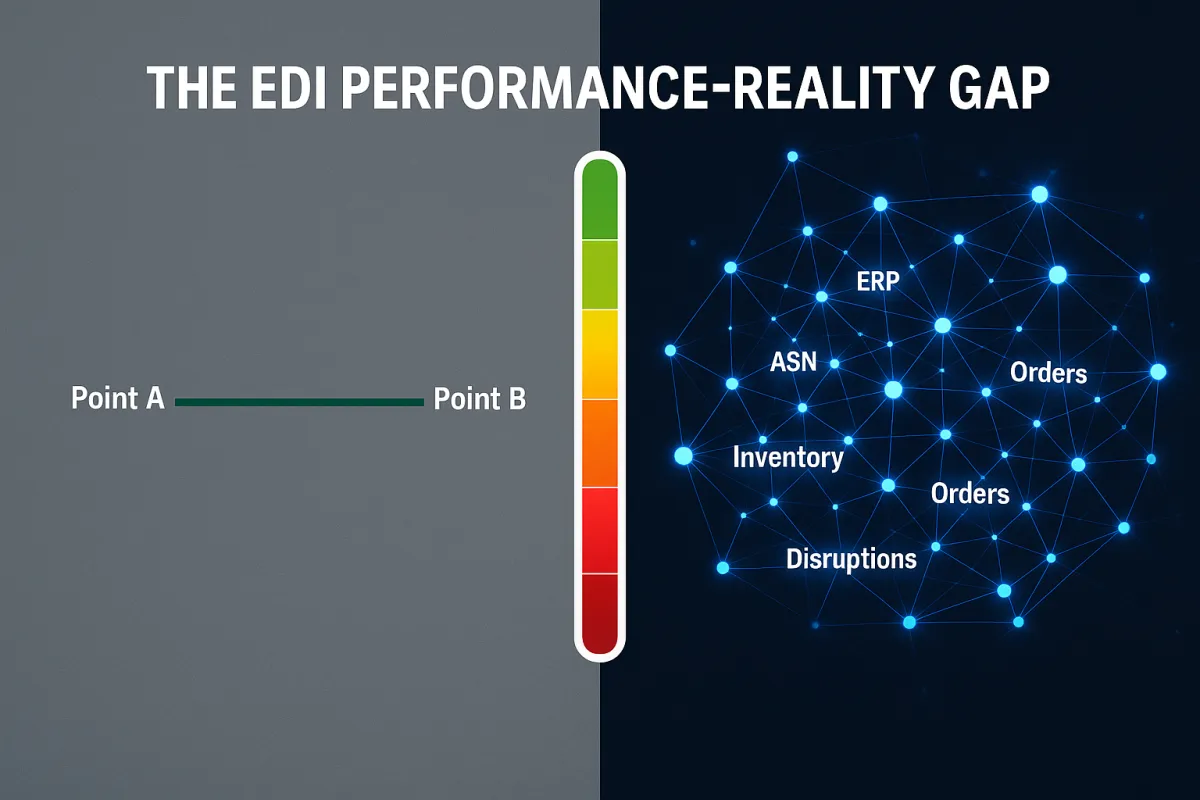
This is the EDI Performance-Reality Gap: the difference between being technically connected and actually delivering reliable supply chain outcomes. You have credentials, a portal was provisioned, and orders can theoretically flow. Yet 66% of organizations report losing up to $500,000 annually due to non-compliance issues, with companies shipping $80 million annually facing up to $4 million in chargeback deductions.
The connection speed became the only scoreboard, but supply chain delays are often attributable to data gaps rather than physical logistics failures. Performance measurement requires a different approach.
The True Cost of the Performance Gap
Each EDI dispute takes roughly 2 hours to resolve. Many businesses find that for every $1 in chargebacks, their true cost balloons to over four times that amount after accounting for investigation time, administrative overhead, and operational rework.
When accounting for investigation time, administrative overhead, and lost inventory, each $1 in direct chargebacks costs approximately $4.41 total. For a mid-sized company facing monthly costs of $10,000-$50,000 for mid-sized suppliers, that multiplier effect becomes severe.
The hidden costs accumulate across platforms. Issues affect users of SPS Commerce, TrueCommerce, IBM Sterling, and other major providers. Over 75% of manufacturing firms process their procurement and shipping data through EDI platforms, with logistics companies reporting an average 33% reduction in document turnaround time through digitization. Yet when companies fall out of compliance, the financial consequences add up quickly.
Integration challenges extend to transportation management systems like Cargoson, MercuryGate, Descartes, and Transporeon, where compliance failures create downstream disruptions in logistics coordination.
Beyond Connection: What Performance Really Means
Real EDI performance means your ERP is fully integrated and operational, the complete order cycle is validated in production, compliance is verified, and you're delivering as expected. It is no longer enough to simply move data from point A to point B. Modern organizations require systems that can coordinate across partners, trigger actions in real time, and provide visibility into both transactions and the processes behind them.
The retailer's supply chain or operations leader tracks something simpler: are their suppliers shipping correctly, on time, with complete ASNs, at the volumes they need?
Supply chain visibility is no longer about looking at a dashboard or running reports for future analysis. It's making use of data as part of a real-time ecosystem. Digital twins and AI-powered analytics are giving organizations synchronized views of inventory, orders, and disruptions across their supply networks.
Modern platforms that provide real-time transaction monitoring allow teams to intervene earlier and reduce the operational cost of exceptions. This capability becomes essential when managing complex trading partner networks that include solutions from Cleo, OpenText, and specialized TMS providers like Cargoson.
The EDI Performance Measurement Framework
EDI helps businesses communicate better, faster and with fewer errors, making it an essential tool for modern supply chain operations. But measurement requires structured metrics.
Key performance indicators include OTIF rates, ASN accuracy, invoice acceptance rates, and dispute resolution time. Penalties typically range from 1% to 5% of the gross invoice amount, depending on the retailer and violation type. For a brand shipping $10 million annually into retail, even a 2% chargeback rate represents $200,000 in avoidable costs.
ASN accuracy is one of the most frequent sources of retail penalties. Retailers rely on ASN data for warehouse automation. Any mismatch disrupts receiving operations. Transportation management platforms like Cargoson require comprehensive visibility to prevent these disruptions from cascading through logistics networks.
The primary driver of low compliance is engagement infrastructure: suppliers don't have clear expectations, accessible tools, or real-time accountability into their own performance. The retail sector reports a 21% decline in out-of-stock events as a direct result of improved forecasting driven by timely EDI updates.
Implementing Real-Time Performance Monitoring
Real-time visibility means understanding what is at risk and what to do next. Visibility is not just a dashboard. It is the ability to spot gaps between planned and actual execution, then close them before they become disruptions.
In 2026, that approach is no longer enough. Modern businesses operate across a network of suppliers, logistics providers, retailers, and internal systems. It needs to trigger actions, update systems in real time, and keep processes aligned across multiple stakeholders.
Technology stack considerations include platforms like Cleo, OpenText, and transportation solutions from providers like Cargoson. The shift toward cloud-native, API-first EDI is accelerating. Enterprises that are rationalising their integration stacks in 2026 are evaluating a new generation of platforms built for speed, automation and real-time data visibility across global trading networks.
Key capabilities include anomaly detection in transaction patterns, demand forecasting that synthesizes order history with market signals, and risk scoring that quantifies supplier reliability based on performance metrics. These tools transform EDI from a passive exchange to a strategic forecasting engine.
Building Trading Partner Scorecards That Drive Results
Industry-wide compliance sits at 43%, meaning most suppliers are regularly losing points without knowing exactly where or why. SPS Commerce's MAX agentic AI capability draws on 300,000 trading connections, 750M+ annual transactions, and decades of real supply chain outcomes to address this gap.
EDI compliance directly impacts how and when suppliers get paid and whether they remain in good standing with major retailers. Frequent violations can lead to ongoing financial penalties, strained relationships with trading partners, and lower supplier performance scores.
Practical scorecard implementation requires tracking metrics across multiple dimensions. OTIF failures trigger chargebacks - typically 3% of the affected order value. Multi-carrier shipping software vendors like ShippyPro, nShift, and Cargoson in the TMS category provide essential data feeds for comprehensive performance measurement.
Retailers track performance through scorecards and OTIF/fulfillment metrics. Reducing chargebacks isn't just about saving money; it's about protecting strategic accounts and keeping doors open for growth.
Prevention and Continuous Improvement
Organizations that treat failures as learning moments build more resilient operations. Regularly assess EDI performance to identify improvement areas, check goal alignment, and adapt quickly to market changes.
To prevent chargebacks, companies need better visibility into their EDI transactions and stronger control over how documents are created, validated, and transmitted. Modern EDI systems make it easier to achieve compliance by reducing manual intervention and automatically enforcing retailer-specific requirements. Instead of reacting to errors after they happen, teams can identify issues earlier in the process and resolve them before they impact shipments or payments.
Integration with modern platforms including Cargoson for transportation orchestration becomes part of a comprehensive prevention strategy. Organizations that modernize their integration layer, eliminate batch windows, and enforce upstream data accuracy reduce penalties, improve retailer scorecards, and protect margins.
By aligning EDI solutions with evolving business requirements, investing in robust ERP integration, and choosing the right technology partners, businesses can reduce errors and scale confidently. EDI chargebacks represent a significant financial threat that businesses must address proactively. Throughout this guide, we've seen how these penalties quickly add up, with 66% of businesses losing up to $500,000 annually due to poor EDI integration. Undoubtedly, the cost extends beyond direct penalties—damaging partner relationships, diverting resources, and ultimately harming your brand reputation.
The gap between connection and performance isn't just technical—it's strategic. Organizations that measure and close this gap transform their supply chain from a cost center into a competitive advantage.