The Hidden Integration Complexity Crisis: Your Complete Framework to Evaluate Hybrid EDI-API Solutions and Prevent the 78% Implementation Failure Rate in 2026


Early-stage companies face a harsh reality: 70-95% of B2B projects fail to meet their objectives, and integration failures often stall enterprise deals before they start. When you can't promise a realistic EDI timeline, you lose momentum exactly when it matters most.
Your challenge isn't just technical. As tech infrastructure expands, integration complexity grows with it. Hybrid environments, cloud applications, and connected devices generate enormous amounts of data across departments. Each system needs to communicate in real time to operate efficiently, but traditional integrations weren't built for that kind of scale.
The data tells the complete story. Only 2% of organizations have integrated more than half their applications. MuleSoft's 2025 findings show that 98% of enterprises struggle with widespread application connectivity, creating massive inefficiencies. This statistic reflects the percentage of organizations achieving broad integration, while the average organization has only 29% of its applications connected. Meanwhile, 84% of all system integration projects fail or partially fail.
When your integration approach forces you to manage both EDI's scheduled batch transmissions and modern APIs that can push the same information in real time, operational overhead compounds fast. Each new trading partner requires custom mapping, testing, and coordination. As your partner count grows, so does complexity.
Why Traditional "EDI vs API" Thinking Creates Operational Nightmares
The choice between EDI and API often isn't binary. The future lies in hybrid connectivity where EDI and APIs coexist to support diverse IT ecosystems. A hybrid approach offers flexibility, which helps organizations modernize without disrupting existing workflows or supply chain operations. APIs that work with EDI and can connect to common ERPs like SAP S/4HANA, Oracle Fusion, NetSuite, and MS Dynamics 365, are essential for businesses seeking agile, efficient, and future-ready supply chain integration.
But this pragmatic approach comes with a hidden cost. Steering through the complexities of integration can be daunting. Transactional APIs enable legacy EDI systems to link with modern REST APIs, safeguarding investments while updating business operations. Cross-training staff on legacy EDI and modern APIs leads to a smoother transition and implementation of hybrid EDI and API integration solutions.
Suppliers may use different API technologies (REST, SOAP, GraphQL), authentication methods (OAuth, API keys, custom tokens), and data formats (JSON, XML, CSV). This diversity requires custom connectors and middleware for each integration. Many EDI platforms require highly specific, hard-coded workflows for each system. If your process changes, say your ERP is updated, or a trading partner modifies their document structure, the entire flow can break. This rigidity forces businesses into endless cycles of development and testing, just to make small adjustments. The lack of dynamic routing, reusable logic, or modular connectors keeps teams dependent on developers and slows down agility.
The Multi-Vendor Management Tax
Legacy integrators often focused on single connections or one-off projects. They link two systems, but not the dynamic framework needed to manage hundreds of connections across business partners and platforms. When a new system connects, these rigid setups can break down, creating delays, data mismatches, and rising costs.
Point-to-point integration costs escalate quickly. This complexity goes beyond mere resource allocation. Current EDI systems struggle with batch processing, where single invoice errors cause entire batches to be rejected, requiring manual rework. The high hourly rates charged by current EDI providers for troubleshooting increase cost pressure, while slow support response times during critical morning hours disrupt business operations.
Consider the hidden operational burden: IT teams at large retailers face overwhelming resource constraints and system complexity challenges on a daily basis. IT resources are limited, and implementing changes takes a lot of time. Competing priorities limit the capacity to implement new solutions. Many companies rely on just one or two technical specialists for all EDI development and maintenance, which poses a significant risk to business continuity.
The Complete Hybrid Integration Evaluation Framework
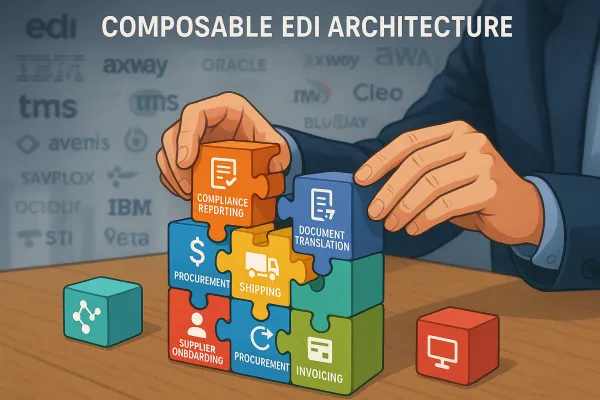
Success depends on choosing partners with proven experience managing both EDI and API integrations, plus deep knowledge of ERP systems. They should design flexible solutions that connect legacy platforms and modern SaaS tools without creating data silos.
Your technology partner needs to excel across multiple dimensions. Different backend systems have different integration requirements, so companies need options for both EDI and API integration. In the last year, we've seen more businesses than ever win and lose based on their ability to respond to changing business, market and partner requirements immediately. A unified platform for API and EDI transactions unlocks the agility you need. Gain the flexibility to onboard new partners or quickly respond to a new requirement from an existing trading partner.
Technical Capabilities Assessment Matrix
System Integration requirements are non-negotiable. Your platform must seamlessly connect with ERP, accounting, WMS, or TMS systems like SAP, Oracle, Microsoft Dynamics, or NetSuite to automate workflows. A TMS should seamlessly integrate with your existing systems, such as ERP, Payment Gateways, Accounting Systems, E-Commerce Platforms and CRM. These capabilities allow for smooth data flow across different platforms, reducing manual data entry and minimizing errors. Ensure the TMS supports APIs and other integration tools to connect with your current and future software solutions.
Partner Management capabilities should simplify onboarding and configuration of trading partners with support for custom rules and document formats for each. Companies often see: Shorter partner onboarding timelines: APIs simplify the process of connecting with new trading partners, reducing setup time from weeks to days. Better developer experience: Modern API documentation and tools make integrations easier to build, test, and maintain. Real-time alerts and visibility: APIs provide instant updates on order status, shipment tracking, and exceptions, enabling faster resolution. Reduced mapping complexity: Prebuilt mappings cut down the time and effort required for partner-specific EDI formats. Easier business system integration: APIs connect seamlessly with enterprise systems, ensuring inventory levels and order data stay up to date.
Monitoring & Alerts become crucial for operational success. Real-time dashboards and customizable alerts help track transaction flow and quickly detect failures or issues. Look for tools that show you what's happening in real time. Some platforms give you a live dashboard where you can see failed transactions, reasons for failure, and where things got stuck, without digging through logs or waiting on IT.
Cost Structure Analysis Beyond License Fees
Hidden implementation costs devastate project budgets. Large IT projects run 45% over budget and deliver 56% less value. The combination of cost overruns and value shortfalls devastates project ROI. Integration challenges are the primary driver of both budget and value failures.
Consider ongoing operational expenses carefully. Those customers that do end up paying for the customization experience the headaches associated with longer implementations and increased difficulty in upgrading their solutions. There is a much better return on investment (ROI) from going with the base package, even if that means modifying existing processes.
Implementation Strategy: Avoiding the 78% Failure Rate
Instead of starting from scratch for every connection, modern platforms let you onboard trading partners and integrate applications in days, not months. This agility allows your business to scale operations without waiting on complex custom builds or manual mapping.
Three readiness factors determine success. Partner Readiness means every carrier and customer can send/receive APIs or use a self-service web portal. System Limits requires your WMS, TMS, or ERP to send and receive API messages without messy workarounds. A WMS can publish shipment updates by API while still sending an EDI 945 to partners that need it. This dual path gives you live visibility without duplicating effort.
Compliance Comfort ensures finance and quality teams feel confident using digital logs in place of traditional EDI control reports. Without EDI, how can we provide documents for audits? APIs don't remove the record, they relocate it. Every call is time‑stamped, stored in a message log, and can be exported on demand as a PDF‑style snapshot for auditors. Most cloud hubs even let you schedule regular reports, so finance still sees a familiar file in its folder.
Phased Migration Approach
Smart organizations start small with pilot projects. Inventory-centric documents (943, 856, 945, 846) keep riding EDI until your ERP and trading partners are ready for a broader API leap. Because the portal is already API-first, it's the easiest, lowest-risk foothold for modernising your wider integration landscape. In short, dock scheduling software gives you live dock intelligence that EDI never could. By exposing that intelligence through APIs you can gradually shift status and appointment traffic off traditional EDI, unlocking real-time planning and lower overhead, while keeping your inventory documents exactly where they are until the business case says "go."
Technology Partner Selection Criteria That Actually Matter
More organizations want faster onboarding, flexible integrations, and cloud-based tools that remove dependency on legacy systems. Many companies combine EDI with newer solutions like APIs or web services to get the best of both worlds through platforms like Orderful. This allows them to enjoy the speed and flexibility of APIs while maintaining the reliability and security of EDI.
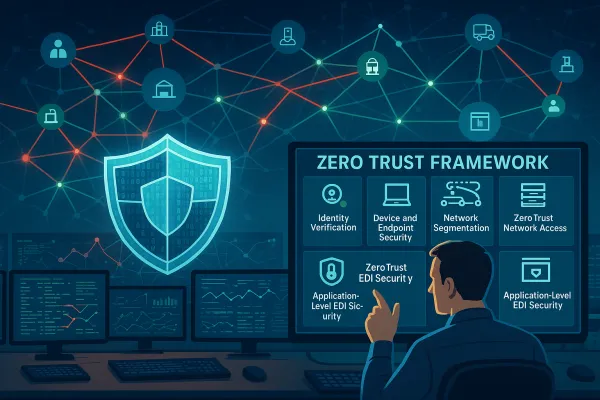
Security and compliance capabilities matter deeply when integration involves sensitive business and customer data. Look for partners with certifications such as ISO 27001, and confirm they're prepared to meet regulatory frameworks like HIPAA, if applicable to your industry.
Scalability planning prevents future bottlenecks. Your integration needs today might look very different a year from now. The right partner should support new standards, data formats, and business models as your operations evolve without requiring a full rebuild every time.
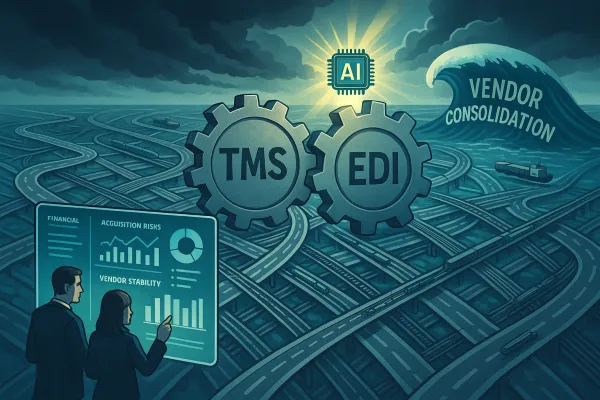
Leading TMS providers requiring robust integration include Cargoson, MercuryGate, and Descartes. Our research into the TMS market shows that this is one of the fastest growing of enterprise software markets; clearly many companies are going through the complex and time consuming TMS supplier selection process. Complexities are increased because there are fundamentally different paths, with different pros and cons, that companies can go down.
Vendor Neutrality and Future-Proofing
Avoiding lock-in scenarios requires careful evaluation. Not all TMS vendors are created equal, so it's essential to establish criteria for evaluating proposals and how well each vendor meets your TMS requirements. You can categorize vendors using a tiered approach based on a few key factors: Experience: Consider the vendor's experience and pedigree. A vendor with a deep understanding of your industry's challenges will be better equipped to provide a solution that meets your needs. Innovation: A vendor that is continuously improving their product and staying ahead of industry trends will be a more valuable partner in the long term. Support: A TMS is a critical component of your logistics operations, requiring vendor support to ensure a smooth implementation and ongoing operation.
Building Your Implementation Roadmap
Modern integration partners fix this by combining the proven reliability of EDI with the flexibility of APIs and cloud-native tools. Instead of isolated connections, they deliver a holistic approach where every integration supports real-time visibility and continuous collaboration. The best integration partners help you build a strategy that adapts to new technologies and customer expectations.
Implementing EDI or API integration requires careful planning and execution. Here are some practical steps to consider:
Assess your current systems first. Before you investigate your TMS options, it's important to have a thorough understanding of what your current capabilities and systems are. Some questions to ask include: Is your system networked with other technology platforms, like a CRM sales tool or reporting platform? What are the pain points and bright spots of your current system? What functionality would you like to keep, add or omit? Assessing your current capabilities and future needs will help you understand the type of features and platform you're in the market for.
Define integration requirements around mapping data fields between systems, establishing communication protocols, and setting up error-handling mechanisms. Modern digital integration platforms eliminate the point-to-point complexity that currently overwhelms IT teams. Instead of managing individual EDI connections with hundreds of suppliers, a unified platform handles all supplier communications via standardized interfaces, requiring minimal IT configuration and maintenance.
Consider Cargoson alongside other TMS options during your evaluation. This supplier selection guide includes over 150 criteria that can be used in selecting a supplier, market shares, and other important information about the transportation management systems market. ARC offers a supplier selection guide for TMS that is configurable. The guide offers nearly 100 features and functions. Prospective buyers of TMS can delete criteria that do not apply to them, add criteria that are missing, and weight the remaining criteria in a way that best addresses the needs of their business.
Success depends on building hybrid integration strategies that combine EDI's reliability with API speed and agility, creating a single environment where both technologies work together. This approach allows companies to modernize their supply chain operations without losing compatibility with existing partners who depend on traditional EDI workflows.