The Hybrid EDI-PDF Integration Architecture Guide: How to Automate Mixed-Format Order Processing and Bridge Non-EDI Trading Partners Without Breaking Supply Chain Performance in 2026

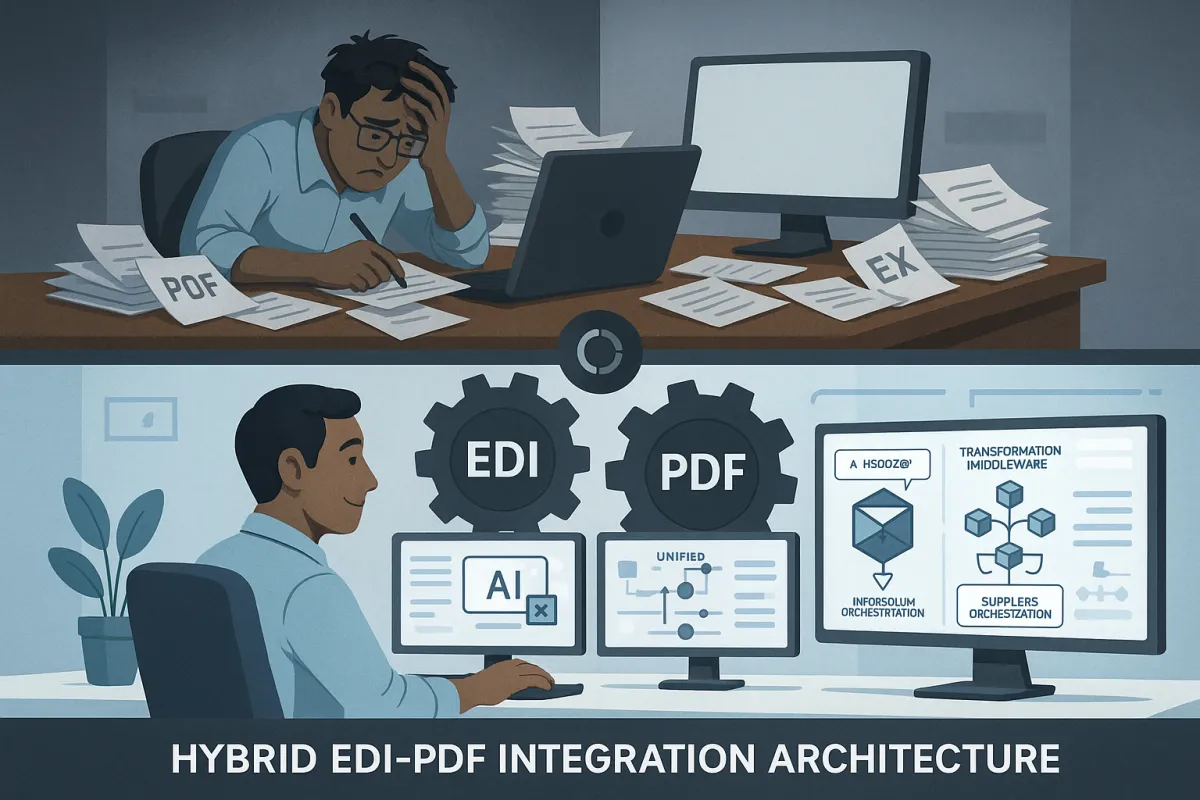
Many suppliers still manage multiple order formats daily, processing EDI orders through automated systems while handling PDF documents, Excel files, and email attachments manually from non-EDI trading partners. This fragmented approach creates data silos, inflates processing costs by up to 40%, and introduces delays that cascade throughout the supply chain.
What used to be a back-office EDI system running batch EDI transactions is now expected to support real-time, omnichannel commerce, tight EDI integration for supply chain visibility, and seamless integration with cloud business systems such as ERPs, WMS, TMS, ecommerce platforms, and 3PLs. Trading partners such as Walmart EDI, Target EDI, and Costco EDI now expect retailers, brands, and distributors to meet strict compliance rules, faster turnaround times, and more complex scenarios, such as dropship and marketplace fulfillment. The pressure becomes acute when retailers demand both EDI compliance for automated orders and accept manual submissions from smaller suppliers who can't afford full EDI implementations.
Consider a manufacturer managing 150 trading partners: 60% use EDI, 25% send PDF purchase orders via email, and 15% upload Excel files to web portals. Without hybrid integration, teams manually key data from non-EDI sources, creating bottlenecks that delay shipments by 1-3 days and increase error rates by 15-20%.
Understanding the Hybrid EDI-PDF Integration Architecture
An automated solution needs to intelligently extract the necessary data from these documents and transform it into the standardized EDI formats that your trading partners expect. This is where the real value lies – cutting down on manual data entry, reducing errors, and speeding up your entire workflow. The architecture requires three core components: intelligent document processing engines, transformation middleware, and unified workflow orchestration.
The technical foundation starts with AI-powered document extraction that works across formats without requiring template mapping for each supplier variation. The feature is built to extract clean and structured data from PDFs, scanned files, handwritten notes, images, and complex templates. It works without OCR or NLP rules, which means you do not need to train models for every supplier or layout. The platform learns patterns automatically and sends organized data straight into your SAP workflows.
Integration patterns vary based on your existing infrastructure. Direct ERP connectivity works when you have modern APIs and standardized data models. However, systems using an ERP (Enterprise Resource Planning) system, a WMS (Warehouse Management System), or other critical business software look for providers that offer pre-built connectors or robust APIs (Application Programming Interfaces). Solutions like Jitterbit, for instance, are highlighted for their integration-ready nature as part of broader business automation platforms. Middleware approaches become necessary when bridging legacy systems with modern hybrid processing requirements.
Core Technical Components and Data Flow Design
The data flow begins with intelligent ingestion that handles multiple input channels simultaneously. Email monitoring systems capture PDF attachments, web service APIs accept XML and JSON uploads, and portal integrations pull Excel files on scheduled intervals. Once enabled, it handles several common challenges that slow down EDI and SAP teams. You get cleaner data, fewer exceptions, and faster cycle times.
Document classification happens automatically using machine learning models trained on purchase order patterns, invoice layouts, and shipping notice formats. The system identifies document types, extracts key fields like purchase order numbers, line items, quantities, and delivery dates, then validates data against business rules before routing to appropriate processing workflows.
Transformation engines convert extracted data into standardized EDI formats (X12, EDIFACT, or custom XML schemas) while maintaining data lineage for audit trails. Look for an EDI integration platform that can mix EDI with non-EDI formats (XML, JSON, CSV) and convert seamlessly between them, so you can automate invoices or order flows regardless of whether partners use classic interchange standards or modern APIs.
Exception handling mechanisms catch validation failures, missing required fields, and format inconsistencies before they disrupt downstream processes. Modern systems provide contextual error messages and suggested corrections, enabling quick resolution without technical expertise.
Implementation Roadmap for Hybrid Integration Systems
Start by cataloging your trading partner landscape. Document which partners use EDI, which send PDFs or Excel files, and which prefer web portal submissions. Determining your systems of record (one or multiple ERPs, plus WMS/TMS, ecommerce, CRM) will determine the type of connectivity your platform will need to have in addition to core EDI functionality. This assessment reveals integration complexity and helps prioritize implementation phases.
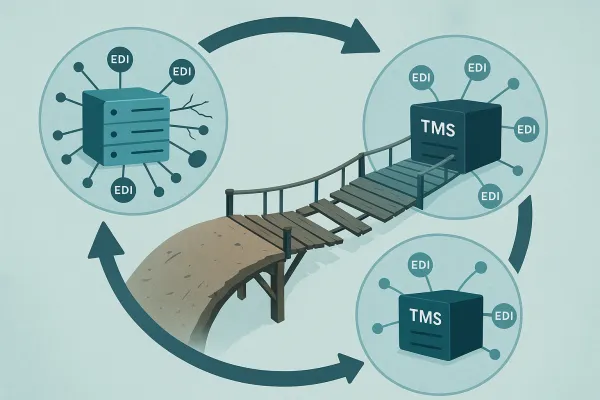
Systems architecture planning requires mapping data flows between your ERP, WMS, TMS, and ecommerce platforms. Integrating EDI with TMS can be technically challenging, especially for organizations with outdated systems or limited IT resources. Businesses may need to invest in middleware solutions to bridge the gap between legacy systems and modern EDI requirements. Consider whether your TMS can handle the additional document types or if you need separate processing pipelines.
Platform selection becomes critical here. Solutions like Celigo, TrueCommerce, and SPS Commerce offer different approaches to hybrid processing. Cargoson provides a modern alternative with unified carrier management and automated document processing, while traditional providers like MercuryGate and Descartes focus more heavily on pure EDI workflows.
Phased deployment reduces implementation risk. Begin with high-volume PDF trading partners who send standardized purchase order formats. Libraries of prebuilt trading-partner profiles (e.g., Walmart, Target, Costco) with ready-to-use maps and rules. Self-service tools that allow internal teams to add new partners or documents without long service projects. Versioning and change management to prevent updates to partner requirements from breaking downstream logic.
Trading Partner Onboarding Automation
Automated onboarding begins with partner assessment workflows that collect requirements, document formats, and communication preferences. Template libraries store common document layouts for major retailers and manufacturers, while custom rule engines accommodate unique partner specifications without requiring separate integrations.
Pre-built connectors accelerate onboarding for established trading relationships. With tools like reusable, pre-validated partner profiles and auto-configure mappings from sample EDI files, the time to establish EDI connections is shorter and more transparent. The system analyzes sample documents, suggests field mappings, and generates validation rules automatically.
Testing and validation frameworks ensure accuracy before going live. Sandbox environments allow partners to submit test documents while monitoring data extraction and transformation results. Parallel processing during cutover periods lets you compare automated results against manual processing to verify accuracy.
Performance Optimization and Monitoring Strategies
Real-time dashboards provide visibility across mixed-format transactions. To meet the demand from both suppliers and vendors, you should be able to answer "Where's my order?" or "Did that invoice go through?" in seconds, not hours. Transaction queues show processing status for EDI messages, PDF extractions, and Excel uploads with detailed error context when issues occur.
Exception queues organize processing failures by type: validation errors, missing data, format inconsistencies, and partner-specific rules violations. The platform should resolve most errors automatically (retries, reformatting, enrichment), with only edge cases needing human review. Automated retry mechanisms handle temporary failures while escalating persistent issues to operations teams.
SLA management becomes complex when mixing processing speeds. EDI transactions typically complete in seconds, while PDF extraction and validation might require 30-60 seconds per document. Capacity planning must account for peak volumes during month-end cycles when both EDI and manual document submissions spike simultaneously.
Performance monitoring compares processing times across format types. Document complexity affects extraction speed – simple PO forms process faster than multi-page contracts with embedded tables. The system should provide metrics on extraction accuracy, processing latency, and error rates broken down by trading partner and document type.
Advanced Automation and AI Integration
AI-powered automation learns from historical processing patterns to improve accuracy over time. Machine learning models analyze successful extractions to identify optimal field mappings and validation rules for similar document layouts. AI or rules-based auto-mapping to suggest field matches and transformations.
Intelligent document classification reduces manual routing decisions. The system recognizes purchase orders, invoices, advance ship notices, and other document types regardless of source format. Classification confidence scores help operations teams prioritize manual review for ambiguous documents.
Predictive exception handling identifies potential problems before they cause processing failures. Pattern recognition flags unusual data values, missing required fields, and format deviations that historically cause downstream errors. Proactive alerts enable corrective action before documents reach critical processing stages.
Security and Compliance in Mixed-Format Environments
Data protection requirements vary across transmission methods. EDI typically uses AS2 encryption and digital certificates, while email attachments rely on TLS and potentially additional encryption. Web portal uploads need secure authentication and session management. The hybrid system must maintain consistent security standards regardless of input channel.
Audit trails become more complex when tracking mixed-format processing. Because EDI documents are processed by computers rather than humans, a standard format must be used so the receiving computer can read and understand the documents. Today, there are many EDI standards, protocols, and versions in use. OpenText delivers the broadest EDI integration support of any EDI vendor including specific regional and industry standards, as well as API integration and email/fax to EDI solutions. Document lineage must trace PDF extraction, data transformation, and final EDI output while maintaining compliance with retention policies.
Regulatory compliance spans multiple frameworks depending on industry and geography. Healthcare organizations need HIPAA compliance for patient data in any format. Financial services require SOX controls for invoice processing. GDPR affects any system processing EU personal data, regardless of whether it arrives via EDI or PDF.
Access controls must govern both automated and manual processing workflows. Role-based permissions determine who can view original documents, modify extraction results, and approve exception handling decisions. Segregation of duties ensures no single user can process transactions end-to-end without appropriate oversight.
Future-Proofing Your Hybrid Integration Strategy
The evolution toward API-based integrations creates opportunities to reduce reliance on traditional EDI formats. But 2026 marks a definitive pivot: modern transportation software increasingly integrates via APIs. They provide real-time rate access, smoother onboarding, and high-fidelity shipment status updates across ecosystem partners. However, PDF and Excel processing will remain necessary for smaller trading partners who lack technical resources for API implementations.
Migration planning should consider gradual transitions rather than wholesale replacements. Partners currently sending PDF purchase orders might adopt API connectivity for new transactions while maintaining existing document flows during transition periods. The hybrid system must support parallel processing modes during these migrations.
Scalability considerations extend beyond volume to format diversity. As order volumes grow, your EDI setup must scale without constant tuning: Cloud-native runtime that scales horizontally during peaks. New document formats, additional trading partners, and expanding business requirements demand flexible architectures that accommodate growth without major reconfiguration.
The hybrid EDI-PDF integration architecture represents a practical solution to real supply chain challenges. The number of suppliers sending nonstandard formats continues to grow. Rather than forcing universal EDI adoption or maintaining manual processes indefinitely, hybrid approaches enable automated processing regardless of partner technical capabilities. Success requires careful planning, appropriate technology selection, and phased implementation that respects both business requirements and existing partner relationships.
Start by assessing your current mixed-format volume and complexity. Document which partners create the biggest manual processing burdens and begin there. The goal isn't perfect automation immediately – it's reducing manual effort while maintaining accuracy and partner satisfaction. With proper implementation, hybrid systems can process 80-90% of transactions automatically while providing clear workflows for exceptions that require human intervention.