The Mixed Document Crisis: How to Build Unified Hybrid EDI-OCR Integration That Handles Both Electronic and Paper Trading Partners Without Breaking Your TMS Workflow in 2026

Your supply chain team receives 847 invoices this week. Of those, 523 arrive through EDI from established trading partners, while 324 come as PDF email attachments from smaller suppliers who haven't implemented EDI. Currently, these documents flow through completely separate processing systems, creating workflow delays and data inconsistencies that make manual work time-consuming, error-prone, and expensive, with various documents created at each stage continuing to be a huge challenge for most organizations.
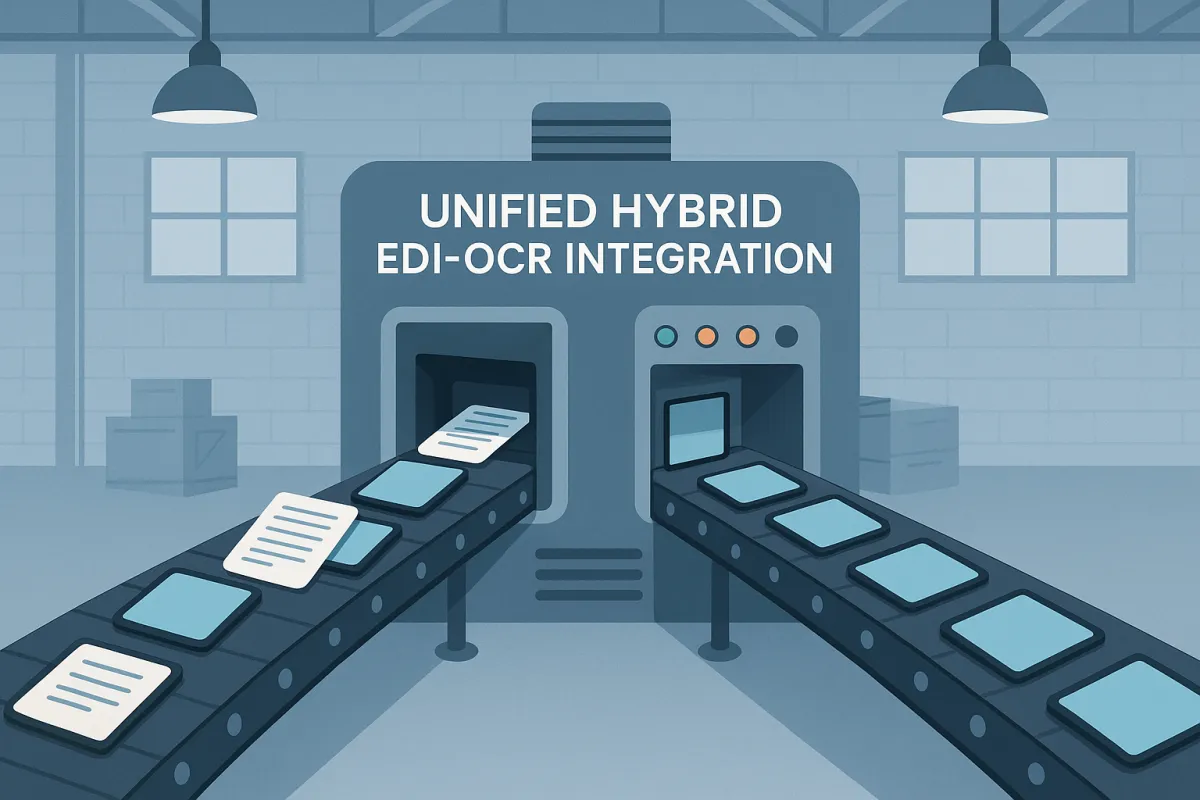
This scenario reflects a broader challenge facing supply chain professionals in 2026. OCR bridges the digital-physical gap by converting unstructured documents into standardized digital workflows, enabling end-to-end automation. The solution involves building unified hybrid EDI-OCR architectures that automatically route structured electronic transactions through traditional EDI workflows while processing paper and PDF documents from the same trading partners through intelligent document processing systems.
The Hidden Challenge of Mixed Document Trading Partners
Most trading partner relationships aren't purely electronic or purely paper-based. A single manufacturer might send EDI purchase orders but fax delivery confirmations. Your largest retailer could use EDI for standard invoicing while sending PDF change orders via email. For non-EDI business partners, hybrid solutions include integration methods via Email, PDFs, Excel, flat files, leveraging web portals and OCR to translate and communicate data between business partners.
The mixed document challenge creates several specific problems:
- Transportation management systems like Cargoson, MercuryGate, and Descartes receive shipment data through multiple channels, making consolidated reporting difficult
- Purchase order acknowledgments arrive through EDI while delivery confirmations come via PDF, breaking automated workflows
- Invoice processing requires separate validation rules for EDI 810 transactions versus extracted PDF data
The Real Cost of Document Fragmentation
Traditional supply chain management approaches rely heavily on manual work and are time-consuming, error-prone, and expensive, with inefficient processes leading to high costs, mistakes, legal issues, and ultimately the loss of customers. Document fragmentation amplifies these costs because each format requires separate processing resources, validation procedures, and exception handling.
Processing delays compound when documents don't flow through unified systems. A single shipment might generate an EDI advance ship notice that updates your TMS immediately, while the proof of delivery arrives as a scanned PDF hours later, requiring manual data entry to complete the transaction record.
Architecture Fundamentals: Building Document-Agnostic Integration
Successful hybrid EDI-OCR integration requires a three-layer architecture that treats document format as an implementation detail rather than a fundamental distinction. Hybrid integration maximizes technology strengths by combining EDI's standardized reliability with API's real-time speed, creating seamless workflows that satisfy both legacy and modern system requirements.
The foundation starts with universal document intake. Whether your supplier sends an EDI 856 advance ship notice or emails a PDF delivery receipt, both documents contain the same core business information: shipment details, item quantities, delivery dates. Your integration architecture should capture this information regardless of format and route it to the appropriate processing engine.
Document classification engines analyze incoming files to determine their format and content type. Intelligent Document Processing uses artificial intelligence to convert documents into structured data, mimicking how a trained human would read, understand, and process paperwork, but faster, more accurately, and at scale. Modern classification systems can distinguish between an EDI transaction set and a PDF invoice with over 99% accuracy.
The Three-Layer Integration Model
Layer one handles document intake from all sources: AS2 connections, SFTP drops, email attachments, web portal uploads, and API submissions. This layer normalizes transport protocols while preserving document content and metadata.
Layer two contains the processing router, which decides whether documents flow through traditional EDI translation or intelligent OCR extraction. This decision engine considers trading partner profiles, document types, and business rules to route each document appropriately.
Layer three manages business system integration, ensuring that extracted data reaches your ERP, TMS, or WMS in the expected format regardless of its original form. Whether data originated from an EDI 850 purchase order or a scanned PDF requisition, it arrives at your procurement system as a standardized business object.
Implementing Smart Document Routing and Classification
Smart routing begins with comprehensive trading partner profiles that define expected document types and formats for each relationship. Adopt a hybrid model: retain EDI for high-volume partners and layer portals, email automation, or API networks for others, achieving full supplier coverage with a mix of technologies unified in a single visibility layer.
Your routing engine should handle scenarios like receiving both EDI and PDF invoices from the same supplier on the same day. Perhaps their accounting system generates EDI 810 transactions for standard invoices while their field service team emails PDF invoices for emergency repairs. Both document types need processing, but through different paths.
Document classification relies on multiple signals: file format, sender identity, content analysis, and embedded metadata. Intelligent Document Processing combines artificial intelligence and OCR to extract data from unstructured documents such as claims forms, invoices, and contracts. Advanced classifiers can identify purchase order numbers within PDF text and match them against EDI transaction expectations.
Trading Partner Configuration Strategies
Configure trading partner profiles to specify primary and fallback processing methods. Your largest retailer might primarily use EDI but occasionally send PDF change orders during system maintenance. Your profile should route EDI documents through standard processing while triggering OCR workflows for PDF exceptions.
Exception handling becomes critical when documents don't match expected patterns. If you receive a PDF from a trading partner configured for EDI-only processing, your system should flag this for manual review while still extracting available data through OCR processing.
OCR Integration for Non-EDI Documents
Modern OCR platforms like Rossum, ABBYY, and Google Document AI offer specialized capabilities for supply chain documents. By harnessing AI, OCR, and Machine Learning, IDP enhances efficiency, speed, and accuracy of supply chain document data extraction, leading to significant improvements in data extraction accuracy, work efficiency, and decision-making capabilities.
Unlike generic OCR tools, supply chain-focused solutions understand document context. They recognize that a "Ship To" address on an invoice corresponds to a delivery location, not a billing address. They can extract line item details from tables with varying layouts and map them to standard product codes.
Integration with platforms like Orderful's AI mapping capabilities allows OCR-extracted data to flow through the same validation and routing logic as traditional EDI transactions. This ensures consistent business rules regardless of document origin format.
Data Standardization and Mapping
Converting OCR output to EDI-equivalent data structures requires sophisticated mapping logic. Intelligent algorithms extract essential data from structured, semi-structured, and unstructured documents, ensuring accuracy and compliance while automating document flow within supply chain processes. A PDF invoice might list quantities in a "Qty" column while your EDI 810 transactions use "UOM" fields for unit of measure.
Validation procedures should apply the same business rules to both EDI and OCR-extracted data. Purchase order line items need quantity validation, pricing checks, and inventory verification regardless of whether they originated from an EDI 850 or a scanned requisition form.
TMS Integration and Workflow Orchestration
Transportation management systems require consistent data feeds to maintain accurate shipment tracking and carrier coordination. Whether shipment notifications arrive through EDI advance ship notices or PDF delivery confirmations, your TMS needs standardized data structures.
Platforms like Cargoson, Transporeon, and Blue Yonder have evolved to handle hybrid document workflows. APIs that work with EDI and can connect to common ERPs like SAP S/4HANA, Oracle Fusion, NetSuite, and MS Dynamics 365 are essential for businesses seeking agile, efficient, and future-ready supply chain integration, enabling seamless automation and real-time supply chain visibility.
Carrier integrations present particular challenges because carriers often use mixed communication methods. A single carrier might send EDI 214 status updates for major shipments while emailing PDF delivery receipts for smaller packages. Your TMS integration should consolidate these updates into unified shipment records.
Performance Monitoring and Exception Management
Monitor processing performance across both EDI and OCR workflows using consistent metrics. Document processing time, extraction accuracy, and exception rates should be tracked regardless of input format. This unified visibility helps identify bottlenecks and optimize resource allocation.
Alert systems should trigger when document processing fails, whether due to EDI syntax errors or OCR extraction issues. Your operations team needs consistent notification procedures that don't require format-specific troubleshooting expertise.
Implementation Roadmap and Best Practices
Start your hybrid implementation with a pilot program targeting 5-10 trading partners who currently use mixed communication methods. Most companies use a hybrid approach because rebuilding every partner integration is not realistic. Focus on high-volume document types like invoices or advance ship notices where automation benefits are most apparent.
Phase one should establish basic document intake and classification capabilities. Implement routing logic that separates EDI transactions from PDF documents while maintaining audit trails for both processing paths. This foundation enables you to handle mixed documents without disrupting existing workflows.
Phase two adds intelligent OCR processing for non-EDI documents. IDP solutions help extract, transfer and validate data using AI/ML technologies, connecting disparate data sources and computer systems without costly custom integrations, with leading companies achieving 80% reduction in human dependency and 60% reduction in turnaround time. Begin with document types that have consistent layouts and clear data fields.
Phase three integrates OCR-extracted data with your existing business logic and validation rules. This ensures that PDF-derived data receives the same quality checks and processing logic as traditional EDI transactions.
Avoiding Common Integration Pitfalls
Don't underestimate the training requirements for hybrid systems. Your team needs to understand both EDI transaction troubleshooting and OCR accuracy validation. Cross-training existing EDI specialists on document processing concepts prevents knowledge silos.
Legacy system compatibility often creates unexpected challenges. Your 20-year-old ERP might handle EDI integration smoothly but struggle with the API calls required for modern OCR platforms. Plan for middleware solutions that bridge these gaps without requiring core system modifications.
Budget for ongoing accuracy improvements in OCR processing. Advanced solutions achieve 99.99% accuracy in data extraction and extract data 10x faster than traditional OCR solutions, but reaching these performance levels requires continuous model training and validation rule refinement.
Success metrics should encompass end-to-end processing efficiency rather than format-specific performance. Track total document processing time from receipt to business system integration, regardless of whether documents originated as EDI transactions or PDF attachments. This holistic view ensures that hybrid architectures deliver genuine operational improvements rather than just technical complexity.