The Multi-Provider EDI Tax: How to Build a 70% Cost Reduction Business Case for Vendor Consolidation While Navigating TMS Landscape Changes in 2025


Most companies using multiple EDI providers don't realize they're paying a hidden tax that can cost them 200-300% more than necessary. Companies often see their EDI line items double or triple simply because their networks are split across different providers. But the financial hit extends far beyond visible costs.
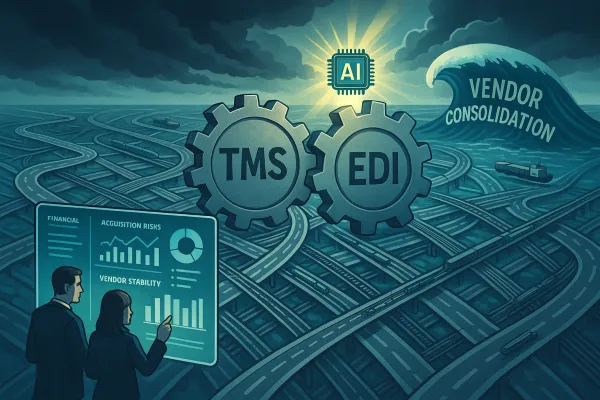
Here's what makes EDI vendor consolidation urgent in 2025: Companies achieve up to 70% cost savings through volume-based contracts and the elimination of duplicate fees across multiple providers. Meanwhile, the TMS vendor landscape is experiencing its own major consolidation wave, creating dual pressure on supply chain professionals to reassess their integration strategies. The most significant TMS vendor consolidation wave in over a decade is reshaping European procurement decisions right now. WiseTech's acquisition of E2open in 2025, Descartes' purchase of 3GTMS for $115 million in March 2025, and Körber's transformation of MercuryGate into Infios following their 2024 acquisition represent just the beginning of a fundamental market restructuring.
The Hidden Mathematics of Multi-Provider EDI Tax
Your finance team sees separate line items for multiple EDI VANs and assumes that's normal. What they don't see is how fragmented volumes destroy your negotiating power. Simply put, routing all your EDI traffic through one provider gives you bargaining power that fragmented volumes cannot match. Organizations typically secure up to 50% savings on current EDI expenditures after consolidation.
The real cost multiplication happens in three areas:
Duplicate Infrastructure Fees: Each VAN charges setup, maintenance, and connection fees. Removal of VAN inter-connect fees and hidden charges [and] lower per-kilo-character pricing available in 2025 becomes accessible only with consolidated volumes.
Administrative Overhead: Multiple networks mean multiple EDI VAN provider contracts to maintain, resources to deploy and a lack of centralized visibility into transaction data. Each provider requires separate support relationships, different testing procedures, and individual compliance tracking.
Operational Inefficiency: Consolidation reduces new trading partner setup from months to just 5 days, unlocking previously blocked revenue opportunities. Multiple VANs create bottlenecks that directly impact your ability to onboard partners and capture revenue.
The Security Risk Multiplication Factor
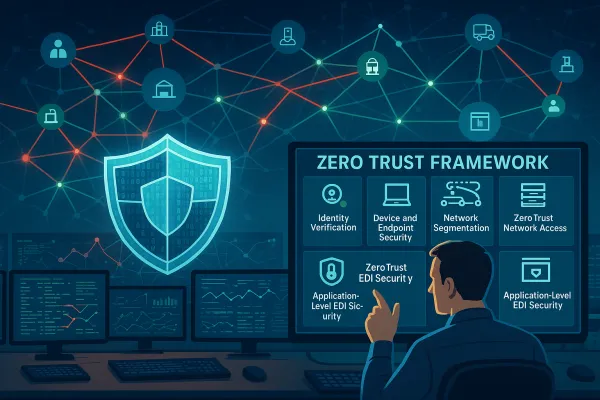
Security isn't just about individual provider strength. Using multiple VAN providers increases your third-party risk. Not only are you opening the risk to those directly serving you, but those who also serve your providers. This increases your risk dramatically.
The numbers are sobering: 77% of CISOs report a complete lack of visibility into their vendors' security practices, creating blind spots in security posture. When you multiply this across multiple EDI providers, you're exponentially increasing your exposure points.
Consider what happened with the Change Healthcare breach. A recent breach at Change Healthcare resulted in USD 2.40B in damages, highlighting the serious security gaps in fragmented EDI environments. Now imagine managing security protocols across five different EDI providers, each with different standards, update cycles, and compliance frameworks.
Regulatory fines can be substantial – HIPAA violations alone may cost up to USD 50,000 per incident, turning security gaps into significant financial liabilities. Multiple providers mean multiple points of potential failure and multiple compliance frameworks to manage.
Building Your 70% Cost Reduction Business Case
The financial argument for EDI vendor consolidation becomes clear when you map all costs. 77% of businesses typically manage multiple VANs—some maintaining as many as 10 or more. By consolidating to a single VAN, you're reducing complexity and freeing up valuable in-house IT resources.
Here's your calculation framework:
Direct Cost Analysis: Add up all VAN fees, per-transaction costs, setup charges, and support contracts across providers. Don't forget interconnect fees between VANs and duplicate licensing costs for similar functionality.
Hidden Cost Discovery: Soft EDI costs, which are also known as indirect costs, are those that you don't see on your monthly expense reports, but chew up your resources... These issues are tedious and time-consuming for employees, meaning that energy is misallocated here as opposed to being spent on building customer relationships, processing orders, and other functions that ultimately help the business thrive.
Volume Leverage Calculation: Calculate your total transaction volume across all providers. Use this as your negotiating baseline for consolidated pricing. Most organizations find they can negotiate significantly better per-transaction rates with consolidated volumes.
Partner Onboarding Impact: 42% of integration experts reported taking more than a month to onboard new trading partners in 2021, up from 37% in 2020. Calculate the revenue impact of faster partner onboarding and multiply by the number of partners you add annually.
The TMS Vendor Consolidation Connection
The timing of your EDI consolidation matters because TMS vendor changes often force EDI relationship reviews. Körber Supply Chain Software acquired MercuryGate International Inc., a Transportation Management System provider, to expand its supply chain execution portfolio, creating what is now known as Infios. This wasn't just a typical software acquisition; it represented a strategic move to integrate OMS, WMS, and TMS functionalities into a comprehensive supply chain platform.
When your TMS vendor gets acquired, your EDI connections often require updates. Standard TMS contracts rarely address acquisition scenarios adequately. Include specific language requiring 12-18 months advance notice of any acquisition discussions that might impact service delivery or platform functionality.
Smart supply chain teams are using this TMS consolidation wave as an opportunity to reassess their entire integration strategy. The post-consolidation landscape reveals three distinct categories: global mega-vendors (Infios/MercuryGate, Descartes, SAP TM, Oracle TM, E2open/WiseTech), European specialists (Alpega, nShift, Transporeon/Trimble), and emerging European-native solutions (including Cargoson) that focus specifically on cross-border European operations.
The risk extends beyond just system changes. 66% of technology projects end in partial or total failure, with 17% of large IT projects threatening company existence. When your TMS vendor becomes an acquisition target, you inherit these integration risks without directly managing the project.
Implementation Strategy: Phased Consolidation Without Disruption
The key to successful EDI vendor consolidation lies in methodical planning. Phased migration prevents supply chain disruption: Successful consolidation requires thorough auditing, testing, and parallel systems during transition to maintain business continuity.
Start with a comprehensive audit of your current EDI landscape. Document every connection, transaction type, and partner relationship across all providers. Supply chain leaders need a full report of transactions flowing through the supply chain. Compiling data and statistics from individual EDI VANs is labor intensive and leaves room for manual error.
Prioritize partner migrations based on transaction volume and business criticality. High-volume, low-complexity connections should migrate first to build confidence and demonstrate immediate cost benefits.
During vendor evaluation, examine providers' acquisition history and integration track records. Look for partners who can handle complex, multi-protocol environments and offer robust testing capabilities. Consider solutions from established providers like SPS Commerce, TrueCommerce, IBM Sterling, alongside newer platforms including Cargoson that specialize in European cross-border operations.
Plan for parallel systems during migration windows. Some suppliers will have gone bust, others not lived up to expectations, while some businesses will have had to bring onboard new suppliers - disrupting partner relationships during consolidation can be costly.
Measuring Success Beyond Initial Cost Savings
Cost reduction is just the beginning. A consolidated EDI VAN platform delivers unified visibility that fundamentally changes how businesses make decisions... Upon consolidation, companies gain: Comprehensive reporting across all trading relationships · Real-time visibility into transaction status and partner performance · Centralized data for proactive business decisions rather than reactive troubleshooting.
Track these success metrics:
Partner Onboarding Velocity: Measure time-to-live for new trading partners before and after consolidation. Multiple VANs require different processes and testing that slow things down. Remove bottlenecks and improve time-to-market with a single EDI VAN, pre-connected to key trading partners.
Error Rate Reduction: 51% of companies report improved data quality and accuracy after optimizing their B2B integration solutions. Fewer integration points typically mean fewer failure modes.
IT Resource Reallocation: Calculate how much IT time gets freed up from managing fewer vendor relationships and use this for strategic projects rather than maintenance.
Business Agility: Your ability to respond to market changes, onboard emergency suppliers, or enter new markets depends heavily on integration agility. Consolidated EDI infrastructure typically enables faster business responses.
The window for optimal EDI vendor consolidation is narrowing as both EDI and TMS markets consolidate simultaneously. Companies that act now can capture maximum savings and position themselves for the integrated supply chain platforms that are becoming the new standard. Those who wait may find their options limited and their negotiating power significantly reduced.