The Strategic Guide to Hybrid EDI-API Integration: How to Modernize Supply Chain Data Exchange Without Breaking Your Trading Partner Network in 2025

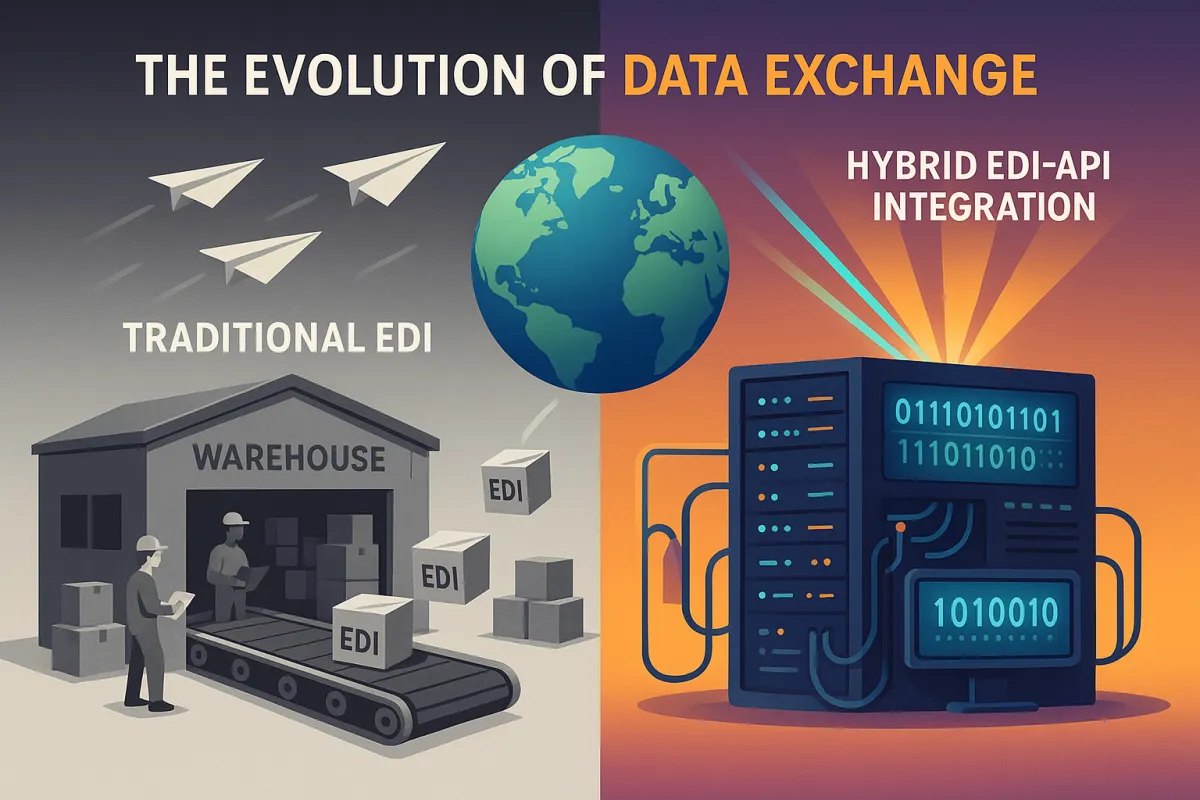
Most supply chain professionals face an uncomfortable truth: the EDI software market is expected to reach $5.30 billion by 2032, while hybrid integration platforms grew from $11.02 billion in 2024 to $12.24 billion in 2025. Your existing EDI infrastructure works, but you're losing opportunities because it can't deliver the real-time capabilities your trading partners increasingly demand.
The hybrid EDI-API integration approach has emerged as the practical solution for 2025. Rather than forcing a choice between EDI's reliability and API's flexibility, this strategy lets you modernize gradually while maintaining the trading partner relationships that drive your business.
Why Hybrid EDI-API Integration is the Dominant Strategy for 2025
The numbers tell the story clearly. EDI accounted for $8.38 trillion in B2B electronic sales by 2021, representing 76.5% of all digital sales with 8.3% year-over-year growth. Meanwhile, roughly 25% of EDI connections have been replaced with APIs as of 2020, and API connectivity is increasing, especially among parcel and LTL freight carriers.
Here's what this means for your operation: EDI isn't going anywhere, but APIs are becoming non-negotiable for competitive advantage. EDI and API are complementary technologies that work best together, with API integration augmenting EDI and giving deeper context to B2B integrations.
Consider the Tesla case study that illustrates both the opportunity and risk. When Tesla chose to skip EDI in favor of API-based integrations, many carriers found themselves in a bind, requiring specialized solutions to transform carriers' existing data into API-compatible formats. Companies that had hybrid capabilities were ready immediately.
The business case for hybrid integration centers on three factors: cost flexibility, partner compatibility, and future readiness. The future lies in hybrid connectivity where EDI and APIs coexist to support diverse IT ecosystems, offering flexibility that helps organizations modernize without disrupting existing workflows or supply chain operations.
The Strategic Framework for Hybrid Implementation
Start with a pilot approach that minimizes risk while proving value. Here's the step-by-step process that works:
Phase 1: Current State Assessment
Document your existing EDI transactions by volume, partner, and document type. Map these against your business-critical processes to identify which transactions drive the most value and which cause the most friction. This analysis typically reveals that 80% of your transaction volume comes from 20% of your document types.
Phase 2: Partner and Document Prioritization
Select one trading partner who has expressed API interest but maintains EDI requirements. API-EDI hybrid models are becoming more popular in fast-paced markets because they make it easier to scale, enroll partners quickly, and follow new digital rules. Focus on high-frequency, time-sensitive documents first.
Phase 3: Dual-Feed Implementation
Run parallel EDI and API feeds for your pilot documents. This approach provides immediate rollback capability while allowing you to measure performance differences. Track metrics like processing speed, error rates, and partner satisfaction during this period.
Phase 4: Gradual Transition
Move additional document types to API only after establishing 99.9% success rates and partner comfort with the new process. Maintain EDI for backup and compliance purposes during the transition period.
Risk mitigation requires planning for three scenarios: API downtime, partner system changes, and compliance requirements. Your hybrid architecture should automatically fail back to EDI if API connectivity drops, ensuring business continuity.
Critical Success Factors and Common Pitfalls
Three readiness hurdles determine hybrid integration success: partner readiness, system limitations, and compliance comfort. Partner readiness varies dramatically by industry and company size. Larger organizations, such as Walmart, leverage integration technology to strengthen supply chain control and demand new trading partners adopt and implement EDI as the base price of entry.
System limitations often surface during integration testing. APIs can be bogged down by internet connectivity problems due to interruptions that can affect every system connected via API, and as anyone in the transportation industry will attest, when it's down, nothing gets done.
The most common pitfall is underestimating compliance complexity. Different trading partners have varying tolerance for API-based transactions, especially in regulated industries. Build compliance validation into your hybrid workflows from day one rather than retrofitting later.
Error monitoring becomes more complex with hybrid systems. Establish unified dashboards that track both EDI and API transactions, allowing you to spot patterns and performance differences quickly. Set up automated alerts for transaction failures that require immediate attention.
Platform and Vendor Selection for Hybrid Architectures
Your platform choice determines implementation success. The Cleo Integration Cloud allows organizations to connect to enterprise and SaaS applications with a variety of connectors and APIs, automatically accepting, transforming, orchestrating, connecting, and integrating all B2B data types from any source to any target. IBM Sterling B2B Integrator offers similar hybrid capabilities with strong enterprise-grade security.
For transportation-specific needs, consider specialized solutions. Cargoson is a cloud-based Transportation Management System (TMS) for shippers to organize daily logistics tasks, built for manufacturers, retailers, wholesalers, and 3rd party warehouse logistics providers using different logistics companies. Competitors include nShift, Transporeon, and traditional providers like SPS Commerce and TrueCommerce.
EDI is leading in terms of connecting technologies used in TMS deployment, but API connectivity is increasing, especially among parcel and LTL freight carriers. This creates opportunities for hybrid solutions that can handle both communication methods seamlessly.
Cost analysis reveals interesting trade-offs. Per-transaction EDI pricing typically runs $0.10-$0.50 per document, while API calls often cost $0.01-$0.05. However, API setup and maintenance costs can be higher initially. Flat-rate hybrid models from providers like Orderful and Zenbridge are gaining popularity for predictable monthly expenses.
Real-World Implementation Scenarios by Document Type
Different document types benefit from different approaches. Core EDI documents like 850 purchase orders and 856 advance ship notices work well with API enhancement for real-time status updates while maintaining EDI for the official transaction record.
Status-heavy documents present the best API opportunities. EDI 214 (Transportation Carrier Shipment Status Message) is used by transportation carriers to send shipment statuses, including time, date, location, route, identification numbers, and conveyance. Converting these to API calls provides real-time tracking without disrupting core business processes.
Transportation-specific workflows show clear hybrid patterns. EDI connectivity allows TMS systems to transmit and receive standardized documents like 204s, 210s, and 214s instantaneously, automating the entire transaction and resulting in fewer delays and less information rekeying. Layer APIs on top for real-time rate queries and tracking updates.
Inventory documents like 943, 856, 945, and 846 often remain better suited for EDI due to their structured, batch-oriented nature. However, adding API endpoints for urgent inventory queries or exception handling provides the best of both worlds.
Future-Proofing Your Hybrid Integration Strategy
The hybrid connectivity of EDI and APIs enables real-time decision-making and intelligent automation, for example, flagging unusual order volumes or automating dispute resolution workflows, and coupling EDI and APIs with your ERP can assist with AI-readiness.
AI readiness requires unified data access. Enabling AI to fully deliver requires more than just connecting EDI, APIs, and ERP - it also depends on having a truly integrated ecosystem that AI can seamlessly access, as a fragmented landscape creates barriers, and a fully integrated ecosystem ensures AI has the breadth and depth of data needed.
Compliance considerations multiply with hybrid architectures. The standardized and structured nature of EDI formats means less data cleaning is likely required before feeding it into AI models, and AI can more easily extract patterns and insights from EDI across different trading partners. Maintain this advantage while gaining API flexibility.
Audit trail management becomes more complex but also more powerful. Hybrid systems can provide both the structured audit trails EDI excels at and the detailed transaction logs APIs generate. Design your system to correlate related EDI and API transactions for complete visibility.
Scaling strategies should anticipate growth in both directions. As your partner ecosystem expands, you'll onboard some partners via EDI, others via API, and many using both methods. Automating the onboarding process for new trading partners reduces complexity and accelerates integration, with automation tools using pre-built templates and validation processes ensuring new partners can integrate and start transacting swiftly.
Getting Started: Your 90-Day Implementation Roadmap
Days 1-30: Assessment and Planning
Catalog your current EDI transactions, trading partner requirements, and internal system capabilities. Identify your highest-volume, most time-sensitive document types. Select one trading partner for your pilot who has both EDI requirements and API interest.
Days 31-60: Pilot Implementation
Set up dual EDI-API feeds for your selected document type with your pilot partner. Implement monitoring dashboards and establish success metrics. Integrated TMS platforms save 20-30% on admin labor and reduce billing/invoicing errors by 40-50% when properly implemented.
Days 61-90: Testing and Optimization
Run comprehensive testing scenarios including failure conditions. Establish live rollback capabilities with 99.9% success rate thresholds. Document lessons learned and prepare expansion criteria for additional partners and document types.
Change management requires attention to both internal teams and trading partners. Train your EDI specialists on API concepts and your developers on EDI standards. Most successful implementations create hybrid teams rather than separate EDI and API groups.
The hybrid EDI-API approach isn't just about technology—it's about positioning your organization for the next decade of supply chain evolution. Start with one pilot, prove the value, and expand systematically. Your trading partners and internal teams will thank you for the gradual, thoughtful approach rather than a disruptive replacement strategy.