
The Bounded Autonomy Implementation Framework for Agentic AI in EDI: How to Prevent the 76% Failure Rate and Build Production-Ready Autonomous Trading Partner Operations in 2026

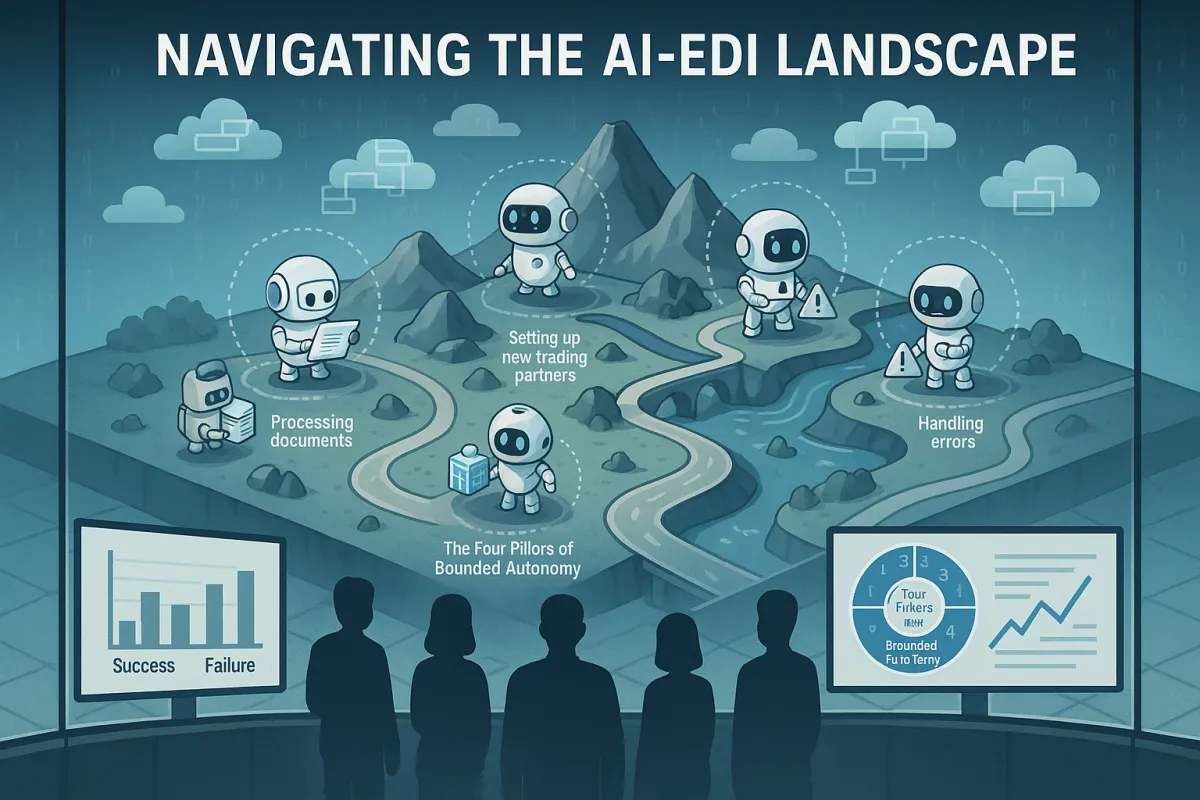
Gartner predicts over 40% of agentic AI projects will be canceled by the end of 2027, yet major EDI vendors like Jitterbit and TrueCommerce announced general availability of AI assistants for EDI operations in April 2026. The gap between ambitious pilot projects and production-ready autonomous trading partner operations has never been wider. Nearly 68% of organizations are deploying agentic AI systems, but fewer than 30% successfully scale them to production.
The answer isn't avoiding agentic AI for EDI—it's implementing bounded autonomy frameworks that prevent the catastrophic failures plaguing most deployments while delivering measurable automation benefits. Here's how to be in the successful minority.
The Critical Agentic AI Implementation Crisis Facing EDI Operations
The statistics paint a sobering picture. Gartner's research shows that over 40% of agentic AI projects will fail by 2027 due to escalating costs, unclear business value, and inadequate risk controls. Additional data reveals that up to 85% of all AI projects fail to move beyond initial testing, with 42% of companies abandoning most AI initiatives in 2025.
For EDI operations specifically, this failure rate creates unique risks. Unlike other business applications, EDI systems directly impact trading partner relationships, compliance requirements, and supply chain operations. Agentic AI specifically introduces failure modes that traditional AI projects do not face, including autonomous agents making decisions in production without sufficient human oversight frameworks.
Yet the market is moving forward rapidly. Jitterbit announced general availability of its EDI AI Assistant in April 2026, featuring natural language processing that allows non-technical team members to interact with complex transaction data, "grounding every action in secure enterprise data". Similarly, TrueCommerce embedded agentic AI across its platform to transform customer onboarding and trading partner integrations, with its Truedi assistant powered by agentic AI.
Why Traditional "Human-in-the-Loop" EDI Automation Fails
The pattern is consistent: the narrower the scope, the higher the success rate. Single-task AI agents with defined scope achieve 54% success rates, while large-scale AI transformations deliver only 8%. This matters because EDI environments handle multiple document types, complex trading partner configurations, and interconnected ERP systems.
Many current agentic AI propositions "lack significant value or return on investment (ROI), as current models don't have the maturity and agency to autonomously achieve complex business goals". Traditional human-in-the-loop approaches fail because they create bottlenecks exactly where automation should provide speed—in responding to trading partner exceptions, processing document errors, and maintaining data mapping accuracy.
The security implications compound these problems. Model errors can propagate into unauthorized actions, malformed requests, cross-workspace execution, and other costly failures when agents have direct write access to production EDI systems.
Understanding Bounded Autonomy Architecture for EDI Systems
Bounded Autonomy is a governance framework for artificial intelligence that grants an AI agent the freedom to make decisions and execute tasks independently, but only within a specific, pre-defined set of constraints. For EDI operations, this means agents can handle routine document processing, error resolution, and partner onboarding while operating within strict operational boundaries.
There are two ways to introduce bounded autonomy: workflows and sandboxes. Agentic workflows function as pre-defined circuitry—human-designed edges with lightweight AI Agent nodes that hold measured autonomy. Sandbox environments enforce boundaries—autonomy is explicitly defined by permitted access rights and pre-approved premises.
Leading transportation management platforms like Cargoson, alongside established EDI providers like Cleo, E2open, and nShift, are beginning to implement these frameworks. True agency emerges not from unlimited freedom, but from tightly scoped independence within guarded perimeters. This hybrid model delivers reliability, auditability, and scalable deployment while preserving human oversight where it matters.
The Four Pillars of Bounded Autonomy for EDI Operations
Successful bounded autonomy implementations for EDI require four technical foundations:
Operational Limits: The agent is restricted to a specific domain. An "HR Agent" has autonomy to update leave balances but has zero access to the "Finance" database. For EDI, this means document processing agents can validate 850 purchase orders but cannot modify trading partner setup configurations.
Contextual Awareness: Agents deliver personalized guidance based on each customer's ERP, transaction type, and account context, learning continuously from real interactions rather than surfacing generic help articles.
Orchestration: The AI is free to act only if its certainty score is high (e.g., >95%). If confidence drops to 94%, the "bound" triggers a handover to a human.
Governance: Even though the AI acts alone, every decision is recorded in an immutable log, ensuring humans can replay the logic later.
We treated LLMs like autonomous employees when we should have treated them like unpredictable components in a deterministic system. Hard-coding deterministic guardrails around probabilistic AI models prevents the infinite loops and token burning that plague uncontrolled deployments.
The Production-Ready Implementation Framework
Based on successful deployments, bounded autonomy for EDI follows a graduated approach. Most organizations will harvest outsized gains from well-governed Level 2–4 systems long before Level 5 is necessary. Start by piloting a single Level-2 workflow, defining necessary human oversight and success metrics, and iterating toward bounded autonomy.
Level 1: Assisted Agents with Bounded Tasks
Agents handle document validation and error flagging but require human approval for all actions. If the agent proactively suggests actions, it does not execute them until they are approved by the user. This makes L1 agents well-suited for high-stakes, high-expertise workflows where autonomous agent activities can be particularly costly if inaccurate.
Level 2: Conditional Autonomy with Guardrails
Agents process routine transactions automatically within defined parameters. The autonomy is limited by time. The agent can retry a failed task 3 times, but if it fails a 4th time, it must stop and alert a human.
Level 3: Escalation-Driven Autonomy
Multi-tool orchestration with bounded time/budget authority and strong guardrails including rate limits, RBAC, and circuit breakers. Agents handle complex scenarios but escalate based on predefined thresholds.
Transportation management platforms like Cargoson can leverage this framework alongside industry leaders. Effective governance requires a multidimensional approach integrating organizational, technical, and ethical controls. Organizations must define approved operational limits for agents, with risk classification determining autonomy levels, data access permissions, and approval requirements.
Technical Safeguards: API Permissions and Sandbox Architecture
The most critical technical control: Never give language models direct system access. Instead, all executable behavior is constrained by typed action contracts, permission-aware capability exposure, scoped context, validation before side effects, consumer-side execution boundaries, and optional human approval.
For EDI environments, this means agents interact through middleware APIs with schema-level permissions. Sandboxes limit interactions to approved systems, networks, and protocols. For instance, an AI Agent might access a database but not external APIs without clearance.
Every agent should possess a verifiable digital identity enabling authentication, authorization, and traceability. Agent permissions must never exceed those of supervising humans.
Measuring Success: KPIs and Performance Monitoring for Bounded EDI Agents
Successful bounded autonomy implementations focus on specific, measurable outcomes rather than feature lists. ROI shouldn't be calculated on cost savings alone. The real value is "Opportunity Capture"—the ability to handle a 10x surge in volume without increasing your operational footprint.
Key performance indicators include:
- Time to Resolution: Customers report resolving issues "with unprecedented speed" by having agents suggest critical dataset comparisons and automate manual checks between trading partners and ERP systems
- Exception Reduction: TrueCommerce's Truedi resolved 91% of issues using agentic AI, resulting in a 12% reduction in overall support cases
- Accuracy Maintenance: Automated trading partner mapping eliminates time-intensive onboarding steps "with heightened accuracy," resulting in validated, production-ready connections
- Risk Mitigation: Track boundary violations, escalation triggers, and audit trail completeness
Taking time to do it right costs less than rushing and failing. Quick and dirty approaches show 80%+ failure rates while production-ready approaches achieve significantly higher success rates.
Low-Risk Starting Points for EDI Bounded Autonomy
The highest-value, lowest-risk applications focus on document processing and data validation:
Invoice Data Capture: Agents ingest documents from emails, portals, and EDI feeds; validate against business rules; and push clean data downstream automatically while flagging exceptions for human review.
Transaction Status Monitoring: Agents identify and resolve transaction failures in seconds by using AI to filter messages across trading partners via specific keywords or error types.
Partner Onboarding Assistance: Agents instantly retrieve or update complex connection details without opening support tickets or waiting for technical administrators.
These applications avoid the complexity that causes most agentic AI failures while delivering immediate operational value.
The Future of Bounded Autonomy in EDI Operations Through 2030
Gartner predicts at least 15% of day-to-day work decisions will be made autonomously through agentic AI by 2028, up from 0% in 2024, with 33% of enterprise software applications including agentic AI by 2028.
For EDI operations, this evolution will be measured rather than revolutionary. We will see less of the single, all-powerful agent and more of an "agentic mesh"—a network of specialized agents, each operating within a bounded domain, working together to tackle complex problems.
In 2026, AI will stop being a pilot conversation and become the engine that drives operational advantage. The challenge isn't technological capability—it's execution, governance, and reimagining autonomous agents as common as databases and APIs.
Forward-thinking transportation management vendors like Cargoson are positioning themselves alongside industry leaders by implementing these frameworks early. The competitive advantage goes to platforms that can scale execution while keeping risk manageable through structured bounded autonomy rather than hoping unlimited agents "figure it out."
The 24% of organizations successfully scaling agentic AI to production share one characteristic: they treat autonomy as a design choice, not an accident. Bounded autonomy frameworks provide the structure to join that successful minority while avoiding the failures that plague most implementations.
Start with single-document validation, implement strict operational boundaries, and measure success through exception reduction rather than feature complexity. The future belongs to those who build trust through constraints, not those who eliminate them.