The Critical TMS Vendor EDI Integration Assessment Framework: How to Evaluate Transportation Management System Data Exchange Capabilities That Prevent the 80% Implementation Failure Rate and Future-Proof Your Supply Chain Operations in 2026

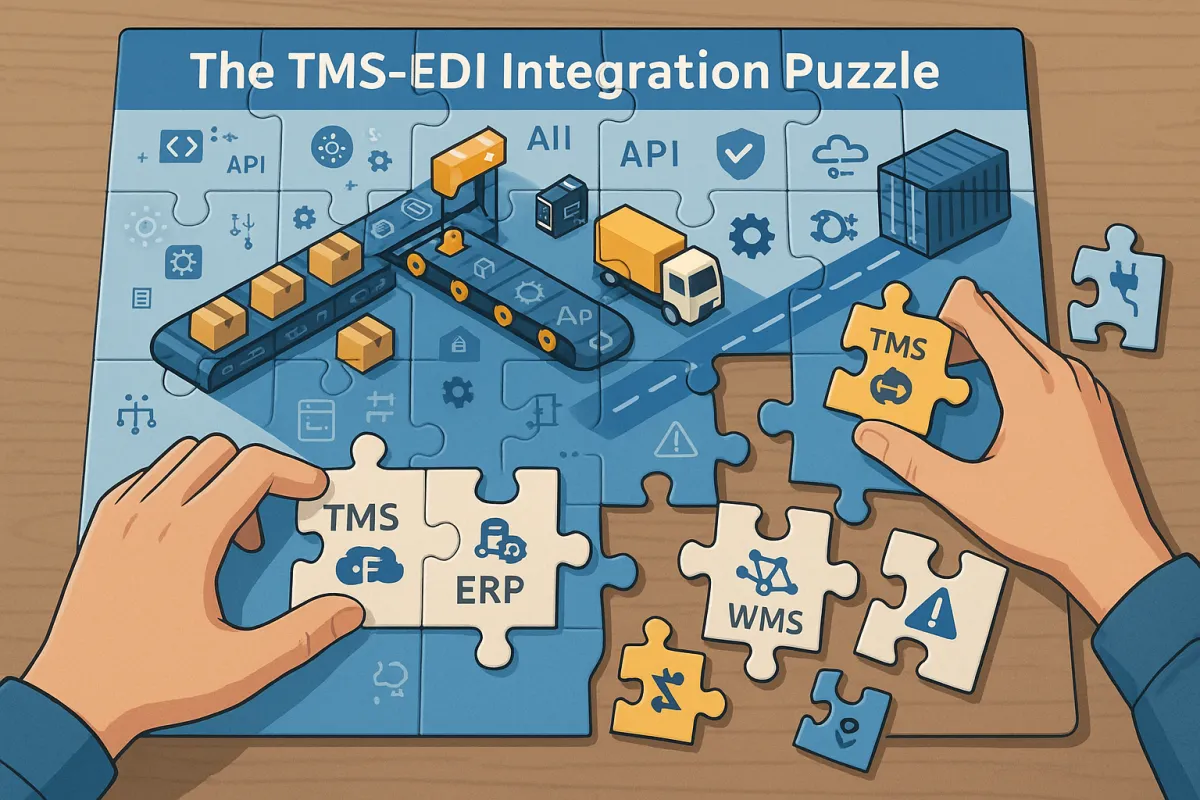
TMS vendors just announced another record quarter, yet over 80% of businesses have experienced a supply chain disruption in the past 12 months, highlighting the fragility of global supply operations. Because TMS and EDI systems are deeply connected, even minor mismatches between the two systems can lead to costly disruptions. The numbers behind this crisis tell a story procurement teams need to understand: for automotive manufacturers, downtime costs an astonishing $22,000 per minute. This figure alone demonstrates why proper EDI implementation is not merely a technical concern but a critical financial imperative.
While the 2026 Gartner Magic Quadrant for Transportation Management Systems shows leaders like Blue Yonder, Oracle, SAP, and Manhattan Active continuing to dominate, the evaluation criteria most companies use completely miss the EDI integration capabilities that separate successful implementations from costly disasters. WiseTech Global's $2.1 billion acquisition of E2open signals the beginning of an unprecedented consolidation wave, while Descartes Systems Group has acquired Columbus, Ohio-based 3Gtms for $115 million USD in cash, fundamentally reshaping your vendor options.
The Real Cost of Poor TMS-EDI Integration Planning
European manufacturers are discovering integration costs the hard way. In a comprehensive analysis of EDI integration failures, 66% of organizations reported losing up to $500,000 in 2020 due to non-compliance issues. EDI errors cost businesses between 1% and 5% of gross invoice amounts in retailer chargebacks alone. A company shipping $80 million annually could face up to $4 million in deductions.
The symptoms of integration strain show up in predictable patterns. Every TMS platform structures its data differently. Without precise mapping between new and existing fields, critical information can be dropped or misrouted. Sound familiar? Older EDI connections often rely on protocols like FTP or AS2. If the new TMS doesn't support those methods or supports them differently, message delivery can fail entirely.
Here's what most TMS evaluations miss: each EDI dispute requires approximately 2 hours to resolve, and 5-25% of inbound orders experience preventable errors that consume team capacity. When you multiply this across your full trading partner network, the operational overhead becomes staggering. Nearly one-quarter of companies (24%) lose $500,000 or more annually to integration issues related to their supply chains. These losses stem largely from communication failures between partners.
Core EDI Integration Capabilities Every TMS Must Have
Building resilient TMS-EDI integration requires specific technical capabilities that many procurement teams overlook. Start with standards support. Trading partners such as Walmart EDI, Target EDI, and Costco EDI now expect retailers, brands, and distributors to meet strict compliance rules, faster turnaround times, and more complex scenarios, while supporting multiple transports: AS2, SFTP/FTP, VAN, APIs, and portal automation. Common documents: POs, invoices, ship notices, inventory, remittance, and returns.
Modern TMS platforms need hybrid EDI-API capabilities. You often need both: EDI messaging plus real-time API data. Ask if the platform natively supports hybrid EDI + API workflows. Confirm how it handles legacy XML/flat file formats. The reality? Organizations often consolidate EDI with peripheral systems of record, such as an ERP or TMS. These consolidations can lead to significant shortcomings and unintended consequences.
ERP, TMS, and WMS tend to have very lightweight EDI processing. When evaluating platforms like Oracle TM, SAP TM, Manhattan Active, Blue Yonder, or emerging solutions like Cargoson, you need dedicated EDI assessment beyond the basic TMS functionality checklist. The EDI software market is large but a lot of players are not innovative; especially integrated EDI solutions inside ERPs, TMSs, and WMSs. For ERP, TMS, and WMS providers, it would not be a worthwhile investment to innovate their EDI modules as it is not their main service, capability, or function.
The TMS Vendor EDI Assessment Matrix
Your evaluation framework needs to address technical design versus workflow alignment issues systematically. Trying to integrate all of this without a clear architecture produces a fragile mess that breaks every time a customer adds a new EDI partner or a telematics vendor updates their API. The integration patterns that hold up in logistics follow a few rules: an event-driven backbone for load and status events (not point-to-point spaghetti), a standardized EDI translation layer that isolates customer-specific quirks from downstream systems, a master data hub for customers, locations, and carriers, contract-versioned APIs between the TMS and consumers.
Build your assessment matrix around these core areas:
Standards Compatibility Testing: GS1 EDI: Part of the overall GS1 system, GS1 is effectively a subset of EDIFACT that is popular within global supply chains. You also need to make sure that your system is able to accommodate a number of different transmission protocols. These include repurposed protocols such as FTP, SFTP, and HTTP, and EDI-specific protocols like OFTP, X.400 and AS2.
Implementation Methodology Evaluation: When comparing platforms like Descartes, MercuryGate, FreightPOP, or Cargoson, examine their partner onboarding process. According to industry analysts, up to 75% of all EDI migrations fail, with many of these failures stemming from inadequate EDI functionality within ERP systems. These built-in tools typically offer only lightweight EDI processing that lacks the depth and flexibility needed for modern supply chains.
Testing and Validation Requirements: Neglecting thorough end-to-end testing stands as one of the most overlooked pitfalls in EDI ERP integration projects, often leading to catastrophic failures when systems finally go live. This critical mistake frequently separates successful implementations from those that cost companies millions in emergency fixes and lost business.
Trading Partner Onboarding Speed Assessment
Cloud-based architecture can reduce onboarding timelines from weeks to days, but only if properly implemented. A modern EDI integration platform makes it easy to onboard and maintain partners: Libraries of prebuilt trading-partner profiles (e.g., Walmart, Target, Costco) with ready-to-use maps and rules. When evaluating platforms like ShippyPro, Sendcloud, ShipStation, or Cargoson, focus on their specific partner network depth rather than general connectivity claims.
Partner requirement complexity varies dramatically across industries. A single retailer may require a unique variation of what should be a standard EDI 850 purchase order. One automotive manufacturer discovered they needed 47 different mapping variations for the same transaction type across their supplier base. This complexity explains why don't underestimate the challenge of onboarding a supplier with little experience using EDI.
API-first approaches can accelerate connectivity when implemented correctly. Look for an EDI integration platform that can mix EDI with non-EDI formats (XML, JSON, CSV) and convert seamlessly between them. Modern EDI software should dramatically cut down the tedious work of mapping and testing: Graphical mapping tools for building and maintaining maps without deep EDI expertise. AI or rules-based auto-mapping to suggest field matches and transformations.
Real-Time Visibility and Error Management Evaluation
Legacy systems create visibility gaps that cost companies millions in reactive troubleshooting. Research shows that the average manufacturer deals with 800 hours of downtime per year – or more than 15 hours per week – and the costs can be outrageous. Just for perspective, consider that the average automotive manufacturer loses $22,000 per minute of downtime.
When evaluating monitoring capabilities of platforms like Shippo, EasyPost, ClickPost, or Cargoson, examine their real-time alerting systems. Real-time dashboards of all EDI transactions across partners and business systems. Drill down to document-level status (accepted, rejected, in error, reprocessed). Configurable notifications on failures, SLAs, or specific partner flows. Exception queues with root-cause context and tools to automatically fix and retry.
Modern platforms should resolve most errors automatically. This is where modern EDI automation strategy pays off. The platform should resolve most errors automatically (retries, reformatting, enrichment), with only edge cases needing human review. The technical requirement? Proactive connection monitoring identifies transmission failures within seconds rather than hours. Automatic retry logic with exponential backoff handles transient failures without human intervention. Alerting systems notify the right teams when retries are exhausted so they can escalate with the trading partner or VAN.
Implementation Success Factors and Vendor Selection Criteria
Your final decision framework must account for the current vendor consolidation environment. Companies undergoing integration often experience 12-18 months of reduced innovation while they harmonize platforms and teams. When your vendor becomes an acquisition target, you inherit integration risks and delays without managing the project directly.
Speed to production advantages become more important during market uncertainty. Plan for 8–12 months to implement properly—not the "weeks" you'll hear in sales calls. In 2026, TMS selection has shifted from feature shopping to execution risk management. The evidence points to a 76% failure rate for logistics transformations, with integration friction (legacy formats vs JSON APIs) and hidden costs as recurring drivers.
ROI measurement must extend beyond simple cost calculations. European shippers face a sobering reality: 66% of technology projects end in partial or total failure, yet companies that properly plan their EDI integration assessment typically see measurable improvements within the first year. Include metrics for reduced manual data entry, faster partner onboarding, improved compliance accuracy, and enhanced supply chain visibility when building your business case.
The post-consolidation landscape offers three distinct vendor categories for your evaluation: global mega-vendors (Oracle TM, SAP TM, E2open/WiseTech, Descartes), European specialists (Alpega, nShift, Transporeon), and emerging European-native solutions like Cargoson that maintain development focus specifically on European regulatory requirements. Each presents different risk-reward profiles for long-term EDI integration success.
Your procurement timeline matters more than ever. eFTI platforms can start operations in January 2026, with full enforcement on July 9, 2027. If you touch EU freight, treat data exchange as a contractual requirement. Get dates, scope, and remedies in writing (not 'roadmap'). Companies that secure EDI-capable TMS platforms before market consolidation eliminates choices position themselves to navigate 2026's perfect storm successfully.