The Critical PEPPOL AS4 Integration Framework: How to Migrate EDI Systems from AS2 to AS4 Protocol Requirements Without Breaking Supply Chain Operations in 2026

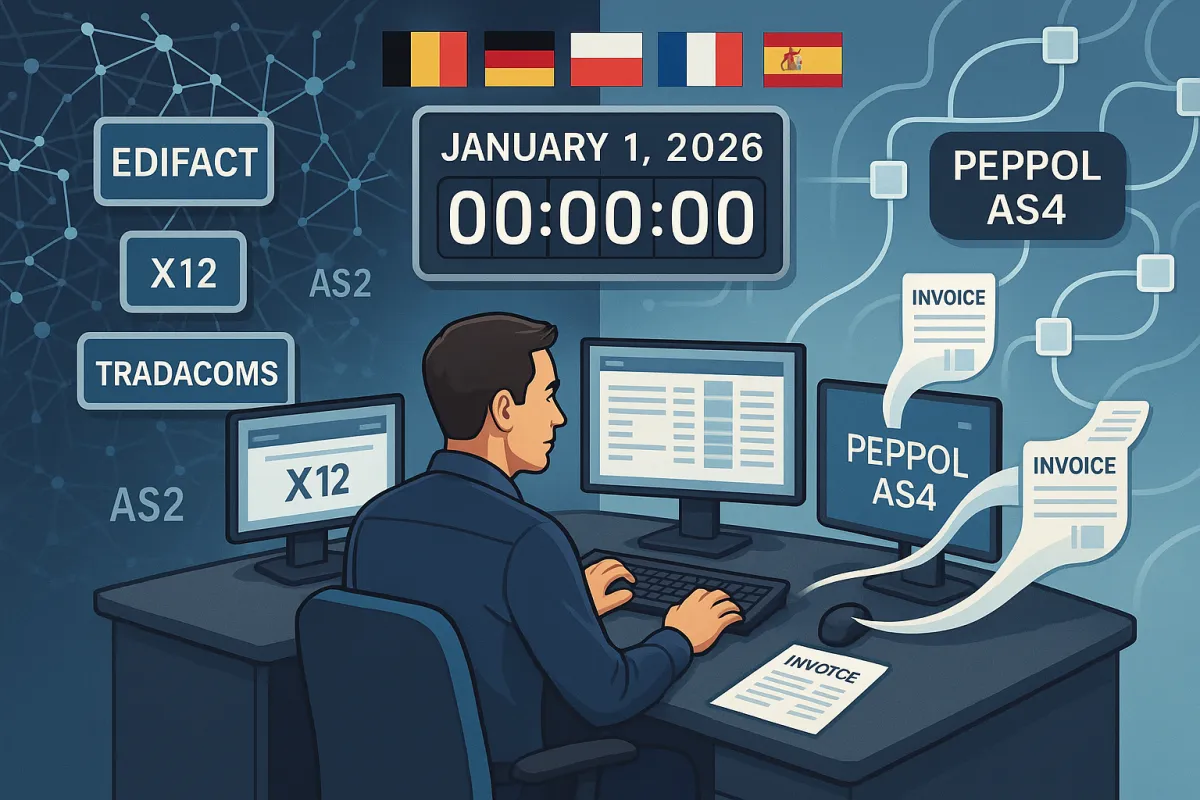
Belgium's January 1, 2026 mandate requiring all VAT-registered businesses to exchange B2B invoices via the PEPPOL network caught many EDI managers off guard. While they scrambled with PEPPOL registration, the deeper technical challenge sits beneath: AS4 is the mandatory transport protocol in the PEPPOL eDelivery network since February 2020. Your existing AS2-based EDI workflows and TMS integrations need complete architectural changes, not just new message formats.
The reality hits hardest for teams managing complex supply chains where fines start at €1,500 for technical non-compliance, escalating to €5,000 for repeated violations. But penalties represent just one risk. Belgium plans real-time reporting from January 2028, integrating tax authorities directly into transaction flow, meaning today's integration decisions determine your readiness for future compliance mandates across Europe.
The PEPPOL AS4 Mandate Reality: Why Traditional EDI Systems Face Compliance Crisis in 2026
All Belgian VAT-registered businesses must issue structured e-invoices using the PEPPOL network, complying with EN 16931 standard starting January 1. This isn't just another EDI format change. The mandate fundamentally alters how your systems communicate with European trading partners.
The enforcement structure creates immediate operational risks. Technical readiness penalties apply when companies cannot issue or receive structured e-invoices through PEPPOL-compliant systems. Your current AS2 connections to Belgian suppliers become non-compliant overnight.
Belgian authorities implemented a three-month grace period ending March 2026, but only for businesses demonstrating active compliance efforts before the deadline. PDF invoices via email become invalid, regardless of encryption or digital signatures your current workflows include.
Belgium, Germany, and Poland mandate PEPPOL for B2B transactions as of 2026, with France and Spain adding PEPPOL support alongside national systems. This positions Belgium as the leading indicator for European EDI requirements, not an isolated compliance burden.
AS4 vs AS2: Understanding the Protocol Architecture Differences That Impact EDI Integration
AS4 messages must be signed and encrypted, with exactly one encrypted payload as Standard Business Document (SBD). Your existing AS2 infrastructure cannot process these requirements without substantial modifications.
The technical architecture differences create integration complexity beyond message formatting. AS4 runs on SOAP/WSDL using HTTP as communication protocol, securing document exchange through TLS and WS-Security for encryption. Your AS2-based TMS connections rely on different security models that don't translate directly.
AS4 offers better support for modern security standards, improved error handling, and native support for large file transfers compared to AS2. However, these advantages require rebuilding message processing logic, not just updating transport protocols.
TMS vendors like Cargoson, MercuryGate, and nShift face similar architectural decisions. Some offer native AS4 support, others require middleware solutions, and many still evaluate integration strategies. Your vendor's approach determines implementation complexity and ongoing maintenance requirements.
The Hidden Integration Complexity: Why Standard EDI-to-AS4 Migration Approaches Fail
The common pitfall: adding PEPPOL as afterthought where ERP generates PDF or flat file, converter turns it into UBL, result gets pushed to Access Point - works until edge cases with cross-border VAT rules. This describes exactly how most EDI teams approach PEPPOL integration.
The scheme identification challenge exemplifies deeper issues. PEPPOL participant identifiers must match exact format requirements for each country and entity type. Getting the scheme ID wrong represents the most common integration error, causing message rejection even when invoice content validates correctly.
Your existing EDI workflows likely handle VAT calculations differently across trading partners. PEPPOL's structured approach requires consistent VAT handling that may conflict with customer-specific EDI customizations you've built over years.
One-Way/Push is the only exchange pattern supported by OpenPEPPOL, while One-Way/Pull and Two-Way/Push patterns are prohibited. TMS systems designed around polling mechanisms or synchronous acknowledgments need architectural changes to support PEPPOL messaging patterns.
The TMS-PEPPOL Integration Architecture Decision Framework
Access Points must be certified by PEPPOL Authorities before joining production network, ensuring compliance with technical and governance requirements. This certification requirement affects whether you build direct integration or partner with certified providers.
Building direct AS4 integration requires substantial technical investment. Implementation requires following detailed technical specifications for AS4 message exchange patterns, obtaining valid certificates from approved authorities, and ensuring adequate infrastructure for message volumes.
Certified Access Point providers like EDICOM, Comarch, Tradeshift, and others handle protocol compliance, certificate management, and PEPPOL network connectivity. Your decision framework should evaluate internal IT capabilities, compliance requirements, and total cost of ownership.
TMS integration strategies vary significantly. Cargoson and other cloud-native platforms often provide built-in PEPPOL connectivity. Legacy TMS installations may require separate middleware or API bridges. Hybrid approaches combining internal TMS capabilities with external Access Point services offer flexibility but increase complexity.
Step-by-Step AS4 Protocol Implementation Strategy for EDI Teams
New Access Point implementations must support AS4 as primary protocol, with existing AS2 deployments planning migration within OpenPEPPOL timeline. Your implementation roadmap should prioritize AS4 compliance while maintaining existing AS2 connections during transition.
Start with technical requirements assessment. All PEPPOL communications require TLS 1.2+ for transport encryption, XML digital signatures for document integrity, certificate-based authentication of Access Points, and authorization validation through SMP lookup.
Certificate management becomes critical operational requirement. PEPPOL PKI certificates require regular renewal and proper key management practices. Many EDI teams underestimate the ongoing operational overhead of certificate lifecycle management.
Message processing logic needs complete redesign. PEPPOL AS4 messages must use MIME encoding for transmission, with exactly one encrypted payload as Standard Business Document. Your existing message parsing and routing logic requires modification to handle SBD wrapping and AS4 message structure.
Vendor integration strategies differ substantially. Established EDI providers like IBM Sterling, Cleo, and SPS Commerce offer varying levels of AS4 support. Some provide complete PEPPOL integration, others require additional modules or third-party partnerships.
Testing and Validation Framework to Prevent Production Failures
Complete comprehensive testing in PEPPOL test environment before certification for production deployment. The PEPPOL test network allows validation of message formatting, protocol compliance, and error handling scenarios.
Common failure scenarios include certificate validation errors, message size limitations, and SMP lookup failures. PEPPOL Access Points must support messages up to 100 MB for post-award services and up to 2 GB for pre-award procurement.
Testing should validate duplicate message handling, timestamp validation, and error response processing. AS4 processing includes duplicate checking via MessageId comparison, timestamp validation with configurable tolerance, and proper error response generation.
Integration testing with your TMS systems should cover document flow from internal systems through AS4 transport to PEPPOL network delivery. Many implementation failures occur at interface points between internal systems and AS4 message processing.
Future-Proofing Your EDI Architecture: Beyond 2026 Compliance Requirements
Belgium's future e-Reporting system planned for 2028 uses 5-corner model adding near real-time transaction reporting to tax authorities, built on PEPPOL-based exchange. Your AS4 integration decisions today determine readiness for continuous compliance monitoring.
The regulatory trajectory across Europe suggests PEPPOL becomes the standard B2B communication infrastructure. Belgium's mandate represents broader modernization triggered by ViDA framework affecting multiple countries. Investment in AS4 capabilities provides foundation for expansion into additional European markets.
API-first architecture strategies become increasingly important. Modern TMS platforms combining traditional EDI support with RESTful API capabilities offer more flexible integration options. This hybrid approach supports both legacy trading partner requirements and modern digital compliance mandates.
Consider how AS4 integration supports broader digital transformation initiatives. Structured invoice data flows enabled by PEPPOL compliance can enhance analytics, automate accounting processes, and improve cash flow management beyond basic compliance requirements.
Vendor Selection Criteria: Evaluating AS4-Capable EDI and TMS Solutions
Evaluate current vendor capabilities systematically. TMS vendors vary significantly in AS4 readiness. Some platforms like Cargoson offer integrated PEPPOL connectivity, while others require separate middleware or partnerships with certified Access Point providers.
Protocol support depth matters more than feature lists. AS4 implementations must conform to CEF eDelivery AS4 Profile and OpenPEPPOL specifications that restrict optional features. Vendors claiming AS4 support may not handle PEPPOL-specific requirements correctly.
Migration support strategies differ substantially between vendors. Some offer automated conversion tools, others provide consulting services, and many expect customers to handle integration complexity independently. Evaluate vendor support capabilities alongside technical features.
Ongoing compliance management becomes critical operational factor. Certificate renewal, specification updates, and network connectivity monitoring require continuous attention. Vendors offering managed services may provide better long-term value than self-managed implementations.
The January 2026 deadline approaches rapidly, but thoughtful AS4 integration today positions your organization for European digital compliance requirements extending well beyond Belgium. Start with technical assessment, select appropriate vendor partnerships, and implement comprehensive testing before production deployment. Your AS4 integration strategy determines not just 2026 compliance, but competitive advantage in European markets for years ahead.