The Orderful Mosaic AI-Native EDI Revolution: How Transportation Management System Vendors Must Adapt Their Integration Strategies to Compete in 2026's Changing Market

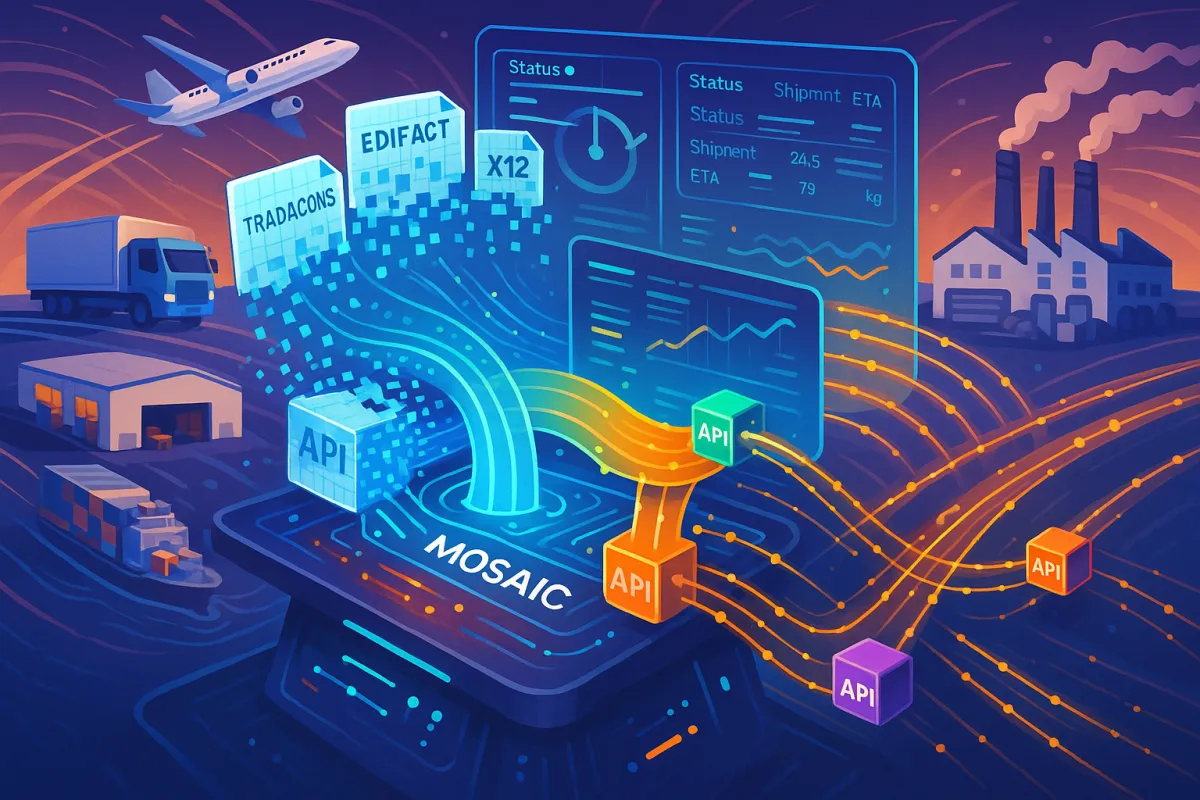
Orderful launched Mosaic on December 15, 2025, marking a significant shift in EDI integration with the industry's first AI-native platform that eliminates manual mapping entirely and reduces what used to be a years-long problem to weeks-long implementations. This creates new challenges for TMS vendors who must now compete against platforms that automatically adapt to trading partner requirements, with AI that understands each partner's unique specifications and adjusts payloads in real time.
The transportation industry is experiencing a definitive pivot from EDI to API-first integrations in 2026, with modern transportation software increasingly providing real-time rate access, smoother onboarding, and high-fidelity shipment status updates. This shift puts pressure on TMS vendors to modernize their integration strategies quickly, especially as getting a TMS to talk cleanly to your ERP, WMS, carrier base, and visibility tools remains harder than it should be for mid-market shippers without dedicated IT teams to manage EDI connections and API configurations.
How Mosaic Transforms Traditional EDI Integration Challenges
Mosaic runs on Orderful's proven EDI network while introducing a new interface layer that removes the complexity of legacy X12 and EDIFACT formats, normalizing partner variance behind a single consistent interface where AI interprets each partner's requirements automatically. The platform addresses a fundamental problem: EDI complexity is not a document format problem but a partner-variance problem, as every trading partner implements the same standards differently.
Traditional TMS-EDI integrations require building custom maps for each trading partner, but Mosaic relies on AI to interpret, adapt, and transform data, learning from Orderful's network of over 10,000 trading partners and absorbing decades of partner rules, document behaviors, and edge cases. When a trading partner changes their requirements, the network adapts automatically with no remapping needed.
The platform shifts from most legacy EDI flows that live outside the ERP and are fragile, fragmenting visibility and breaking under system changes to EDI built into your ERP with pre-built connectors for SAP, NetSuite, and Dynamics, eliminating middleware and shadow systems.
The New TMS Vendor Evaluation Framework
The emergence of AI-native EDI platforms forces transportation management system buyers to rethink their integration criteria. Vendor selection criteria must prioritize API maturity over feature checklists, with solutions from providers including Cargoson, MercuryGate (now Infios), Descartes, nShift, and Manhattan Active demonstrating varying approaches to API-first architecture.
AI is no longer a feature to evaluate as a line item, as TMS platforms now require API connectivity to large language models like OpenAI's ChatGPT and Anthropic's Claude at minimum. This capability enables analysts to pull operational data and run sophisticated queries, building custom reports and generating scenario analyses without needing data science teams, turning the TMS from a transaction system into an analytical engine.
The regulatory landscape adds urgency to these decisions. European manufacturers face the eFTI Regulation applying in full from July 9, 2027, requiring QR code generation and machine-readable format requirements for every shipment across all transport modes. Basic API integrations cost €5,000-€15,000 while complex ERP connections exceed €50,000, with European procurement teams facing 15-25% budget increases in 2026-2027 if reactive.
Hybrid EDI and API Requirements
Modern TMS buyers need platforms that support both technologies. EDI will remain for large carriers and structured freight networks, but APIs will power high-volume, time-sensitive, and cross-border operations. Companies increasingly need hybrid approaches that leverage both EDI messaging and real-time API data, as EDI showed clear limitations in 2025 with delays in status updates, inconsistent message quality, and slow onboarding pushing companies toward API-first connectivity.
TMS connectivity has improved significantly, with vendors shipping more prebuilt connectors and cleaner links between TMS applications and enterprise systems. However, enterprises running SAP ECC or Oracle E-Business Suite incur integration bills of USD 500,000 to USD 3 million when layering a cloud TMS, as legacy systems lack modern APIs.
Impact on Traditional TMS Vendor Strategies
The vendor consolidation wave amplifies competitive pressure. WiseTech Global's $2.1 billion acquisition of E2open and Descartes Systems Group's acquisition of 3GTMS for USD 115 million represent the most significant vendor consolidation wave in TMS market history, with Körber's transformation of MercuryGate into Infios following their 2024 acquisition.
Europe could lack over two million drivers by 2026, impacting half of all freight movements, while unfilled driver positions for heavy goods vehicles in Europe have surged to 426,000 in 2024. This capacity crisis forces TMS vendors to provide better marketplace integrations and carrier connectivity options.
Leading vendors are adapting their strategies differently. Manhattan's total cost of ownership ranks as relatively high, while cloud-native solutions like Cargoson focus on reducing implementation complexity through pre-built integrations and European carrier connectivity, building true API/EDI connections with carriers rather than requiring standardized EDI messages that carriers must implement themselves.
The Marketplace Integration Imperative
Vendors must now offer integrated marketplace capabilities to help shippers access alternative capacity. Spot market access capabilities separate capacity-resistant platforms from traditional contract-focused systems, with platforms integrating with spot market networks like Uber Freight, nShift's broader network, or FreightPOP's multi-carrier connections.
Traditional carriers require access through standard EDI formats that carriers must implement, while modern platforms build true API/EDI connections with carriers, not just accounts in software or standardized EDI messages that carriers must implement themselves. Established enterprise vendors like Oracle, SAP TM, and MercuryGate increasingly offer marketplace connectivity, while platforms like Cargoson provide European-focused integration capabilities specifically designed for shipper workflows with European-specific regulatory compliance.
Cost and Implementation Implications for TMS Buyers
Software generated 69.83% of revenue in 2025, yet services are expanding at a 9.37% CAGR as enterprises demand consulting and integration, with AI-infused modules driving new consulting work because training prediction models demands historical shipment data cleansing and parameter optimization.
High-end enterprise pricing typically starts at $30,000-$100,000 annually, with implementation costs sometimes reaching six figures and requiring significant investment in both cost and implementation time. However, cloud TMS implementations often conclude within eight weeks, compared to 6-18 months for traditional systems, which matters when European transport regulations change frequently or when expanding into new markets.
The complexity varies significantly by vendor approach. Single-vendor solutions like Alvys TMS offer distinct advantages with native EDI engines for seamlessly integrated communication, with no need for third-party EDI, costly custom integrations, or per-transaction charges, reducing total cost of ownership and integration complexity.
What TMS Vendors Must Do to Compete
TMS vendors must transform their platforms to compete against AI-native EDI solutions. Many ERP, TMS and WMS platforms now come with native AI and even agentic capabilities, with workflow-focused platforms adding more agentic AI features that can sit on top of core systems like ERP.
AI is no longer a bolt-on feature but the connective tissue of advanced transportation management systems, with smart algorithms that anticipate disruptions, suggest alternate carriers, and adjust plans automatically when variables shift, providing actionable recommendations based on historic patterns and live signals.
Regulatory compliance becomes a competitive differentiator. Leading TMS providers like MercuryGate, Descartes, and Cargoson are already preparing eFTI-compatible solutions, requiring evaluation of each vendor's specific experience with EU compliance requirements rather than general API connectivity claims.
Integration Architecture Requirements
Organizations are seeking full integration across the entire supply chain ecosystem: ERP, WMS, planning systems, visibility platforms, and financial tools, with the objective to eliminate data silos and latency, enabling faster, more aligned decision-making and greater agility with reduced manual effort.
API allows transportation management systems to transmit data in less than a second with cloud-based solutions, but integration quality matters more than speed. Vendors must ensure their platforms can connect seamlessly to road hauliers using different telematics systems, rail operators with varying data standards, and maritime carriers managing container tracking through diverse port systems.
Transportation management will center on real-time coordination, AI-assisted decisions, and cleaner integration across the entire planning-to-execution spectrum, with AI integrating more deeply into TMS workflows while remaining decision support rather than autonomy.
Strategic Recommendations for Supply Chain Teams
European shippers who act decisively within the next 90 days with proper frameworks that account for both capacity and consolidation scenarios position themselves to navigate 2026's perfect storm successfully, while those who delay risk joining the statistics of failed implementations and budget overruns that plague reactive procurement strategies.
Start evaluating API-first TMS platforms now, while vendor options remain diverse and implementation timelines allow for proper testing, as European transport operations require reliable connectivity—the question is whether you'll build it proactively or reactively.
Your evaluation framework should focus on practical implementation approaches. Phased deployment minimizes operational risk while building internal confidence in marketplace connectivity, starting with non-critical lanes or spot freight before expanding to core transportation volumes, with Phase 1 focusing on establishing technical connectivity and testing rate accuracy against contracted benchmarks.
Companies that modernize incrementally, rather than overhaul everything at once, will see the strongest and most reliable gains, with modernization efforts continuing to focus on practical outcomes like reducing manual load, accelerating tender cycles, and improving ETA reliability rather than chasing sweeping transformations.
The window for optimal procurement is narrowing. The procurement window for securing optimal TMS platforms before vendor consolidation eliminates choices and capacity shortages worsen cost structures runs through Q1 2026, giving approximately 3-4 months of leverage before capacity tightens again.