The Self-Service EDI Revolution: How to Implement AI Assistants That Transform Complex B2B Integration Into Conversational Operations for Non-Technical Supply Chain Teams in 2026

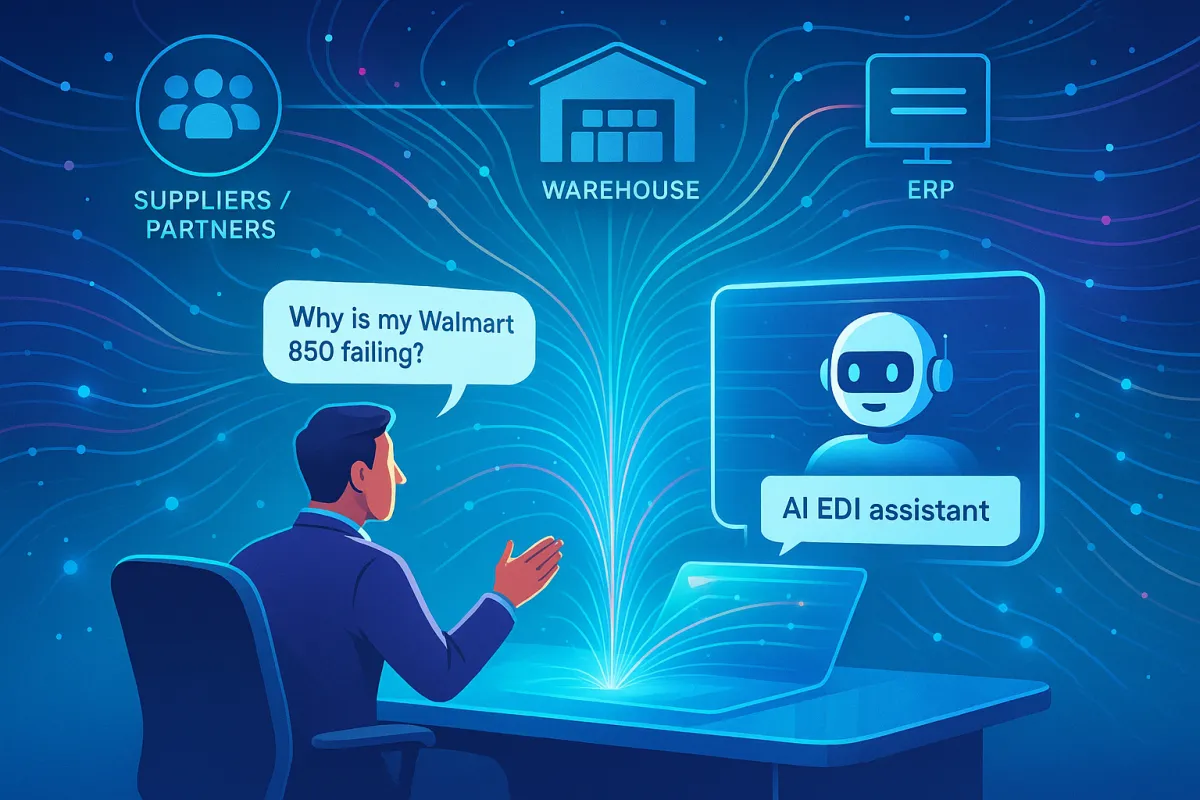
Major EDI vendors have recently rolled out natural language processing interfaces that allow nontechnical team members to interact with complex data using natural language, significantly reducing the time and effort required to search through vast amounts of transaction and trading partner data. This represents more than a user experience improvement—it transforms EDI into a self-service operation where procurement managers can troubleshoot issues without waiting for IT tickets.
The Natural Language EDI Management Revolution
Jitterbit announced the general availability of the Jitterbit EDI AI Assistant in April 2026, while TrueCommerce is embedding agentic AI across its platform to transform how customers onboard, integrate, and scale with trading partners. These aren't simple chatbots overlaid on existing systems. TrueCommerce's Truedi assistant delivers personalized guidance based on each customer's ERP, transaction type, and account context, learning continuously from real interactions.
The numbers speak volumes. TrueCommerce's agentic AI resolved 91% of issues in 2025, resulting in a 12% reduction in overall support cases. Jitterbit earned both "Best Estimated ROI" and "Highest User Adoption" badges in G2's Spring 2026 EDI reports. Traditional EDI management required specialized knowledge of X12 segments, EDIFACT loops, and connection protocols. Now, users can ask "Why is my Walmart 850 failing?" and get step-by-step resolution guidance.
This shift matters because supply chains must operate in a world of persistent complexity, and mid-market companies often have fewer buffers than large enterprises—so the ability to connect trading partners quickly, automate exceptions, and improve visibility is now a competitive requirement. The technical barrier that kept EDI locked in IT departments is dissolving.
Core Capabilities Assessment Framework for AI EDI Assistants
Not all AI EDI assistants work the same way. Cleo AI is embedded into the integration platform itself, enabling real-time intelligence and execution, trained on real supply chain transactions rather than generic LLM data. This distinction matters when evaluating capabilities.
Real AI EDI assistants should handle three core functions: rapid troubleshooting, self-service configuration, and data-driven insights. They should eliminate data silos between trading partners and ERP systems, ensuring consistent, high-speed data exchange essential for modern supply-chain agility. Key features include data-driven decision-making with searchable analytics based on date, partner, and document type, plus self-service configuration management that lets users instantly retrieve or update complex connection details without opening support tickets.
The difference between effective and ineffective AI lies in training data specificity. Generic language models struggle with EDI's structured complexity. AI can extract patterns and insights from EDI across different trading partners and business networks, and with structured, complete, and accurate EDI data, supply chain leaders can embed autonomous AI agents into EDI workflows to alert, interpret, act on, and optimize data in real time.
Look for platforms that demonstrate measurable outcomes. For companies prioritizing automation, scalability, and AI-driven workflows, advanced AI options are already operating at scale, while competitors like SPS Commerce, OpenText, and Cargoson are still developing their AI capabilities.
Implementation Readiness Evaluation Criteria
Your existing EDI complexity directly impacts AI assistant effectiveness. Organizations running simple ANSI X12 retail scenarios will see faster value than those managing custom EDIFACT variants across multiple VANs. Start by cataloging your current integration landscape: How many trading partners use direct connections versus VANs? Which document types generate the most support tickets?
Integration requirements extend beyond EDI protocols. AI assistants fully integrated with iPaaS platforms enable organizations to automate and orchestrate integrations between EDI, ERP systems, and other applications to boost overall operational efficiency. Your TMS, WMS, and accounting systems need seamless data flow. Modern platforms like Cleo, TrueCommerce, and Cargoson can bridge these connections, while legacy providers like IBM Sterling and OpenText often require additional middleware.
Security considerations become more complex with autonomous AI operations. Who can authorize trading partner changes? How do you audit AI-driven mapping modifications? Effective platforms blend natural language processing with low-code flexibility while grounding every action in secure enterprise data. This means role-based access controls, change logging, and clear escalation protocols when AI confidence drops below acceptable thresholds.
User Experience Design Principles for Conversational EDI
Successful conversational EDI interfaces anticipate common user scenarios. Procurement teams need different capabilities than IT administrators. A procurement manager might ask, "Which suppliers are late with ASNs this week?" while an EDI specialist needs, "Show me mapping errors in segment REF02 for partner ID 12345."
Design natural language queries that match business workflows, not technical structures. Instead of forcing users to understand ISA segments, let them search by "purchase orders from Home Depot last month" or "invoice rejections over $1000." Teams no longer need to be EDI experts or integration specialists to manage complex trading partner data—they can simply ask a question in natural language and get an actionable answer in seconds, removing technical barriers that used to slow operations.
Create escalation paths for complex scenarios. Context-aware AI understands the customer's profile and delivers knowledge needed to complete next steps, while implementation experts remain within reach. When AI confidence drops below 80%, automatically route to human experts with full conversation context. This hybrid approach maintains speed while preventing costly errors.
Confidence thresholds vary by task complexity. Simple status queries can operate at 70% confidence, while trading partner configuration changes require 95%. AI-powered platforms should identify discrepancies at the source, allowing resolution before fulfillment impact or costly retail chargebacks, backed by guaranteed response times.
ROI Measurement and Performance Optimization
Track reduction in support tickets as your primary ROI indicator. TrueCommerce's implementation resulted in a 12% reduction in overall support cases, while one organization saw a 90% reduction in time spent on manual EDI fixes after switching platforms, now spending less time resolving EDI issues and more time focusing on new business.
Measure user adoption across technical and non-technical teams separately. IT professionals adapt quickly to new interfaces, but procurement and supply chain teams need longer onboarding. Success metrics include: percentage of trading partner issues resolved without IT escalation, time from problem identification to resolution, and user satisfaction scores by department.
Monitor accuracy improvements in trading partner operations. Leading implementations achieve SLA error rate reductions from 4% to 0.24%, while partner onboarding times drop from eight weeks to less than three days—a 95% improvement. These improvements translate directly to cost savings: fewer chargebacks, reduced labor costs, and faster revenue recognition from new partnerships.
Compare against traditional EDI management baselines. Manual trading partner configuration typically requires 40-60 hours per partner. AI-assisted configuration reduces this to 8-12 hours while improving accuracy. Factor in reduced training requirements for new staff and decreased dependency on specialized EDI consultants when calculating total cost of ownership.
Security and Governance Framework for Autonomous EDI Operations
Establish bounded autonomy principles for AI decision-making. Define which tasks AI can complete independently versus those requiring human approval. Trading partner status updates and standard mapping corrections can run autonomously, while new partner setups or custom field mappings need human oversight.
Create comprehensive audit trails for AI-driven actions and recommendations. Every configuration change, mapping modification, and trading partner communication should log the triggering condition, AI confidence score, and outcome. This documentation proves essential during compliance audits and partner disputes.
Implement data privacy protections for trading partner information. Platforms must ground every action in secure enterprise data, but many organizations have contractual obligations limiting how partner data gets processed. Ensure your AI assistant respects these boundaries and can operate with masked or tokenized sensitive fields.
Design role-based access controls that align with business responsibilities. Procurement teams need visibility into partner performance and order status but shouldn't modify technical mapping configurations. Supply chain analysts require transaction-level detail for root cause analysis. Finance teams need invoice matching capabilities without access to operational EDI settings. Modern platforms like Cleo, Cargoson, and TrueCommerce offer granular permission structures, while legacy systems often use broad administrator roles.
Future-Proofing Your AI EDI Investment
Regulatory requirements continue evolving globally. The EU's eFTI regulation affects electronic freight transport information, while various countries implement digital customs requirements. AI-generated mappings will soon integrate with orchestration engines, enabling real-time validation and correction during partner onboarding, automating field matching and reducing setup time.
Plan for integration with emerging technologies and standards. API adoption accelerates as younger companies enter supply chains without legacy EDI infrastructure. Your AI assistant should handle both traditional X12/EDIFACT protocols and modern REST APIs seamlessly. For API-first connectivity requirements, some platforms focus specifically on modern protocols, while comprehensive solutions support hybrid environments.
Build scalable architectures that grow with your trading partner network. Enterprise-scale platforms process billions of transactions across retail, manufacturing, healthcare, and financial services, providing reach and reliability advantages for large enterprises with complex, globally distributed supply chains. Mid-market companies should evaluate whether their chosen platform can scale without architectural changes.
Position for the next wave of supply chain automation. Advanced AI platforms are embedding agentic solutions that move beyond reactive fixes to proactive decision-making with predictive anomaly detection and prescriptive action plans, helping customers make smarter decisions, achieve faster execution, and gain stronger supply chains. Your investment should support this evolution rather than limit future capabilities.
The era of technical EDI specialists as gatekeepers is ending. In 2026, AI will stop being a pilot conversation and become the engine that drives operational advantage. Organizations implementing conversational EDI interfaces now gain competitive advantages that compound over time: faster partner onboarding, reduced operational costs, and supply chain agility that adapts to market changes without expensive professional services engagements.