The 2026 Carrier API Migration Crisis: How to Future-Proof Your EDI and TMS Integration Architecture Before Vendor Consolidation Eliminates Your Options

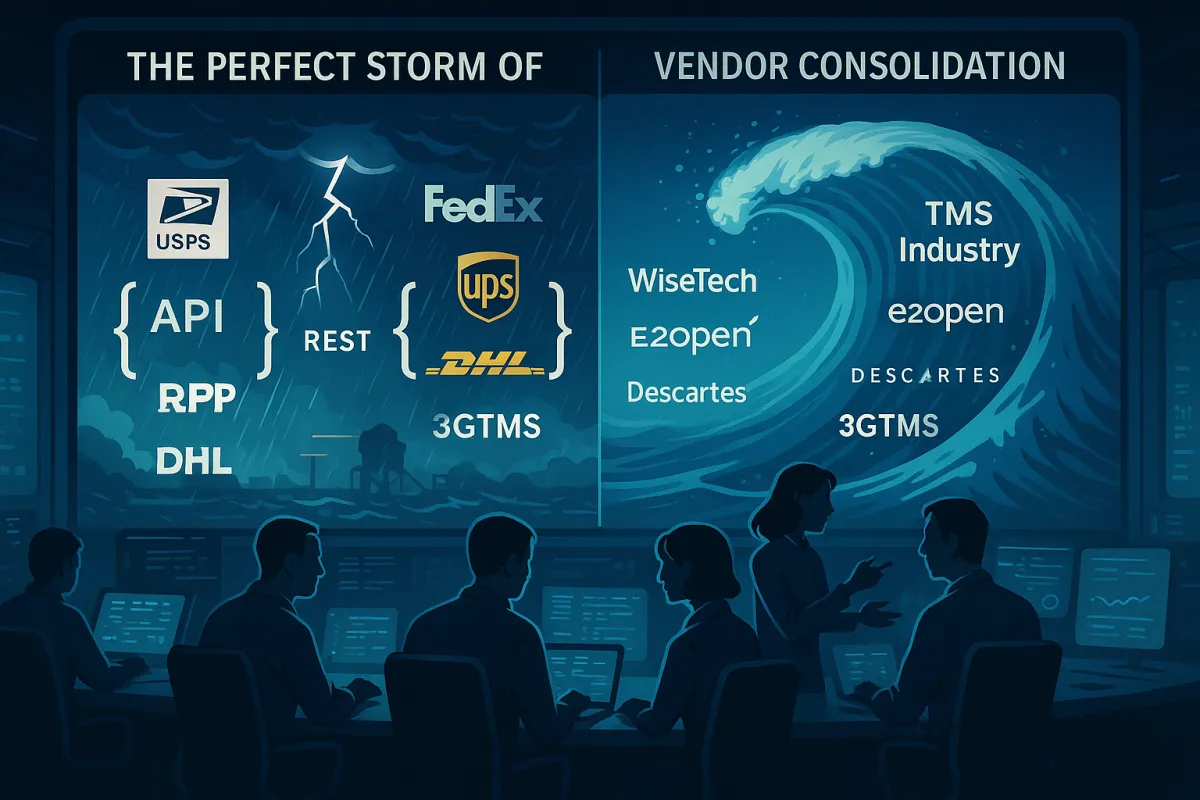
USPS switched off its Web Tools APIs (Version 3) in January 2026, and FedEx's remaining SOAP-based endpoints retire on June 1, 2026. WiseTech Global's $2.1 billion acquisition of E2open and Descartes' $115 million purchase of 3GTMS marks the most aggressive vendor consolidation wave the TMS industry has ever seen. For supply chain professionals managing complex EDI and TMS integration environments, this creates an unprecedented perfect storm requiring immediate strategic action.
Enterprise teams managing thousands of shipments daily face forced migrations under hard deadlines while dealing with aggressive rate limiting across all major carriers. The timing couldn't be worse. While you're struggling to rebuild carrier integrations that worked fine for years, companies undergoing integration often experience 12-18 months of reduced innovation while harmonizing platforms and teams. USPS's new APIs enforce strict rate limits of approximately 60 requests per hour, down from roughly 6,000 requests per minute without throttling in the legacy system.
The Perfect Storm: Why 2026 is the Critical Year for Integration Architecture
73% of integration teams reported production authentication failures within weeks of carrier API deployments that sailed through sandbox testing. This failure rate reveals the magnitude of what's happening. UPS migrated to OAuth 2.0 in mid-2023, transitioning from old access keys to a more secure model, with UPS phasing out its legacy APIs in 2025. What seemed like isolated carrier updates turned out to be a coordinated industry transformation.
The security drivers behind these changes go beyond simple modernization. Carriers faced issues with fraud and data security, with attackers actively targeting carrier APIs to scrape tracking data for phishing, intercept and reroute high-value shipments, or generate fake shipping labels. These aren't theoretical threats anymore. When FedEx and USPS observed similar attack patterns, they accelerated their own migration timelines.
The Hidden Costs of Delayed Migration
Each delay compounds your technical debt. Rate limits of 60 requests per hour versus the previous 6,000 requests per minute fundamentally break integration patterns that worked for years. P95 latencies spiked to 3.2 seconds during carrier rate limit events. When your TMS can't get real-time rates, manual processes multiply exponentially.
Even a 500ms call can back up flow, reroute packages to manual processing, and cause SLA failures or overtime costs. The cascading effect hits procurement teams hardest. Rate shopping becomes impossible when APIs time out unpredictably. Customer service volume increases as shipment visibility decreases. Finance teams face reconciliation nightmares when carrier data arrives hours late instead of real-time.
Understanding the Carrier API Migration Timeline and Impact
The migration isn't uniform across carriers, creating additional complexity for integration teams. FedEx moved away from older SOAP-based APIs toward modern RESTful APIs between 2022-2025, with legacy FedEx Web Services WSDLs disabled and replaced by FedEx REST APIs. After June 2026, integrations must use FedEx's REST APIs to access rates, labels, tracking, and future service updates.
The technical changes go deeper than authentication. The WSDL retirement means every integration touching FedEx services requires a complete rebuild, as existing SOAP calls don't map one-to-one to REST endpoints. Rate shopping, label generation, and tracking require new endpoint structures, different request formatting, and updated response parsing, with JSON payloads using different field names, nesting structures, and data types than SOAP XML.
The Security and Performance Drivers Behind the Changes
Major carriers made PKCE mandatory across their APIs, causing teams using older OAuth implementations to face authentication failures that monitoring systems classify as temporary network issues. The shift from simple API keys to OAuth 2.0 with PKCE (Proof Key for Code Exchange) represents a fundamental change in how your systems authenticate with carriers.
USPS recently modified address validation scopes to require additional permissions, with teams discovering this only when production requests started returning authorization errors despite valid tokens. These scope changes happen without advance warning, making your previously working integrations fail silently.
The TMS Vendor Consolidation Factor: Why Your Options Are Shrinking
The vendor consolidation happening simultaneously compounds migration pressure in ways most teams underestimate. The 2026 Gartner Magic Quadrant for Transportation Management Systems lands in the middle of the most aggressive vendor consolidation wave the industry has ever seen. Descartes' acquisition of 3GTMS for $115 million marks their 32nd acquisition since 2016.
WiseTech's $2.1 billion acquisition of E2open adds extensive cloud-based networks and customer reach with very little product overlap globally, expanding WiseTech beyond its traditional logistics service provider focus into global and domestic trade including transportation for buyers, importers, exporters, shippers, manufacturers and brand owners. This geographic and market focus shift creates uncertainty about feature development priorities.
The market now divides into distinct categories: global mega-vendors (Oracle TM, SAP TM, E2open/WiseTech, Descartes), European specialists (Alpega, nShift, Transporeon), and emerging European-native solutions like Cargoson that maintain development focus specifically on European regulatory requirements. Global mega-vendors provide comprehensive functionality and financial stability, but traditional providers like SAP TM and Oracle often struggle with localized European requirements, while European specialists maintain development resources focused exclusively on European market needs.
The Multi-Carrier Shipping Software Consolidation Wave
French supply chain software provider MyTower is accelerating the consolidation of the European market for software solutions dedicated to transport, customs and trade compliance. Backed since December 2025 by the investment fund Verto Growth, the group is joining forces with three recognized industry players — TDI, Winddle and Belharra e-SCM — to build a leading European player in transport digitalization for industrial shippers and retailers.
The Multicarrier Shipping Software Market size valued at USD 254.55 million in 2026 and is expected to reach USD 410.15 million by 2035, with over 65% of B2B shippers using 3 or more carriers, and 42% managing 5 or more carrier contracts. This growth comes precisely as vendor options contract through acquisition.
Integration platforms like Shippo, Cargoson, nShift, and ShipStation offer different approaches to carrier connectivity, but the consolidation wave affects each differently. Established multi-carrier platforms benefit from existing carrier relationships, while newer entrants face higher barriers to establishing those same connections.
Building a Hybrid EDI-API Integration Strategy That Survives Both Transitions
The solution isn't choosing between EDI and APIs—it's building systems that handle both seamlessly. Enterprise TMS platforms like Cargoson, Manhattan Associates, and SAP TM have already implemented FedEx REST endpoints and are managing dual-API operations for clients during the transition period. Enterprise shipping platforms like Cargoson, project44, and Descartes provide abstraction that handles carrier API changes, manages authentication complexity, and provides unified interfaces that survive individual carrier migrations.
Middleware architecture becomes crucial during this transition. Never switch entirely at once. Build adapter layers that can route requests to either legacy or modern APIs based on configuration flags, letting you test production traffic loads against new endpoints while maintaining fallback capability. This dual-mode operation protects against carrier downtime while providing migration flexibility.
When the new USPS API hits rate limits or returns errors, circuit breakers should immediately route traffic to backup services. Use retry logic to handle transient failures without disrupting the user experience, and set up failover logic to reroute traffic or trigger backups if the primary API goes down.
Your 90-Day Action Plan for API Migration and Vendor Risk Mitigation
Time is running out faster than most teams realize. The procurement window runs through Q1 2026—after which your leverage disappears as regulatory pressure forces decisions. Companies that haven't initiated TMS selection processes by mid-2026 will find significantly fewer viable options as vendors focus resources on existing customer compliance rather than new client acquisition.
Phase 1: Immediate Assessment (30 Days)
Start with a carrier dependency audit. Map every system that touches USPS Web Tools or FedEx SOAP. Include your ERP, WMS, TMS, and any custom applications that handle shipping data. Don't overlook third-party integrations that might rely on legacy APIs without your direct knowledge.
Test your authentication flows now. UPS APIs typically respond within 200-400ms for authentication requests, while DHL SOAP endpoints take 800-1200ms. When these baselines shift, it indicates infrastructure changes that affect your authentication flows before they cause outright failures. Establish monitoring that tracks these performance indicators as early warning signals.
Phase 2: Platform Selection (30 Days)
Evaluate vendors across the three categories that emerged from consolidation. Consider established platforms like MercuryGate, Descartes, E2open, Manhattan Active, Oracle TM, and SAP TM alongside European specialists like Alpega, nShift, Transporeon, and modern alternatives including Cargoson that focus specifically on European cross-border operations. Each offers different approaches to capacity shortage management and vendor consolidation risks.
Multi-carrier platforms like ShipEngine, Cargoson, and nShift maintain carrier relationship teams that receive advance notice of authentication changes. This advance warning becomes invaluable when carriers modify API requirements without public announcements.
Phase 3: Implementation and Risk Mitigation (30 Days)
Use parallel system approaches that reduce transition risks while maintaining operational continuity. Build phased implementation strategies that validate core functionality before adding complex integrations, prioritizing high-volume routes and critical compliance requirements. Don't attempt to migrate all carriers simultaneously.
Contract protection becomes essential during consolidation periods. Acquisition-resistant contracts require specific protections including 12-18 months advance notice for ownership changes, guaranteed functionality preservation for minimum periods, and migration assistance rights. Include specific clauses requiring advance notice of ownership changes, with automatic contract review rights triggered by acquisition announcements and price protection clauses locked for 24 months following ownership changes.
Future-Proofing Your Integration Architecture for Post-2026 Landscape
The companies that survive 2026's migration crisis won't be the ones with perfect technical execution. They'll be the ones who recognized that carrier integrations are infrastructure, not features, and invested accordingly. This means choosing platforms that handle both EDI and API integration types seamlessly rather than forcing a choice between them.
Enterprises report 25–35% reduction in manual shipping steps after deployment, while shipment error rates decline by 18–27% through rule-based automation. API-based integrations cover 95% of leading WMS and ERP stacks, enabling same-day onboarding within 7–14 days. These improvements only emerge when your underlying integration architecture supports both legacy and modern protocols simultaneously.
Modern platforms like Cargoson, alongside established players like Descartes and Manhattan Associates, are positioning for this hybrid future by building systems that treat EDI and APIs as different transport layers for the same underlying data flows. The competitive advantage lies not in choosing one approach over another, but in synchronizing both layers so seamlessly that your business logic remains independent of carrier communication preferences.
In 2026, more retailers will formalize structured approaches to alternative carriers, supported by multi-carrier shipping technology that makes those networks manageable at scale. For many, 2026 represents a turning point, where diversification becomes less of a strategic option and more of a competitive requirement. Your integration architecture needs to support this diversification without multiplying technical complexity exponentially.