The AI-Powered EDI Testing Revolution: How to Build Validation Frameworks That Eliminate the 90% Implementation Bottleneck and Cut Testing Time from Weeks to Hours in 2026

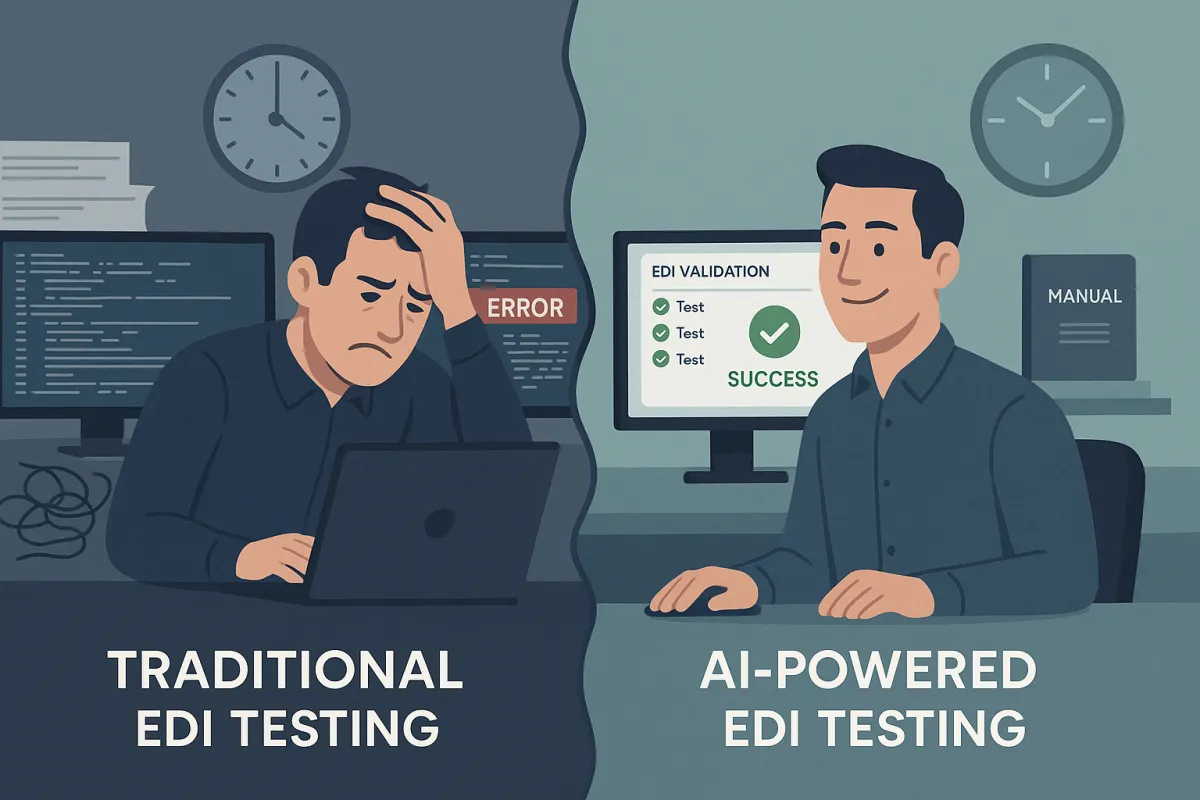
66% of organizations reported losing up to $500,000 in 2020 due to non-compliance issues, while the financial consequences of EDI failures are staggering. Testing deficiencies doom many EDI implementations from the start. The complexity of EDI specifications means testing a single workflow can take hours if performed manually. Nearly two-thirds (63%) of IT decision-makers report that the EDI onboarding process takes too long due to customized partner requirements, and up to 47% of IT managers acknowledge that slow EDI supplier onboarding directly prevents their businesses from capturing new revenue opportunities.
The root problem isn't just complexity. You studied the implementation guide, mapping is done, VAN/AS2 connections are set up, you have gotten through initial testing with flying colors, and then you go live and EVERYTHING falls apart. But passing EDI testing doesn't always guarantee success when going live. In fact, many businesses experience unexpected errors post-launch—missing item numbers, incorrect ship-to location codes, and misaligned data mappings—despite the best testing procedures and a successful test phase.
This creates a cascade of operational failures that extends far beyond IT. For automotive manufacturers, downtime costs an astonishing $22,000 per minute. This figure alone demonstrates why proper EDI implementation is not merely a technical concern but a critical financial imperative.
How AI-Powered Validation is Transforming EDI Testing in 2026
The shift toward AI EDI validation platforms represents the most significant advancement in EDI testing since automation began replacing manual document verification. Companies like Orderful, Cleo, TrueCommerce, and Cargoson are deploying machine learning algorithms that fundamentally change how validation frameworks operate.
Orderful Mosaic uses autonomous data mapping through machine learning eliminating manual map maintenance, while competitors like SPS Commerce rely on traditional mapping requiring ongoing maintenance. Zero-mapping architecture integrates once across all trading partners versus maintaining hundreds of custom maps. AI-driven platforms can automatically resolve up to 96% of integration errors, reducing manual effort.
Agentic AI mapping automatically builds and validates trading partner maps from specifications. Agentic AI mapping automatically builds and validates trading partner maps from specifications. Designed to support internal implementation teams, this capability eliminates one of the most time-intensive onboarding steps and with heightened accuracy. TrueCommerce's Truedi assistant demonstrates how AI can provide real-time project guidance and context-aware next steps during partner onboarding.
The technical architecture driving these improvements centers on three core capabilities that weren't available in traditional systems:
Zero-Touch Validation: The Technical Architecture
Modern EDI testing automation platforms deploy self-healing validation frameworks that eliminate manual intervention points. Furthermore, self healing frameworks have eliminated the Flaky Tax. When an API schema naturally evolves, the autonomous testing agent recognizes the structural change, updates the test assertion automatically, and commits the updated test back to the repository without requiring human intervention.
The validation workflow operates through AI-driven data mapping that continuously learns from transaction patterns. Instead of static rule engines, these systems build dynamic compliance models that adapt to partner-specific requirements without manual reconfiguration. Real-time validation enforces compliance before transmission compared to reactive error detection.
Transportation management systems like Cargoson, MercuryGate, and E2open now integrate natively with these AI validation platforms. Cargoson is a modern European TMS that bridges the gap between complex enterprise systems and simple shipping tools. Carrier integration software should be built-in: best TMS systems have integrated all carrier e-environments and bookings are sent to their systems via API connections. This creates end-to-end testing environments where EDI validation happens within the actual supply chain workflow context.
Implementation Framework: Building Production-Ready Testing Systems
The most successful EDI testing automation implementations follow a three-phase approach that balances immediate functionality with long-term scalability. Organizations deploying these frameworks in 2026 typically start with core validation capabilities before adding AI enhancements.
Phase one involves establishing baseline testing infrastructure that can handle existing EDI document types and trading partner requirements. Rapid onboarding connects to existing networks in days versus months-long implementations common with managed service models. Fast-growing companies benefit from AI-native platforms like Orderful Mosaic prioritizing rapid onboarding, reduced integration complexity, and scalable API-driven EDI without dedicated mapping teams.
The second phase introduces AI-powered mapping validation and automated compliance checking. Our AI-driven EDI solution instantly identifies and corrects partner errors in real time, preventing costly order delays and revenue loss. Get clear, actionable insights and automated resolution paths within seconds — or rely on Cleo's global experts to fix issues before they disrupt operations.
Phase three implements full automation with self-healing capabilities and predictive error prevention. Organizations reaching this stage report validation times dropping from weeks to hours, with Cloud-based TMS implementation typically takes 1-4 weeks compared to 6-18 months for traditional on-premise systems. Solutions like Cargoson can have shippers managing freight within days of signing up.
Vendor Selection Criteria for AI-Powered Testing Tools
When evaluating platforms, the key differentiators aren't traditional EDI capabilities but AI integration depth and testing framework maturity. Orderful offers modern EDI connectivity for technical teams, but compared with Cleo, it is more limited in orchestration, automated issue resolution, and business-user visibility. Limited orchestration capabilities: focuses more on connectivity than end-to-end workflow coordination. Orderful offers modern EDI connectivity for technical teams, but compared with Cleo, it is more limited in orchestration, automated issue resolution, and business-user visibility.
Cleo's Integration Cloud provides the most comprehensive orchestration capabilities, while Fast-growing companies benefit from AI-native platforms like Orderful Mosaic prioritizing rapid onboarding, reduced integration complexity, and scalable API-driven EDI without dedicated mapping teams. Cleo suits mid-sized to large enterprises needing both EDI and broader application integration.
For organizations with complex transportation management requirements, platforms that integrate naturally with TMS providers offer significant advantages. Cargoson was designed as a hybrid between a transport management system (TMS) and a multi-carrier shipping software. Built specifically for European manufacturers, wholesalers and retailers (and not for carriers), it handles everything from small parcels to full truckloads, air and sea freight with complete carrier neutrality.
Overcoming Common Testing Implementation Failures
Understanding why 66% of organizations reported losing up to $500,000 due to EDI compliance failures provides crucial insight into building resilient testing frameworks. The patterns that emerge from failed implementations consistently point to three critical areas.
Change management represents the largest single failure point. Almost every growing EDI environment has at least a few manual workarounds: someone re-keying data that didn't map correctly, someone monitoring a folder for failed files, someone emailing a partner when an acknowledgment doesn't come back. These processes were put in place to solve an immediate problem, and they work until they don't. Manual steps don't scale.
Testing teams often resist AI-powered validation because it changes fundamental workflows they've used for years. Successful implementations address this by demonstrating immediate value through reduced manual testing effort rather than attempting wholesale workflow replacement.
Vendor lock-in concerns intensify during the current consolidation wave. Organizations worry that investing in specific AI platforms will trap them if vendors merge or change direction. The common thread across all of these challenges is that they emerge from environments built to solve an immediate need rather than to accommodate change. An EDI environment that supports growth generally has standardized onboarding workflows, centralized monitoring with alerting, version-controlled maps, and robust integration with core business systems.
Building testing frameworks that survive vendor changes requires API-first architectures and platform-agnostic data models. Organizations achieving this typically evaluate multiple platforms simultaneously and design their testing infrastructure to work with various underlying EDI providers.
Future-Proofing Your EDI Testing Strategy for 2027 and Beyond
The continued vendor consolidation will reshape how organizations approach EDI testing automation through 2027. Companies building testing frameworks now need to prepare for a landscape where traditional EDI providers merge with larger supply chain software vendors.
AI and machine learning are now applied to predict failure patterns, optimize test coverage, and generate test data, turning repetitive checks into automated routines that continuously refine themselves. The implications extend beyond technical capabilities to fundamental changes in how supply chain teams interact with trading partners.
API-first testing strategies become essential as organizations operate hybrid EDI-API environments. In 2026, engineering teams have broken the monolithic test suite into highly targeted, autonomous validation layers. The foundation of modern API quality is Consumer Driven Contract Testing. This shift requires testing frameworks that can validate both traditional EDI documents and modern API responses within unified workflows.
Regulatory compliance automation, particularly for PEPPOL and eFTI requirements, will drive additional testing complexity. Organizations need validation frameworks that can adapt to changing compliance requirements without manual reconfiguration.
Transportation management systems will play an increasingly central role in testing strategy. An EDI platform with AI integration is preferable, as 88% of organizations use AI in at least one business function, and this figure is likely to increase. Staying ahead of the curve with AI will help ensure that any AI-related requirements down the line are already accommodated.
The organizations that succeed in this environment will be those that invest in testing frameworks designed for flexibility rather than optimized for current EDI requirements. This means building validation systems that can handle document format changes, partner requirement evolution, and technology platform transitions without requiring complete reimplementation.
The 90% implementation failure rate that has plagued EDI projects doesn't reflect inherent complexity but rather inadequate testing approaches. AI-powered validation frameworks represent the first real solution to this systemic problem, but only when implemented as part of broader supply chain orchestration strategies rather than isolated testing improvements.