The Complete AI-Powered EDI Platform Evaluation Framework: How to Assess Natural Language Processing Capabilities, Intelligent Automation, and Business Outcomes Beyond Traditional Feature Comparisons in 2026

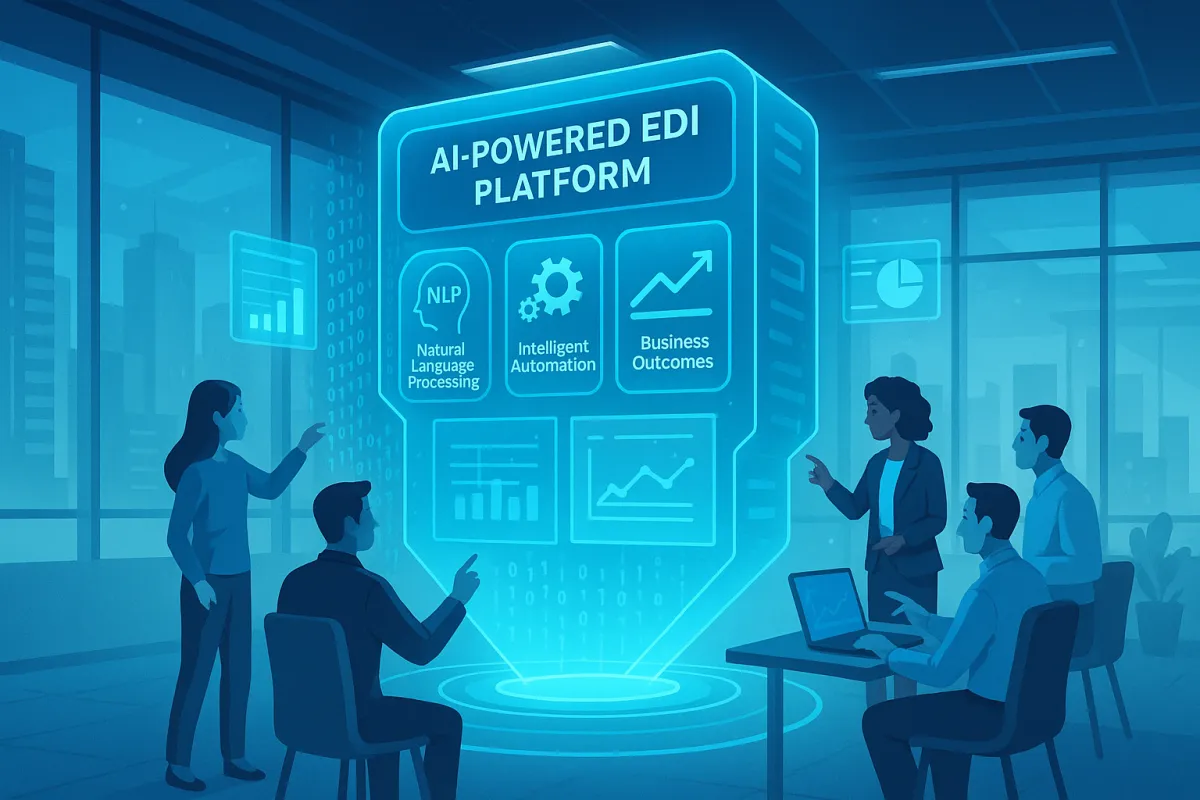
Most companies are still evaluating AI-powered EDI platform evaluation using traditional feature checklists. That approach misses the fundamental shift happening in 2026 where vendors now compete on outcomes rather than connectivity. Most vendors still compete on connectivity. The leaders now compete on outcomes.
The challenge runs deeper than adding AI features to existing EDI tools. Cleo AI is not a bolt-on feature — it's embedded into the integration platform itself, enabling real-time intelligence and execution. This architectural difference fundamentally changes how you need to evaluate platforms, moving beyond traditional comparisons to assess integration depth, automation capabilities, and business impact.
Why Traditional EDI Platform Evaluation Frameworks Fail in the AI Era
Your current evaluation checklist probably includes standard items: document support, protocol compatibility, ERP connections, and pricing models. Those criteria worked fine when EDI platforms were essentially sophisticated file transfer systems. But the best AI EDI platforms 2026 has brought to market have moved beyond simple automation to autonomous mapping. These platforms, led by Orderful's AI-native Mosaic, can reduce onboarding from months to days by using machine learning to eliminate manual data transformation.
The problem with traditional evaluation frameworks becomes obvious when you consider what G2 Spring 2026 reports awarded Jitterbit four "Best Estimated ROI" badges across every capability of the Harmony platform, including Jitterbit EDI. ROI isn't driven by connectivity anymore. It comes from intelligent automation that eliminates manual work you didn't realize you were still doing.
Consider how major vendors are positioning themselves. Jitterbit, Cleo, and Orderful all offer AI capabilities, but they approach the problem differently. Jitterbit's natural language processing interface acts as an intelligent co-pilot, enabling both technical and nontechnical users to securely manage complex Electronic Data Interchange (EDI) operations through simple conversational prompts. Meanwhile, Orderful Mosaic is built for companies that prioritize fast onboarding, reduced integration complexity, and scalable API-driven EDI without dedicated in-house mapping teams.
Transport management system vendors like Cargoson, MercuryGate, and Descartes are also embedding AI capabilities into their platforms, creating an ecosystem where traditional EDI evaluation criteria miss critical capabilities around supply chain orchestration and real-time decision making.
The Five Critical Dimensions for AI-Powered EDI Platform Assessment
Your evaluation framework needs to cover five key areas that traditional assessments ignore: AI architecture depth, natural language processing capabilities, automation intelligence, integration orchestration, and measurable business outcomes.
Start with AI architecture assessment. Key features include data-driven decision-making to quickly pull summary insights with searchable analytics based on date, partner, and document type to monitor supply chain health and partner performance in real time, plus self-service configuration management to instantly retrieve or update complex connection details without opening a support ticket or waiting for a technical administrator.
Integration orchestration capabilities differentiate modern platforms from traditional EDI tools. Unlike EDI tools focused only on document exchange, Cleo orchestrates automated end-to-end workflows and gives IT and business teams visibility into every transaction. This means evaluating not just what data moves between systems, but how the platform coordinates processes across your entire partner ecosystem.
Intelligence depth matters more than feature breadth. AI-powered intelligent exception management identifies, categorizes, and resolves integration issues, with up to 96% of errors handled without manual intervention, plus real-time visibility across transactions and flexible delivery models. Cleo embeds AI directly into operational workflows rather than layering it on top of integrations. This enables automated error detection, clustering, and resolution for minimal manual intervention, guided root-cause analysis for faster troubleshooting, AI-driven mapping and partner onboarding for faster time-to-revenue, and proactive alerting and exception management to minimize disruptions.
Business outcomes evaluation requires measuring tangible improvements beyond technical capabilities. Jitterbit earned 'Best Estimated ROI' and 'Highest User Adoption' badges in the G2 Spring 2026 reports for its EDI capabilities. These badges reflect real user experiences with faster onboarding, reduced support tickets, and improved operational efficiency.
Evaluating Natural Language Processing and Conversational Interfaces
Natural language processing capabilities represent the most significant advancement in making EDI accessible to non-technical users. The Jitterbit EDI AI Assistant is designed to lower the barrier to entry for managing EDI by allowing nontechnical team members to interact with complex data using natural language, significantly reducing the time and effort required to search through vast amounts of transaction and trading partner data. The EDI AI Assistant is a direct extension of our commitment to removing barriers to intelligent automation and accountable, layered AI. By blending natural language processing with low-code flexibility within the Harmony platform, we've eliminated the technical friction of B2B operations while grounding every action in secure enterprise data.
Test scenarios should evaluate real-world use cases. Can a procurement manager ask "Show me all failed invoices from our German suppliers this week" and get accurate results? Does the system understand context when someone asks about "shipment delays affecting our automotive line"? For example, if you need to find an error from a specific trading partner, all you have to do is ask, and the Assistant will return results instantly. It can also be configured to proactively monitor messages for issues, shortening response times even further.
Evaluate how natural language interfaces handle complex B2B scenarios. The Jitterbit EDI AI Assistant has been a game-changer for our team, transforming EDI into a self-service operation. By providing immediate, accurate guidance on trading partner configurations and automated data mapping, we expect our reliance on external support to decrease tremendously. This testimonial from Rich Richardson at UnRavel-IT highlights the practical impact of democratizing EDI management.
Assessment criteria should include accuracy of AI responses, speed of query processing, ability to handle ambiguous requests, integration with existing workflows, and security controls around data access. The platform should maintain audit trails of AI interactions while ensuring that natural language queries don't bypass established security protocols.
Architecture and Integration Depth Assessment Framework
Moving beyond connectivity evaluation requires understanding how platforms orchestrate complex supply chain workflows. Most EDI platforms focus on connectivity, ensuring documents move between systems. Cleo goes further by enabling execution, coordinating workflows across partners, systems, and processes in real time. This integration-to-orchestration distinction makes Cleo the leading AI EDI platform in 2026.
Architecture evaluation must consider the platform's approach to data processing and intelligence. Cleo AI features deep operational context trained on real supply chain transactions (orders, invoices, shipments) — not generic LLM data, end-to-end ecosystem visibility that sees across partners not just one system or step, embedded AI in workflows that operates directly inside order-to-cash and procure-to-pay processes, and moves from insight to execution by automatically resolving issues not just flagging them, with approximately 50% of customers already using AI-driven issue management.
Integration assessment should evaluate how platforms handle complex multi-modal operations. In transport management, platforms like Cargoson offer direct API/EDI integrations with carriers across all transport modes (FTL, LTL, parcel, air, and sea freight), allowing you to compare rates, book shipments, and track imports and deliveries from a single platform. This depth of integration affects how well an EDI platform can coordinate with broader supply chain systems.
Compare architectural approaches across vendors. Orderful is positioned around fast, API-driven onboarding, while Cleo is built to support broader integration requirements across complex, multi-partner environments. The difference becomes more apparent as integration needs move beyond standardized use cases.
Evaluate scalability and regional capabilities. European operations require different considerations than North American deployments. Orderful is primarily focused on North American X12. Expanding into international standards such as EDIFACT, VDA, or TRADACOMS can introduce additional complexity and may require supplemental solutions. Ensure your evaluation includes specific requirements for global operations and compliance with regional standards.
Intelligence and Automation Capabilities Testing
Testing AI-driven capabilities requires moving beyond static demonstrations to evaluate real-world performance under operational conditions. AI improves EDI accuracy by analyzing patterns in transaction data and identifying common errors before they impact a partner. AI supported validation can reduce manual checks, improve data quality, and prevent reprocessing delays.
Evaluate autonomous mapping capabilities through practical scenarios. Orderful offers Mosaic, an AI-native EDI platform that eliminates the need for mapping. Mosaic can automatically translate data into any partner format, reducing errors and speeding up onboarding. Test with real trading partner requirements to assess accuracy and speed of AI-generated mappings.
Error handling assessment should include both reactive and proactive scenarios. Can the platform identify potential issues before they cause transaction failures? SPS Commerce embeds MAX chat, an AI chat, into its day-to-day operations that can spot patterns and flag potential problems. This could resolve small issues before they become rejected shipments or chargebacks.
Testing frameworks should evaluate predictive capabilities. Modern AI-powered platforms can anticipate problems based on historical patterns, seasonal variations, and trading partner behavior. Assess how well platforms handle capacity planning, exception prediction, and automated partner communications during peak periods or disruptions.
Performance under load matters for enterprise deployments. Test how AI capabilities perform when processing high volumes of transactions, multiple simultaneous partner onboarding requests, and complex mapping scenarios. The platform should maintain accuracy and response times even during peak operational periods.
Business Outcomes and ROI Assessment Framework
Moving beyond technical specifications requires establishing measurable business impact criteria. Based 100% on end-user feedback, the G2 Spring 2026 reports awarded Jitterbit four "Best Estimated ROI" badges across every capability of the Harmony platform, including Jitterbit EDI. These recognitions reflect real user experiences with cost savings, productivity improvements, and operational efficiency gains.
ROI measurement should encompass multiple dimensions: onboarding time reduction, error rate improvements, support ticket reduction, and staff productivity gains. If you're depending on IT or a small handful of technical users to address issues, you could face costly delays, as well as potential partner penalties such as chargebacks. With EDI AI Assistant, line-of-business users can quickly act to resolve issues. The Assistant makes even the most complex EDI operations accessible via simple commands, letting a larger team of users quickly re-process a failed invoice, run a custom shipment.
Evaluate platforms based on their ability to demonstrate measurable outcomes. Look for case studies with specific metrics, not general claims about efficiency improvements. In Descartes' published Bahr Transportation success story, the reefer-focused brokerage reports three practical gains from integrated TMS + visibility tooling: bookings up to 15x faster, 30-40% less time spent on load tracking, and 98% on-time delivery performance while handling seasonal spikes and last-minute freight.
Consider total cost of ownership beyond licensing fees. Basic API integrations cost €5,000-€15,000, while complex ERP connections exceed €50,000. AI-powered platforms may have higher upfront costs but deliver savings through reduced implementation time, lower maintenance overhead, and decreased support requirements.
Assessment should include operational resilience and adaptability. Start of application of the new version (v3) of ICS2 messages on 3 February 2026, and decommissioning of older version (v2) means your integration must handle messaging format updates automatically - not through manual system adjustments. Your EDI connections won't automatically adapt to these changes. AI-powered platforms should demonstrate ability to adapt to regulatory changes and evolving business requirements without extensive reconfiguration.
Implementation Strategy and Vendor Selection Decision Matrix
Your decision framework should balance AI capabilities against organizational readiness and technical requirements. Orderful can be effective for organizations prioritizing fast onboarding within a narrow, standardized scope. But as integration needs expand across formats, partners, and systems, its limitations become more pronounced. Cleo takes a different approach by enabling supply chain orchestration, allowing organizations to manage not just how data moves, but how processes are executed across their entire ecosystem.
Vendor evaluation must consider market consolidation trends affecting long-term viability. WiseTech's acquisition of E2open in 2025, Descartes' purchase of 3GTMS for $115 million in March 2025, and Körber's transformation of MercuryGate into Infios following their 2024 acquisition represent just the beginning of a fundamental market restructuring that's forcing European shippers to reconsider their entire TMS procurement strategy.
Implementation strategy should account for regional requirements and regulatory compliance. European operations face different challenges than North American deployments. Consider platforms like Cargoson alongside established providers. Solutions from providers including Cargoson, MercuryGate (now Infios), Descartes, nShift, and Manhattan Active demonstrate varying approaches to API-first architecture. Evaluate their European carrier connectivity, regulatory compliance roadmaps, and real-time data processing capabilities.
Create a decision matrix that weighs AI capabilities against implementation complexity, total cost of ownership, and organizational change requirements. Include criteria for natural language processing maturity, automation depth, integration orchestration capabilities, business outcome measurability, and vendor stability. Score each platform across these dimensions to identify the best fit for your specific requirements and constraints.
Your procurement window for securing optimal platforms is narrowing. The procurement window for securing optimal TMS platforms before vendor consolidation eliminates choices and capacity shortages worsen cost structures runs through Q1 2026, while Europe could lack over two million drivers by 2026, impacting half of all freight movements. This timeline pressure means you need to complete your evaluation and selection process within the next few months to secure implementation resources and avoid the capacity constraints that will emerge as regulatory deadlines approach.