The AI-Powered EDI Vendor Selection Revolution: How to Evaluate Natural Language Assistants and Agentic Capabilities That Transform Complex B2B Operations Into Conversational Workflows in 2026

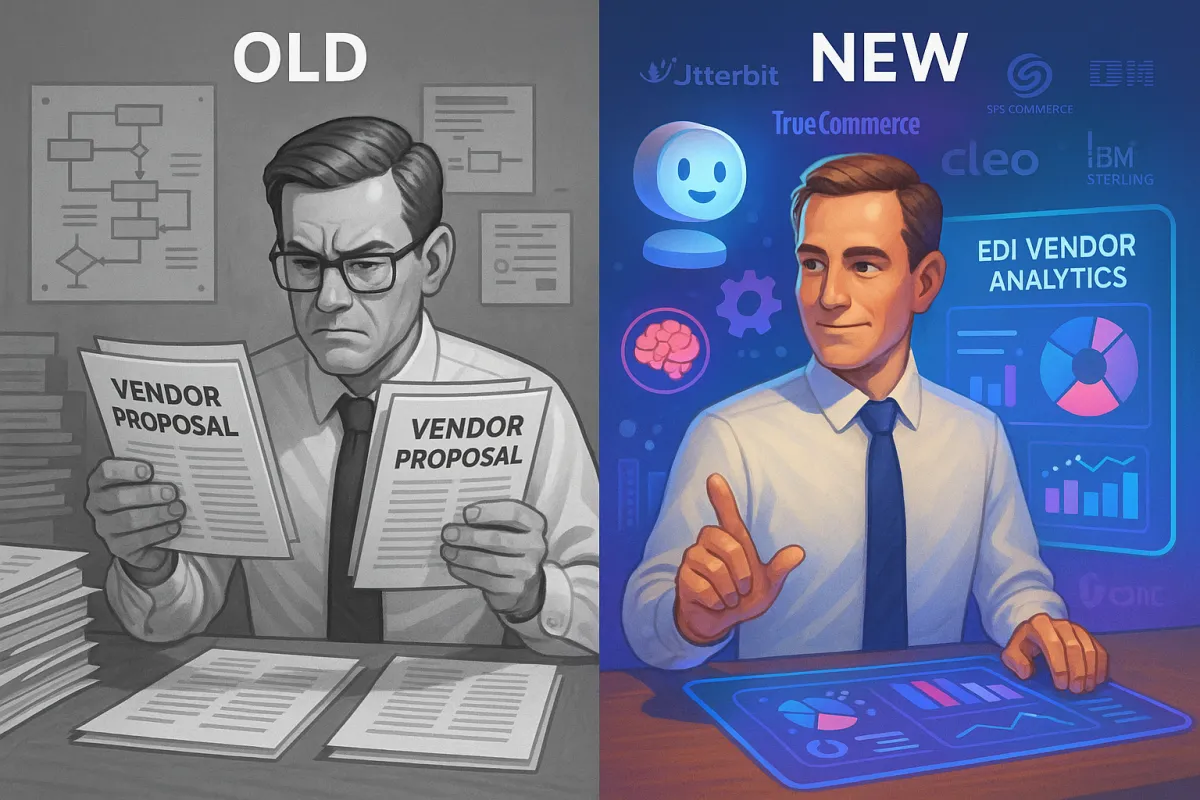
The EDI landscape just shifted. Jitterbit announced the general availability of the Jitterbit EDI AI Assistant on April 9, 2026, followed two days earlier by TrueCommerce embedding agentic AI across its platform on April 7, 2026. These aren't pilot projects or marketing demos. They're production systems delivering an average time-to-go-live of 2.44 months compared to the category average of 3.08 and 91% issue resolution rates, resulting in a 12% reduction in overall support cases.
This marks the moment when AI-powered EDI vendor selection moves from "nice to have" to mandatory evaluation criteria. The same budget cycle that's driving 74% of companies showing no tangible value from AI investments despite $252.3 billion in collective spending in 2024 is now forcing vendors to deliver working solutions, not promises.
The 2026 EDI AI Assistant Revolution is Changing Vendor Selection
Two major announcements in a single week signal something bigger than product updates. The Jitterbit EDI AI Assistant democratizes EDI management by allowing nontechnical team members to interact with complex data using natural language, while TrueCommerce's Truedi delivers personalized guidance based on each customer's ERP, transaction type, and account context, learning continuously from real interactions.
The implications extend beyond these two vendors. Traditional players like SPS Commerce, Cleo, and IBM Sterling now face pressure to match these capabilities. Modern TMS vendors like Cargoson, MercuryGate, and Descartes are watching carefully as the integration between EDI and transportation management becomes increasingly automated through AI assistance.
In 2026, AI will stop being a pilot conversation and become the engine that drives operational advantage. This isn't about incremental improvements to existing workflows. Companies like UnRavel-IT are reporting that the AI assistant has been transforming EDI into a self-service operation, providing immediate, accurate guidance on trading partner configurations and automated data mapping.
Understanding the Difference Between Marketing AI and Production-Ready Assistants
Here's what separates working AI from vendor marketing: accountability frameworks. The launch of the Jitterbit EDI AI Assistant builds upon Jitterbit's industry-first ISO/IEC 42001 certification, establishing measurable standards for AI performance and governance. Compare this to vendors offering "AI-enhanced" features without demonstrable accountability structures.
Real agentic AI performs autonomous tasks with bounded authority. TrueCommerce is introducing agentic AI mapping to automatically build and validate trading partner maps from specifications, eliminating one of the most time-intensive onboarding steps with heightened accuracy, resulting in a validated, production-ready connection. This isn't a chatbot suggesting next steps. This is software that completes complex mapping tasks independently.
TMS vendors including nShift, Manhattan Active, Blue Yonder, and Cargoson should evaluate their EDI providers against these new standards. The integration between transportation management and EDI automation will increasingly depend on AI capabilities that extend beyond basic data transformation.
The Complete AI-Powered EDI Evaluation Framework
Start with capability assessment, not vendor promises. Data-driven decision-making through searchable analytics based on date, partner, and document type to monitor supply chain health represents table-stakes functionality. Advanced implementations offer rapid troubleshooting and root cause analysis to identify and resolve transaction failures in seconds by using AI to filter messages across trading partners via specific keywords or error types.
Self-service configuration management changes your staffing requirements. When users can instantly retrieve or update complex connection details without opening a support ticket or waiting for a technical administrator, you're looking at fundamental workflow transformation. Oracle TM, SAP TM, and 3Gtms/Pacejet users should specifically assess how AI assistants integrate with their existing ERP connectivity.
Integration depth matters more than feature lists. The AI assistant is fully integrated with Jitterbit iPaaS, enabling organizations to automate and orchestrate integrations between EDI, ERP systems, and other applications. Look for vendors that can demonstrate working integrations with your specific technology stack, not generic "enterprise-ready" claims.
Performance metrics provide objective comparison points. The G2 Spring 2026 reports awarded Jitterbit four "Best Estimated ROI" badges across every capability of the Harmony platform, including both "Best Estimated ROI" and "Highest User Adoption" badges for EDI. These aren't vendor-submitted testimonials. They're third-party validated outcomes from actual implementations.
Critical Questions to Ask EDI Vendors About Their AI Capabilities
Ask for demonstrated natural language processing beyond basic queries. Can nontechnical users actually ask a question in natural language and get an actionable answer in seconds? Request a live demonstration with your specific trading partner scenarios, not generic examples.
Evaluate contextual learning capabilities. Personalized guidance based on each customer's ERP, transaction type, and account context, learning continuously from real interactions requires sophisticated data processing. Ask vendors to explain how their AI systems learn from your specific environment and trading partner requirements.
Examine production readiness through customer testimonials. Ron Morrell from Endur ID reported within a couple of sentences, the system presented the solution quickly and walked through the steps rather than requiring extended troubleshooting sessions. Look for customers with similar complexity and trading partner volumes.
Security and data governance shouldn't be afterthoughts. With 57% of IT professionals citing data privacy and security risks as their top concern, your AI-enabled EDI platform needs comprehensive governance frameworks. Vendors should provide clear documentation about data handling, AI decision auditing, and compliance with industry regulations.
Implementation Success Factors for AI-Enhanced EDI Platforms
Time-to-value metrics reveal platform maturity. Jitterbit EDI customers achieve an average time-to-go-live of 2.44 months compared to the category average of 3.08, but the more significant number is iPaaS enterprise customers achieving a full return on investment in an average of just 6.86 months, realizing business value more than 2x faster than the industry average of 15.6 months.
Real customer transformation stories provide implementation insights. Companies report shifting from reactive troubleshooting to proactive management. The system has been transforming EDI into a self-service operation, providing immediate, accurate guidance on trading partner configurations and automated data mapping with expected tremendous reduction in external support reliance.
Change management becomes more complex with AI assistance. Your team needs training on when to trust AI recommendations versus requiring human verification. Only 16% of organizations fully trust AI to make and execute operational decisions while 36% use AI but require humans to make the final decisions. Plan your governance structure before implementation, not after.
Consider implementation approaches of modern TMS vendors including Alpega, FreightPOP, E2open/BluJay, and Cargoson when evaluating EDI platform compatibility. Transportation management systems increasingly require EDI platforms that can handle dynamic routing changes and real-time shipment updates through AI-assisted automation.
Avoiding the 76% AI Implementation Failure Rate
The statistics are sobering. Manufacturing faces a 76.4% AI failure rate with integration consuming 58% of project resources and IoT sensor data quality falling below requirements in 71% of projects. Even worse, the average organization scrapped 46% of AI proof-of-concepts before reaching production, with only 48% of AI projects making it into production.
Bounded autonomy prevents runaway automation. Rather than giving AI systems unlimited decision-making authority, successful implementations define specific parameters for autonomous action. Self-service configuration management allows users to instantly retrieve or update complex connection details without requiring AI systems to make irreversible changes to critical trading relationships.
Integration testing becomes more complex with AI components. AI models in production need data quality signals measured in hours rather than traditional quarterly audits or monthly pipeline checks, and that mismatch is where most data quality AI problems originate. Your testing procedures need to account for AI learning patterns and decision-making validation.
Performance monitoring requires new metrics. Traditional EDI monitoring focused on transaction volume and error rates. AI-enabled systems require monitoring of decision accuracy, learning effectiveness, and user adoption patterns. Earning both "Best Estimated ROI" and "Highest User Adoption" badges suggests that successful AI implementations require both technical performance and user acceptance.
Cost-Benefit Analysis Framework for AI-Enabled EDI Solutions
ROI measurement becomes more complex with AI capabilities. The G2 Spring 2026 reports awarded four "Best Estimated ROI" badges across every capability of the Harmony platform, confirming that unified, AI-infused approach to iPaaS, API Management, EDI, and Low-Code App Development leads the industry in time-to-value. However, these metrics reflect best-case implementations, not typical results.
Hidden costs include training, change management, and governance structure development. While AI assistants reduce technical support requirements, they require investment in user training and governance framework development. Large enterprises abandoned an average of 2.3 AI initiatives in 2025 with an average sunk cost of $7.2M per abandoned large enterprise AI initiative.
Subscription model implications vary by vendor. AI-enhanced features often carry premium pricing, but the cost structure matters. Evaluate whether AI capabilities are included in base pricing or require separate licensing. Some vendors like Uber Freight TMS, Shiptify, and Cargoson are building AI capabilities into core TMS offerings rather than charging separately.
Competitive analysis requires new evaluation criteria. Enterprise customers achieving ROI 7x faster with platforms achieving full value in 2.14 months compared to the category average of 15.42 months represents significant competitive advantage. However, these numbers reflect specific implementation scenarios and vendor capabilities.
Future-Proofing Your EDI Investment in the AI Era
Operational advantage timelines are compressing. In 2026, AI will stop being a pilot conversation and become the engine that drives operational advantage. Companies that delay AI adoption face increasing competitive disadvantage as trading partners demand faster onboarding and more responsive issue resolution.
Vendor consolidation impacts AI development resources. Smaller EDI vendors may struggle to match the AI development investment of larger platforms. Consider the long-term viability of vendor AI roadmaps, not just current capabilities. G2 closed its acquisition of Capterra, Software Advice, and GetApp from Gartner for approximately $110 million in early February 2026, demonstrating ongoing consolidation in evaluation platforms themselves.
Integration with emerging technologies requires forward-compatible architectures. Your AI-enhanced EDI platform should support integration with blockchain supply chain tracking, IoT sensor data, and advanced analytics platforms. Modern TMS vendors like Cargoson alongside established players are building these integrations into their AI strategy.
The window for AI-powered EDI vendor selection advantage is narrowing rapidly. Early adopters are already realizing measurable benefits while laggards face increasingly complex catch-up scenarios. Your next vendor evaluation cycle should treat AI capability as a primary selection criterion, not a secondary consideration.