The Hidden $3.2M Vendor Lock-In Crisis: Your Complete EDI and TMS Cost Assessment Framework to Calculate True Switching Expenses and Build Vendor-Agnostic Integration Architecture Before Consolidation Eliminates Your Options in 2026

Last month, I watched a Fortune 500 automotive supplier's CFO discover their EDI vendor switching costs had quietly ballooned to $3.2 million for a $1 million contract when factoring in data migration, retraining, and lost productivity. The company had unknowingly locked themselves into a system that charged them $200-$2,000 per partner setup fees while demanding $8,000–$24,000 in internal development costs for even basic integrations.
Sound familiar? You're facing the same vendor lock-in crisis that's forcing companies to pay inflated prices while major consolidation waves eliminate procurement options. WiseTech's $2.1 billion acquisition of E2open and Descartes' $115 million purchase of 3GTMS represent just the beginning of a market restructuring that's shrinking your vendor choices by the month.
The Escalating EDI Vendor Lock-In Cost Crisis
The vendor lock-in problem extends beyond immediate switching costs. SaaS vendors increased prices by 8.8% in 2023, with 73% raising their prices that year. Meanwhile, HubSpot raised prices by 12%, Microsoft by 15%, and Webflow by a staggering 23%.
Traditional EDI providers follow this same playbook. They charge $500–$5,000 in setup fees per trading partner while hiding pricing behind lengthy demo processes. Value Added Networks add another $30–$100+ per month for moderate volumes on top of platform fees.
The real damage comes from what most CFOs miss: legacy EDI platforms often require a dedicated EDI coordinator, while modern platforms eliminate this staffing requirement entirely. When you combine these ongoing costs with the 3–8% rejection rates common in poorly validated pipelines that require manual review and resubmission, the total cost of ownership becomes staggering.
The True Cost Components Most CFOs Miss
Hidden costs multiply when you examine the full picture. B2Bi licensing fees, implementation costs, and ongoing maintenance can strain budgets. Companies discover too late that migrating away from B2Bi to a different EDI solution can be difficult due to proprietary formats and dependencies, limiting flexibility and making it challenging to switch vendors.
The consolidation wave compounds these problems. Companies undergoing integration often experience 12-18 months of reduced innovation while they harmonize platforms and teams, with post-acquisition integration timelines spanning 12-18 months during which platform development stagnates and support quality deteriorates.
Consider the complete cost breakdown: Hidden EDI costs include per-transaction fees ($0.10-$1.00 per document that multiply with volume), VAN charges ($500-$1,500/month), setup fees for each trading partner ($1,000-$5,000), hourly support charges ($150-$300/hour), mandatory annual price increases (5-10%), and contract exit fees.
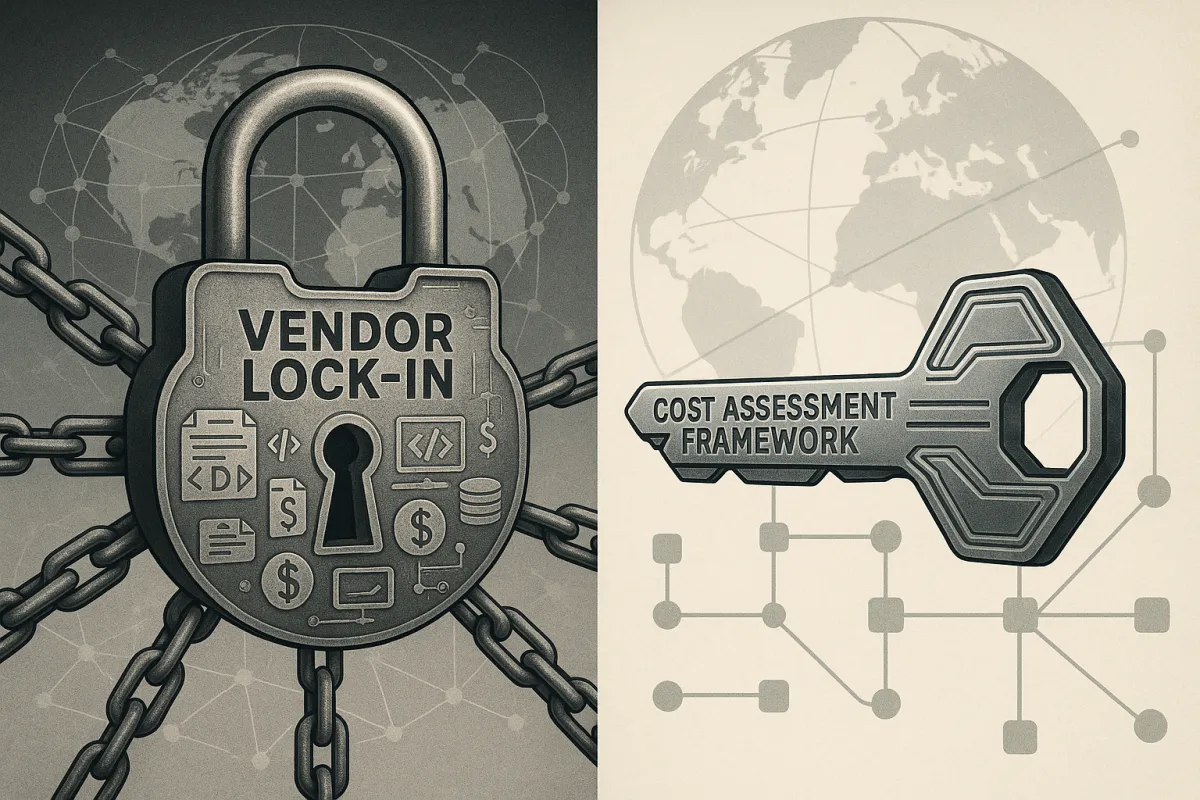
The Complete Vendor Lock-In Cost Assessment Framework
Most organizations don't know they're locked in until renewal time forces the issue. A simple test: if you cannot describe how you would exit a vendor in a single page, including what you would lose, what it would cost, and how long it would take, you do not have enough information to negotiate confidently.
Start with this systematic assessment:
First, categorize your lock-in type. Reversible lock-in means you can leave with planning where your data is exportable in a usable format, integrations can be replicated with reasonable effort, the cost of leaving is mainly internal time, and switching is measured in months. Conversely, restrictive lock-in means you are effectively forced to stay with complete exports unavailable or prohibitively expensive, contract terms making leaving commercially irrational, and switching measured in years.
Next, calculate your true switching costs using this formula: Take your annual contract value and multiply by the 150-200% exit tax when factoring in data migration, retraining, and lost productivity. Add contractual penalties, data egress fees, and internal project management costs. For many companies, this calculation reveals switching costs that exceed two years of current vendor payments.
Data Portability and Integration Dependency Analysis
Data portability requirements serve as insurance against lock-in. Evaluate whether your vendor provides standard export formats or forces proprietary dependencies. Your data should be exportable in a usable format, including history and audit trail, with integrations that can be replicated with reasonable effort, and the cost of leaving mainly internal time.
Technical debt assessment reveals hidden dependencies. When companies build workflows around vendor-specific features, they create what experts call accidental lock-in where you buy a platform, then build hundreds of workflows, integrations, and approval processes around it, with switching later requiring rebuilding how the team works.
Building Vendor-Agnostic EDI Architecture
Modern companies adopt composable EDI approaches where components remain interchangeable rather than monolithic. This architecture prevents the deep integration dependencies that create lock-in scenarios.
The key lies in decoupling EDI translation from your core systems. Cloud EDI solutions that use API technology let manufacturer and retailer systems talk directly to each other, providing the flexibility to switch providers without rebuilding integrations.
Consider how leading platforms approach this challenge. Solutions like Cargoson, Orderful, and Boomi support modular architectures that reduce vendor dependency. Each offers different advantages: Orderful focuses on simplified onboarding with pricing that scales predictably at $189/month per partner with no surprise charges or platform fees, while enterprise platforms like Boomi provide comprehensive integration capabilities but risk their own forms of lock-in through proprietary connectors and data formats.
API-First Integration Strategy
API-first approaches create low-friction gateways while EDI handles heavy lifting behind the scenes. This hybrid architecture allows you to connect once and reach large networks without rebuilding integrations for each provider change.
The implementation strategy requires phased deployment. Start with core API connectivity for your highest-volume partners, then gradually migrate legacy EDI connections. This approach reduces migration risks while maintaining operational continuity throughout the transition.
Cloud infrastructure enables this flexibility. Many businesses choose cloud-based EDI because it's flexible, cost-effective, and easy to scale, eliminating the need for expensive on-premise IT systems. The result: faster data exchange and reduced vendor dependency.
TMS Vendor Consolidation Impact on EDI Strategy
The timing creates a perfect storm for EDI-dependent companies. While Europe faces a shortage of over two million drivers by 2026, impacting half of all freight movements, the TMS consolidation wave eliminates integration options just when companies need them most.
The consolidation numbers tell the story: Descartes has completed 32 acquisitions since 2016, while WiseTech's focus has mainly been on logistics service providers, but with e2open's customer base, they're expanding into global trade including demand, planning, and transportation for manufacturers and brand owners.
This shift creates uncertainty about European manufacturer priorities during integration planning. When vendors undergo major acquisitions, customer support and feature development often stagnate for 12-18 months while teams integrate systems and eliminate redundancies.
Acquisition-Resistant Contract Terms
Smart procurement teams build protection clauses before signing contracts. Essential terms include 12-18 months advance notice for ownership changes, guaranteed functionality preservation for minimum periods, and migration assistance rights with automatic contract review rights triggered by acquisition announcements.
Price protection becomes crucial during consolidation periods. Price protection clauses should lock pricing for 24 months following ownership changes. Without these protections, companies face immediate price increases as new owners seek to maximize revenue from captive customers.
Feature deprecation protection prevents vendors from eliminating functionality that your operations depend on. Include specific clauses requiring alternative solutions or migration assistance if core features get discontinued during vendor transitions.
Implementation Roadmap for Lock-In Prevention
The procurement window narrows rapidly as vendor options disappear. Companies that haven't initiated TMS selection processes by mid-2026 will find significantly fewer viable options as consolidation eliminates redundant platforms.
Your 90-day action plan should prioritize vendor-agnostic architecture over feature lists. Start by auditing your current dependencies and identifying which systems require vendor-specific functionality versus standard capabilities.
Budget planning requires understanding the cost differences between proactive and reactive approaches. Companies that plan migrations during renewal cycles typically see 8-12% budget increases, while those forced into emergency transitions face 15-20% cost escalations plus project risk penalties.
Platform evaluation should include established players like IBM Sterling, SignalEDI, and SPS Commerce alongside modern cloud solutions like Cargoson and Cleo. Each vendor offers different lock-in risk profiles - evaluate them based on data portability, integration flexibility, and contract terms rather than just feature comparisons.
The Q1 2026 deadline provides your last window of optimal procurement leverage before consolidation eliminates choices and regulatory deadlines force rushed decisions. Companies that act decisively now secure better contract terms and vendor-agnostic architectures that protect against future lock-in scenarios.