The Critical Omnichannel Format Fragmentation Crisis: How to Eliminate PDF-EDI-API Data Chaos When the Same Retail Partner Uses Different Order Formats Across Channels Without Breaking Inventory Accuracy or Compliance in 2026

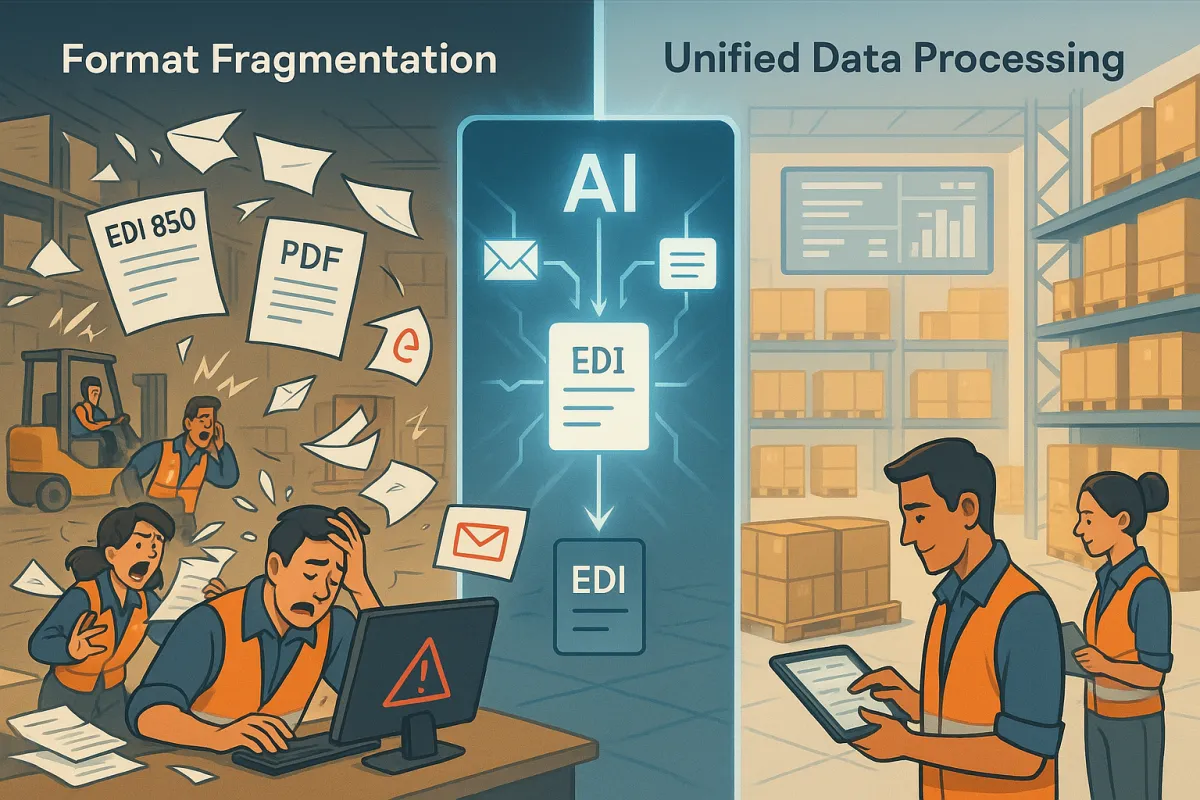
Target sends your warehouse an EDI 850 purchase order for store replenishment. Two hours later, a PDF order arrives via email for the same SKUs but different quantities, destined for Target's marketplace. Your fulfillment team processes them as separate orders, accidentally allocating premium inventory reserved for high-priority retail to the lower-margin marketplace channel. Result? A compliance violation, inventory shortage, and $15,000 in chargebacks. Sound familiar?
Only 15% of retail leaders believe they use their omnichannel systems to full potential, with the rest hampered by fragmented digital add-ons and manual workflows. This format fragmentation crisis hits suppliers hardest when the same retail partner uses different order formats across channels without any unified processing framework.
Companies processing orders that arrive by email, PDF, EDI, or web form must extract customer data, product codes, quantities, pricing, shipping terms, and taxes - but most handle these through completely separate systems. When Target uses EDI for store orders but sends PDF documents for marketplace fulfillment, your inventory allocation logic breaks down.
The Hidden Cost of Format Fragmentation in Omnichannel Operations
The financial impact extends beyond processing delays. Over 75% of manufacturing firms process their procurement and shipping data through EDI platforms, with logistics companies reporting an average 33% reduction in document turnaround time through digitization. The retail sector also reports a 21% decline in out-of-stock events as a direct result of improved forecasting driven by timely EDI updates.
But here's what those statistics miss: when you're handling the same retailer through multiple formats, those efficiency gains disappear. Manual PDF processing introduces errors that EDI automation was designed to eliminate. PDF is not a legally recognised e-invoice format but the majority of incoming invoices still arrive as PDF. Classical OCR solutions regularly fail here because of changing layouts, varying fonts, and multi-page documents. Modern AI-powered solutions solve this problem through fingerprinting.
Transportation management systems vendors recognize this challenge. Cargoson and established platforms like Oracle TM and Descartes are building unified processing capabilities that handle multiple order formats within single workflows.
Why does format mixing create such operational chaos? Simple: your fulfillment team can't distinguish channel priorities when orders arrive in different systems. A PDF marketplace order bypasses the inventory reservation rules you've carefully configured in your EDI workflow. The result? Cross-channel inventory conflicts and compliance failures.
Why Traditional Integration Approaches Fail in Multi-Format Scenarios
Traditional approaches treat each format as a separate integration challenge. You build an EDI connection to handle 850 purchase orders, implement a separate email processor for PDFs, and create API endpoints for modern marketplace connections. Each system operates with different validation rules, inventory allocation logic, and compliance frameworks.
The technical breakdown happens at inventory visibility. This hybrid approach is particularly valuable for businesses pursuing an omnichannel strategy, as it allows them to efficiently manage data flows across multiple sales channels and fulfillment locations, but only when properly unified.
Consider the operational complexity: varying retailer requirements demand different response times, inventory reservation windows, and compliance validations. Your EDI system might reserve inventory for 24 hours, while PDF orders bypass reservation entirely. When both orders target the same inventory pool, allocation errors become inevitable.
Compliance risk multiplies when PDF orders skip EDI validation workflows. Retailers expect the same data accuracy and formatting standards regardless of submission method, but manual PDF processing can't match EDI's built-in validation.
The Unified Data Processing Framework for Multi-Format Operations
Modern omnichannel EDI integration requires architecture that normalizes all order formats into a single processing workflow. This means processing incoming invoices regardless of format: classic PDF, XRechnung, ZUGFeRD, or EDIFACT INVOIC. All documents flow through the same automated process and are output as structured, ERP-ready data.
The key innovation is intelligent format detection and conversion. When a PDF order arrives, the system automatically converts it to standardized EDI format using AI-powered extraction. Modern AI-powered solutions like PEDIF process incoming PDF invoices just as automatically as XRechnung or EDIFACT messages. The AI automatically recognises each supplier's document layout and extracts all relevant data without manual intervention. You do not need to wait for all your suppliers to switch to structured e-invoice formats.
This unified approach eliminates the need for separate processing pipelines. OrderSync operates at this level, processing EDI alongside PDF, email, and spreadsheet orders through one automated order processing pipeline. The same validation rules, inventory checks, and compliance frameworks apply regardless of original format.
Integration capabilities with TMS platforms become crucial for scalability. Solutions like Cargoson, alongside established vendors like SAP TM and Manhattan Active, support API connections that allow seamless data flow between unified order processing and transportation management.
Intelligent routing based on data source ensures proper channel handling. The system recognizes when orders originate from retail store replenishment versus marketplace fulfillment and applies appropriate inventory prioritization rules automatically.
Inventory Allocation Strategy That Prevents Cross-Channel Conflicts
Effective multi-format order processing requires rules-based inventory allocation that recognizes channel hierarchies regardless of order format. High-priority retail replenishment orders (whether EDI or PDF) must reserve inventory before lower-priority marketplace orders can access the same SKUs.
Real-time inventory reconciliation across all order formats prevents the allocation conflicts that lead to chargebacks. When your system processes a Target EDI 850 for store replenishment, it immediately updates available inventory for all channels, including PDF marketplace orders that might arrive minutes later.
Leading TMS and fulfillment platforms address this through dynamic inventory pooling. In today's fast-paced, omnichannel retail environment, maintaining accurate inventory levels across multiple systems and locations is critical for success. EDI 846 documents, also known as inventory advice or inventory inquiry/response, enable trading partners to exchange real-time information about product availability and stock levels. Regularly sharing inventory data via EDI 846s means that all parties have a consistent, up-to-date view of stock levels.
The allocation strategy must account for different fulfillment timelines. EDI orders typically require faster processing than PDF orders, but both need access to the same inventory validation framework to prevent overselling.
Implementation Priorities: Which Formats to Unify First
Start with your highest-volume retailer relationships that generate orders across multiple formats. Target, Walmart, and Amazon often represent the greatest chargeback risk when format fragmentation creates inventory allocation errors.
Prioritization should consider compliance risk over volume. A single compliance violation with a major retailer can cost more than processing inefficiencies with smaller partners. Focus first on retailers whose EDI requirements are strictest and who also send significant non-EDI order volumes.
Phased rollout strategy begins with format unification for your most important channels. Implement PDF-to-EDI conversion for marketplace orders while maintaining existing EDI connections for store replenishment. This approach reduces implementation risk while delivering immediate inventory allocation improvements.
Integration assessment for existing TMS/ERP systems determines technical feasibility. Platforms like Cargoson offer APIs that connect unified order processing with existing warehouse management systems, while established solutions like nShift and Transporeon provide similar connectivity options.
Consider vendor options based on your technical requirements and scale. For small businesses aiming to streamline order processing, ensure compliance, and integrate with trading partners efficiently, leading SMB EDI software options include: SPS Commerce Fulfillment EDI offers a comprehensive solution with full-service support, providing access to a vast network of pre-mapped connections. It's designed to help vendors meet retailer requirements, including EDI compliance and batch processing, making it a strong choice for small businesses seeking scalability and ease of use.
Compliance Protection Across Mixed Data Formats
Solutions must span every stage of B2B retail fulfillment - from electronic data interchange (EDI) order management and advance ship notice (ASN) processing to Uniform Code Council (UCC) label generation and retail compliance execution. The challenge intensifies when handling multiple formats because each must meet identical compliance standards.
Audit trail requirements become complex when converting between formats. Every action is logged automatically. The system records what was extracted, what was validated, what was changed, and who reviewed exceptions. This creates a clear audit trail for compliance and reporting. When PDF orders convert to EDI format, the system must document the entire transformation process for retailer audits.
Retailer-specific compliance mapping ensures that different order channels maintain identical validation standards. Your unified processing framework must apply Target's specific EDI requirements to both native EDI orders and converted PDF orders destined for Target fulfillment.
Chargeback dispute management requires detailed documentation of order processing regardless of original format. When retailers claim compliance violations, you need audit trails showing that converted PDF orders underwent the same validation as native EDI transactions.
ROI Framework and Success Metrics for Format Unification
Quantifying cost savings requires measuring both reduced manual processing and error reduction. Faster Processing Orders move through the system in minutes instead of days. Order entry automation supports regulated industries by maintaining audit trails, validation checks, and clear documentation of changes. These features help meet compliance and reporting requirements without slowing down processing.
Automated processing eliminates data entry mistakes, speeds up order flow and helps capture more revenue while meeting SLA requirements. The financial impact shows most clearly in chargeback reduction. A single format-related compliance violation can cost $10,000-$50,000, making unification ROI measurable within months.
Benchmark data from successful implementations shows 40-60% reduction in order processing time when PDF orders integrate with existing EDI workflows. Companies also report 75% fewer inventory allocation errors across channels.
Cost comparison across different integration platforms varies significantly. Cloud-based solutions like cloud-based solutions are at the forefront of reducing fragmentation in omnichannel retail. By centralizing data and applications in the cloud, retailers can ensure seamless access to information across all channels, while TMS vendors offer different pricing models for unified processing capabilities.
Vendor Selection Criteria for Multi-Format Integration
Technical requirements center on handling PDF OCR, EDI translation, and API management within unified workflows. The solution must support real-time format conversion without introducing processing delays that affect compliance timelines.
Evaluation framework should prioritize compliance features over basic connectivity. Orderful gives retailers the fastest supplier onboarding, guaranteed EDI compliance, and real-time visibility to eliminate chargebacks and improve OTIF. Look for vendors that can demonstrate format unification without compromising retailer-specific compliance requirements.
Consider vendors across categories: specialized EDI providers offer deep compliance expertise, TMS platforms like Cargoson provide broader supply chain integration, and enterprise solutions like Blue Yonder or E2open deliver comprehensive omnichannel capabilities.
Scalability becomes crucial as your retailer network grows. The platform must handle increased format complexity as new retailers introduce different ordering methods without requiring system redesign.
Implementation support varies dramatically between vendors. Full-service providers manage format mapping and retailer onboarding, while self-service platforms require internal technical resources for configuration and maintenance.
The path forward requires acknowledging that format fragmentation won't disappear - retailers will continue using multiple ordering methods across channels. Your competitive advantage comes from unifying these formats into coherent operational frameworks that protect inventory accuracy and compliance regardless of how orders arrive.