The Zero-Mapping EDI Revolution: How AI-Native Platforms Are Eliminating Trading Partner Onboarding Delays While TMS Vendor Consolidation Creates Implementation Chaos in 2026

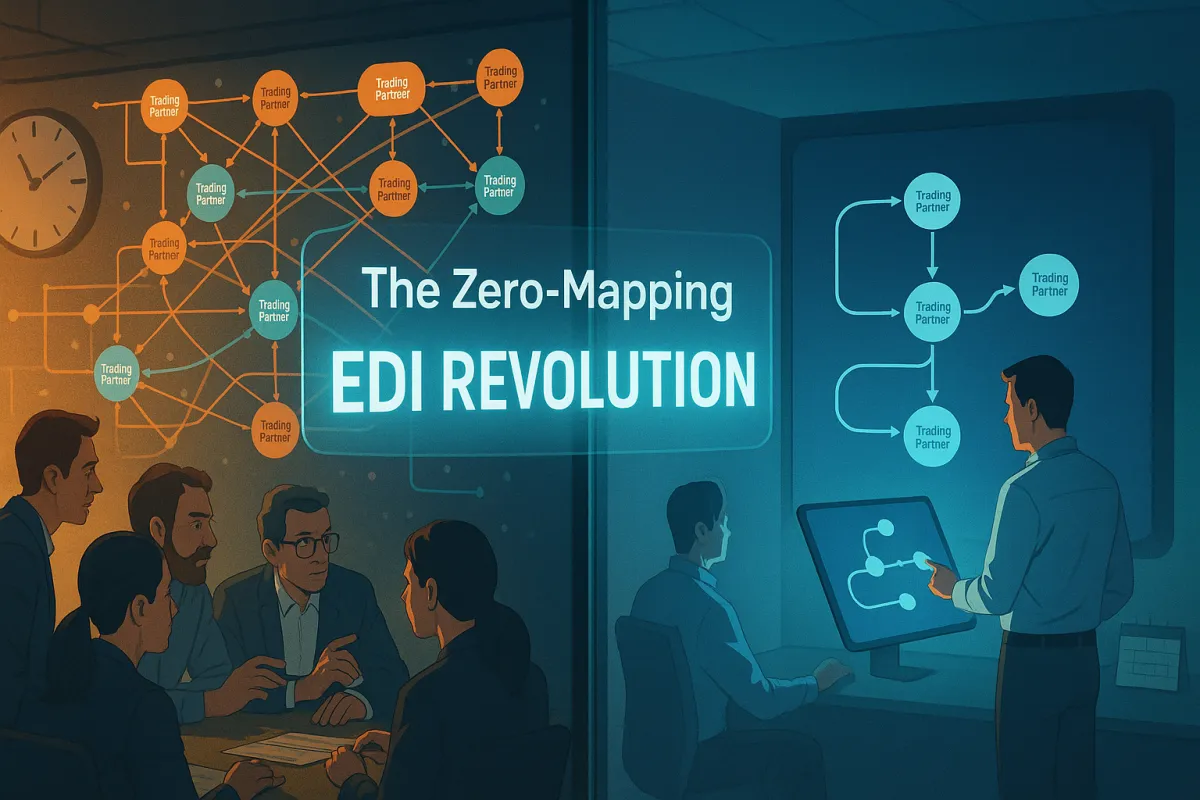
AI-native EDI mapping automation is transforming trading partner onboarding from months-long processes to days, with platforms like Orderful's Mosaic using machine learning to eliminate manual data transformation. While the supply chain faces its biggest disruption in over a decade, major TMS vendor consolidation, including WiseTech's $2.1 billion acquisition of E2open and Descartes' $115 million purchase of 3GTMS, is reshaping the EDI landscape at the worst possible time.
The timing creates a perfect storm for EDI managers. Traditional EDI trading partner onboarding takes weeks, but AI can cut this to hours or days by automatically generating partner profiles, dataflows, and validation checks. Meanwhile, companies undergoing acquisition often experience 12-18 months of reduced innovation while they harmonize platforms and teams.
The Mapping Bottleneck Crisis
Here's what most EDI teams don't realize: EDI mapping has long been a bottleneck in EDI integration projects, with decades of translation depending on manual mapping logic, custom rules, and specialist oversight. One of the most time-consuming aspects of EDI has always been data mapping, but AI is now accelerating this process by learning from semantic models and automating field matching, reducing setup time and simplifying updates over time.
Orderful's Mosaic platform accelerates Best Buy EDI compliance through automated testing and validation before documents reach production, with the API-driven system enforcing Best Buy-specific requirements for purchase orders, acknowledgments, advance ship notices, and invoices, reducing errors that trigger failed test cycles and while automated mapping eliminates the formatting inconsistencies and data structure issues that commonly delay certification.
The productivity drain is massive. Companies across supply chains still devote months, sometimes years, to building mapping logic, maintaining brittle connections, and troubleshooting cryptic document failures. Every new trading partner becomes a custom integration project that drains resources from strategic initiatives.
AI-Native Architecture vs. Enhanced Legacy Systems
AI-enhanced platforms typically build on traditional EDI systems, using AI to assist with mapping, data transformation, error detection, or workflow automation, but the underlying architecture still relies on manually created maps and predefined transformation logic. This feels familiar but doesn't solve the core scaling problem.
AI-native platforms operate differently, with AI as the engine that makes the changes, automatically interpreting data models and updating to meet partners' needs, using one unified platform with machine learning to validate and normalize data in real time, with many AI-native systems designed to be self-healing, meaning they can adjust to changes in partner specifications without requiring manual rework.
Mosaic is Orderful's AI-native EDI platform removing traditional mapping layers through automated EDI transformation at scale, using zero-mapping architecture standardizing data into single JSON structure, then dynamically translating to meet individual partner requirements without static rule sets, standardizing data into clean JSON structure and handling dynamic mapping between JSON and EDI, generating compliant documents for each trading partner based on specific requirements.
Mosaic normalizes partner variance behind a single consistent interface so teams never see it, instead of rebuilding integrations partner by partner, presenting a single consistent interface per document type.
Technical Architecture: JSON Standardization
Rather than forcing teams to manage mapping logic line by line, Mosaic standardizes data into a single, clean JSON structure, with the platform handling data mapping between JSON and EDI dynamically, generating compliant EDI documents for each trading partner based on their specific requirements.
Self-healing integrations continuously learn from transaction patterns across thousands of connected partners, adapting in real time when requirements shift, with developer-friendly JSON replacing cryptic EDI segments, reducing dependency on specialized consultants, while real-time validation catches issues before transmission, and predictive alerts flag inconsistencies early based on partner usage patterns.
Platform Comparison: Leaders vs. Laggards
Orderful Mosaic is a cloud-native, AI-native EDI platform using autonomous data mapping through machine learning to interpret and normalize data without manual map maintenance, with zero-mapping API architecture that integrates once and connects across trading partners, while API-first design enables seamless ERP integration reducing custom development, and real-time validation and centralized visibility enforce compliance rules before documents reach downstream systems, with rapid partner onboarding connecting companies to existing networks, reducing testing feedback loops and minimizing chargeback risk while supporting fast onboarding and scalable growth.
Traditional vendors still have their place. Cleo serves mid-to-large enterprises needing both EDI and broader application integration capabilities. Cleo suits mid-sized to large enterprises needing both EDI and broader application integration, while Boomi works for enterprises seeking integration platforms including EDI as part of wider digital transformation.
TMS integration adds another layer of complexity. Consider platforms like MercuryGate (now part of Körber's Infios), Manhattan Active, and Blue Yonder alongside newer API-first solutions from nShift, Transporeon, Alpega, and Cargoson. European TMS vendors like Alpega and Cargoson offer regional focus advantages including dedicated European development teams, local regulatory expertise, and market-specific feature development priorities.
Vendor Consolidation Impact on Innovation
Companies undergoing integration often experience 12-18 months of reduced innovation while they harmonize platforms and teams. Timeline pressure intensifies beyond 2026, with companies that haven't initiated TMS selection processes by mid-2026 finding significantly fewer viable options as consolidation eliminates redundant platforms.
Standard vendor scoring frameworks built around feature checklists and pricing comparisons miss consolidation risks that now define procurement success, creating dangerous exposure to vendor lock-in scenarios.
Real-World Impact: Speed and Cost Benefits
Machine learning algorithms analyze format specifications, existing mappings, and sample data to recommend optimal field connections between different document formats, reducing onboarding time from weeks to minutes while minimizing errors.
AI-driven platforms that automate data mapping and reduce repetitive testing cycles significantly shorten timelines, with faster time-to-live meaning you begin exchanging compliant documents sooner, reduce the risk of chargebacks, and capture revenue opportunities without prolonged integration projects.
New trading partners go live in days because partner variability is normalized at the network layer, with every onboarding faster than the last. Some organizations report average onboarding times under one day.
Cost comparisons reveal the hidden expenses of traditional mapping. Traditional EDI processes rack up costs for labor, errors, and delays, but with AI automating processes, you can reduce human touchpoints, cut rework, and slash operational expenses. One predictable cost replaces per-partner fees, custom mapping, and consultant cycles as you grow.
Vendor Consolidation Risk Assessment
WiseTech's acquisition of e2open for $3.30 per share equating to an enterprise value of $2.1 billion marks the largest TMS industry acquisition to date, while Descartes Systems Group acquired 3GTMS for $115 million, with this consolidation wave hitting exactly as eFTI platforms require European compliance.
The procurement window for securing optimal TMS platforms before vendor consolidation eliminates choices runs through Q1 2026, with companies that haven't initiated TMS selection processes by mid-2026 finding significantly fewer viable options as consolidation eliminates redundant platforms, and mega-vendors emerging from consolidation facing reduced competitive pressure to accommodate European-specific requirements.
Plan for 15-20% budget increases in 2026-2027 if reactive, or 8-12% if proactive with proper contract protection, with the difference reflecting procurement leverage available before consolidation eliminates competitive pressure between formerly independent vendors.
Contract Protection Strategies
Acquisition-resistant contracts require specific protections including 12-18 months advance notice for ownership changes, guaranteed functionality preservation for minimum periods, and migration assistance rights, with specific clauses requiring 12-18 months advance notice of ownership changes, and automatic contract review rights triggered by acquisition announcements.
Price protection clauses should lock pricing for 24 months following ownership changes, preventing immediate cost increases during integration periods when you have limited negotiation leverage.
Implementation Strategy Framework
Assessment should prioritize automated data normalization over feature checklists. Buyers should evaluate how a solution handles data transformation, error prevention, partner connectivity, and scalability, with the right platform doing more than just automating tasks—it will also reduce operational overhead, protect margin, and support long-term growth.
Can the platform convert JSON to X12 without requiring a consultant to build and maintain custom field mapping? This single question reveals whether you're dealing with genuine automation or enhanced manual processes.
Fast-growing companies benefit from AI-native platforms like Orderful Mosaic prioritizing rapid onboarding, reduced integration complexity, and scalable API-driven EDI without dedicated mapping teams.
Pre-connected trading partner networks accelerate implementation. Network grows stronger every day, which means faster onboarding and better partner coverage, with 10,000+ Trading Partners, 50M+ Transactions Processed, 90% Less EDI-Related Chargebacks, and 10x Faster EDI Implementations.
Change Management for Zero-Mapping Transition
Teams accustomed to manual mapping need different skillsets. RESTful endpoints, modern tooling, and a self-service workflow require zero EDI expertise. The transition from EDI specialist to integration developer requires training but offers better career prospects.
Mosaic validates across the full order-to-cash workflow so downstream issues are caught before a transaction sends, with teams getting actionable context, not raw EDI output, and testing cycles that actually finish on time.
Future-Proofing Your EDI Strategy
In 2026, the landscape is shifting rapidly: generative AI and agentic AI are beginning to automate the most tedious mapping tasks, hybrid EDI+API architectures are becoming the norm, and cloud-native iPaaS solutions are making enterprise-grade EDI accessible to suppliers of all sizes.
AI is revolutionizing EDI by automating data mapping, handling exceptions intelligently, and enabling predictive analytics, transforming EDI from a reactive to a proactive system, capable of making autonomous supply chain decisions and identifying trends before they materialize.
OpenText identifies hybrid EDI+API integration as a key 2026 trend: combining EDI's standardized reliability with API's real-time speed creates seamless workflows that satisfy both legacy and modern system requirements, with companies increasingly using iPaaS solutions to seamlessly convert X12 segments into JSON for internal apps, connecting to major ERP platforms like SAP and Oracle.
European-focused vendors like Cargoson often include compliance features as standard functionality rather than additional charges. When evaluating vendors, prioritize those with consistent innovation roadmaps over acquisition-vulnerable platforms.
The window for action is closing rapidly. The procurement window for securing optimal TMS platforms before vendor consolidation eliminates choices and capacity shortages worsen cost structures runs through Q1 2026, with companies that delay facing reduced vendor options and increased pricing as consolidation eliminates competitive pressure.
Start your vendor evaluation now. Companies adopting these advanced EDI frameworks will gain significant competitive advantages through improved operational efficiency, reduced costs, and enhanced supply chain visibility. The organizations that move decisively in the next 90 days will be positioned to thrive while others struggle with legacy mapping bottlenecks and vendor consolidation chaos.