The Complete EDI Standards Interoperability Assessment Framework: How to Prevent the 78% Data Mapping Failure Rate When Managing Multiple Trading Partners Across X12, EDIFACT, and Regional Standards in 2026

Most organizations with complex trading partner networks discover this harsh reality: 63% of IT decision-makers say EDI onboarding takes too long, with 47% reporting that slow supplier onboarding prevents their businesses from capturing new revenue opportunities. But the real issue isn't just time - mapping errors don't just fail a file; they leak into inventory, invoicing, and shipping, then the cleanup becomes a second job.
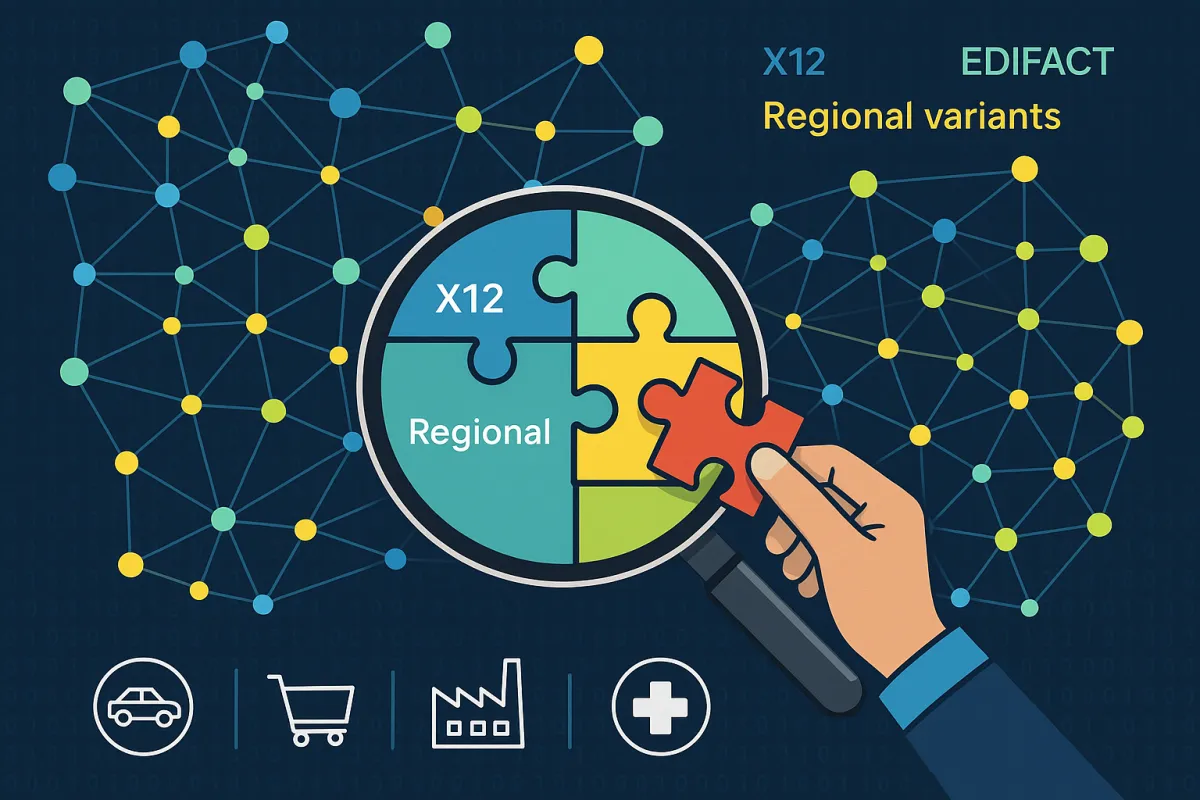
You probably recognize this pattern. Different standards across regions mean X12 dominates North America while EDIFACT rules Europe and Asia, creating a compatibility nightmare when you're managing suppliers across multiple continents. Middleware can convert EDIFACT to ANSI X12 and vice versa, but mappings must be defined carefully to ensure data isn't lost during translation.
The Cross-Border EDI Interoperability Crisis Threatening Modern Supply Chains
85% of businesses utilize EDI for B2B transactions, but the growth in complexity is staggering. The EDI software market is projected to reach $5.30 billion by 2032, meaning more volume, more partners, and more change requests. Each addition to your trading partner network amplifies the interoperability challenge.
The numbers paint a grim picture. Nearly a quarter of companies lose $500K or more to integration issues related to their supply chains. Research by Ovum shows 53% of enterprises experience limitations with their current B2B integration solutions when rapidly onboarding trading partners, with approximately 40% requiring over 30 days to onboard a new partner.
Here's where standards fragmentation becomes expensive. North American brands expanding to Europe find themselves using both X12 domestically and EDIFACT internationally, while European brands moving into North America face the reverse challenge. Transportation management vendors like MercuryGate and Descartes have invested heavily in multi-standard support, but the compatibility matrix remains complex.
Understanding the Root Causes of EDI Standards Fragmentation
Companies usually have different internal data structures due to myriad different IT and ERP systems that don't all follow the same logic - applied to EDI, we could say they speak different languages. The challenge multiplies when requirements can differ from trading partner to trading partner for the same three-digit code EDI document.
Regional standards create additional layers of complexity. UN/EDIFACT emerged as the most popular format outside North America and the only truly international set of standards, now widely used especially in Europe to facilitate multi-country and multi-industry exchanges, leading to several industry-specific subsets like retail-based EANCOM.
Industry-specific requirements add another dimension. In the automotive sector, ODETTE was specially designed for European automotive industry needs, while there are other historical or regional languages like VDA used in the German automotive industry or TRADACOMS used in the UK prior to EDIFACT adoption.
The automotive example shows how standards evolve within sectors. Manufacturing platforms need to handle ODETTE alongside VDA requirements, while retail operations must navigate between TRADACOMS legacy systems and modern EDIFACT implementations.
The True Cost of Poor EDI Standards Assessment
One missing value or incorrect character in an EDI document can throw off an entire transaction, with formats like EDIFACT or ANSI X12 not designed for easy human readability, making spotting errors even harder. Scale makes this exponentially worse.
Experience from past EDI integrations shows there will be errors on early interchanges of every document, and even after orders complete accurately several times, variations in later orders may require manual corrections. Notice how this compounds across multiple trading partners with different standards.
The financial impact extends beyond immediate fixes. Without proper data mapping, companies may introduce friction and delays into communication workflows or risk non-compliance with EDI mandates that many retailers strictly enforce, leading to costly fines, damaged business relationships, and negative vendor scorecards.
When handling partners across Oracle TM and SAP TM environments alongside newer platforms like Cargoson, the complexity of maintaining accurate mappings for each system creates bottlenecks that cascade through your entire operation.
Building Your EDI Standards Compatibility Matrix
Start with a systematic approach to analyzing each trading partner's requirements. Mapping guidelines for each EDI document are usually provided by trading partners or downloadable from their websites when you sign contracts, and you'll provide these guidelines to your EDI software provider or external consultants.
Create standardized intake templates that capture:
- Primary EDI standard (X12, EDIFACT, regional variants)
- Document versions and implementation guides
- Required data elements and optional fields
- Communication protocols and security requirements
- Testing procedures and validation rules
This is done via a translation table that transforms data from your company's source structure into the target structure or target file of the required format - the technical term for this is mapping. But here's the key: standardize your approach across all partners.
Build reusable mapping libraries for common patterns. Data transformation uses an 'intermediate standard' like EDIFACT that both sides understand, similar to how company A speaks German and company B speaks French but both use English as the common denominator - this is a great advantage when several business partners are involved because you only master ONE language.
Platforms like Transporeon and nShift handle multi-standard environments alongside Cargoson by maintaining these intermediate translation layers, reducing the complexity of partner-specific customizations.
The Complete Interoperability Testing Protocol
EDI testing requires both partners to work on the same time frame and is oftentimes the most difficult step. Your testing protocol needs to account for this coordination challenge while validating multiple standards simultaneously.
Implement staged validation:
- Syntax validation - Verify document structure meets standard requirements
- Semantic validation - Confirm data elements contain meaningful values
- Business logic validation - Test against your specific business rules
- Integration validation - Verify end-to-end data flow through your systems
It typically takes two weeks of manually initiating document uploads and double-checking XML documents to complete due diligence, and if orders with errors still appear after two weeks, it's best to extend the test phase until all XML documents are confirmed with no errors for a reasonable time.
Automate where possible but maintain manual oversight during initial phases. Blue Yonder and Manhattan Active offer testing frameworks that integrate with Cargoson and similar platforms to provide comprehensive validation across multiple standards.
Advanced Mapping Strategies for Multi-Standard Environments
EDI data mapping is critical for seamless data translation between different business systems, going beyond mere translation to ensure data from various sources can be understood and processed correctly by the target system. In multi-standard environments, this becomes both more complex and more powerful.
Deploy hub-and-spoke architectures where your central system maintains canonical data formats, then translates to partner-specific requirements. Many large enterprises support both X12 and EDIFACT and expect suppliers to match their preferred format. Your architecture should accommodate this without requiring custom development for each relationship.
Multi-standard and multi-protocol platforms support multiple standards like EDIFACT, X12, UBL, and TRADACOMS to adapt to different trading partners and markets, operating in SaaS mode and allowing connections with retailers in different countries while managing electronic documents according to each country's specifications.
Consider hybrid approaches that combine direct mapping for high-volume partners with template-based mapping for smaller relationships. FreightPOP and E2open provide this flexibility alongside Cargoson for comprehensive standards coverage without vendor lock-in.
Future-Proofing Your EDI Standards Strategy
Both X12 and EDIFACT have undergone significant updates to accommodate new industries, support richer data structures, and align with evolving IT ecosystems, while newer technologies like XML, JSON, and APIs are reshaping data exchange but ANSI X12 and EDIFACT remain foundational pillars.
The trend toward unified platforms becomes more pronounced each year. Many modern businesses shift from traditional EDI formats to XML-based EDI for cloud and API-driven integrations, with EDIFACT preferred for structured, high-volume B2B transactions while XML EDI is used for flexible, web-based integrations.
Plan for standards evolution by:
- Choosing platforms that support both legacy and emerging standards
- Implementing version control for mapping configurations
- Establishing change management processes for standards updates
- Building monitoring systems that detect compatibility issues early
Innovation leaders like Alpega and 3Gtms are developing alongside Cargoson to create adaptable platforms that handle traditional EDI while preparing for API-first futures. In an increasingly globalized world, using common standards is essential to achieve seamless and interoperable communication between companies regardless of industry or location, without which the true benefit of EDI - efficient, agile, and error-free communication - would not be possible on a global scale.
The 78% mapping failure rate isn't inevitable. With systematic assessment frameworks, rigorous testing protocols, and platforms designed for multi-standard environments, you can transform EDI standards interoperability from a constant source of problems into a competitive advantage. Start with one trading partner relationship, perfect your process, then scale across your entire network.