The Complete PDF-to-EDI Automation Implementation Framework for TMS Integration: How to Bridge Non-EDI Trading Partners Without Breaking Transportation Operations in 2026

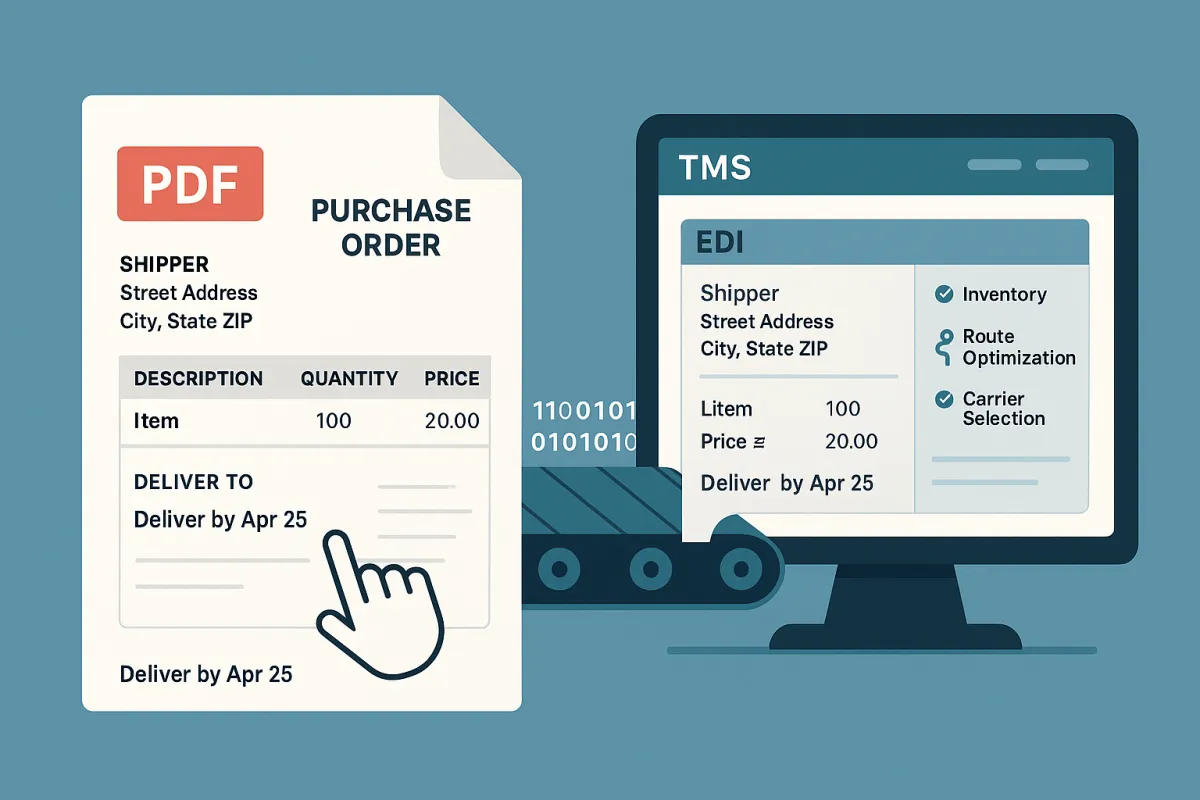
When your transportation department receives 200 PDF orders daily through email while your TMS is waiting for structured EDI, you're looking at a fundamental integration challenge. Despite the rise of EDI and e-procurement portals, a large majority of B2B orders still arrive in PDF format. SME customers don't invest in EDI connectors, purchasing departments work with Word or Excel templates converted to PDF, and email remains the dominant communication channel in many industrial sectors.
The gap between PDF documents and EDI-enabled transportation systems creates manual bottlenecks that eat into operational efficiency. Your team spends hours each day manually extracting shipment details, addresses, and line items from inconsistent PDF formats before entering them into systems like MercuryGate, Descartes, or Oracle Transportation Management. This implementation framework will help you automate that process while maintaining the reliability your transportation operations demand.
Technology Decision Framework: OCR vs AI vs Autonomous Agents
The first decision facing TMS implementations is which technology approach fits your volume and complexity profile. For low volume (less than 20 orders/day), template OCR may suffice if your customers are regular and standardized. For medium volume (20 to 100 orders/day) with varied formats, documentary AI significantly reduces manual workload by automating extraction while keeping a human validation step.
Traditional OCR struggles with variation. If customer A sends a PDF with the order number in the top right and customer B puts it in the middle left, you need two separate rules. With 50 customer formats, you maintain 50 configurations. This creates an administrative burden that scales poorly as your customer base grows.
Agentic OCR acts more like a reader: it perceives layout, understands semantics, and adapts to new document formats without retraining. The contextual understanding dramatically improves pass-through rates beyond 90% by generalizing across unseen document types and reasoning through structural noise.
For high volume operations processing more than 100 orders daily, autonomous agents offer complete automation with measurable ROI. These systems don't just extract data; they execute the entire workflow from PDF receipt to TMS entry, handling business rules like inventory checks, route optimization, and carrier selection automatically.
TMS Vendor Assessment: Evaluating PDF Automation Capabilities
Major TMS platforms are at different maturity levels when it comes to intelligent document processing. Integrating EDI with TMS automates the exchange of critical shipping documents, reducing the need for manual intervention. But PDF-to-EDI automation requires more sophisticated capabilities that not all vendors provide natively.
Oracle Transportation Management and Manhattan Active include built-in document processing engines, but their OCR capabilities are often limited to simple template matching. Blue Yonder's TMS offers stronger AI integration, but implementation complexity can be significant. Emerging platforms like Cargoson and FreightPOP are building PDF automation directly into their core workflows, reducing the need for separate integration projects.
When evaluating vendors, test their systems with your actual customer PDFs, not demo documents. PDF quality varies dramatically in real operations. Some customers scan handwritten forms, others send Excel-generated PDFs with embedded tables, and international customers may include multiple languages. Your evaluation should include accuracy rates across this variety, not just clean sample documents.
API integration depth matters more than initial setup simplicity. Ask vendors how their PDF processing connects to existing EDI workflows, whether extracted data maintains proper validation against EDI standards, and how exceptions are handled when automated extraction fails.
Implementation Strategy and Technical Integration
Start your implementation with document classification and format analysis. Collect 100-200 representative PDF samples from your top customers and analyze their structural patterns. Most transportation documents follow similar layouts despite visual differences: shipper information at the top, line items in tabular format, and delivery instructions at the bottom.
Create a mapping framework that connects extracted PDF fields to EDI segments. Transportation EDI uses specific codes for freight classes, shipping terms, and carrier instructions that may not appear exactly as written in customer PDFs. Your system needs business logic to translate "Next Day Air" to the appropriate EDI code and handle variations like "Overnight Delivery" or "Express Service."
Before sending the EDI document, validate extracted data against transportation standards and business rules. Weight calculations, dimensional data, and hazmat declarations require accuracy checks that prevent costly errors later in the shipping process. Build validation rules that flag suspicious values for manual review rather than allowing questionable data to flow through automatically.
Integration Architecture Considerations
Design your PDF-to-EDI pipeline with proper error handling and rollback capabilities. Transportation operations can't afford data corruption or lost shipments due to automation failures. Implement monitoring that tracks processing success rates, extraction confidence scores, and downstream EDI validation results.
Consider hybrid approaches that combine automated processing with strategic human checkpoints. High-value shipments, international destinations, or hazardous materials may require manual validation even when automated confidence is high. This reduces risk while still capturing efficiency gains on routine domestic shipments.
Addressing Common Integration Challenges and Solutions
Document quality presents the biggest obstacle to reliable automation. Data Extraction: Extracting data from PDFs accurately can be difficult, especially when dealing with complex documents that include tables, images, and free-form text. Poor-quality scans, handwritten exceptions, and languages or fonts the model hasn't seen create edge cases that break simple OCR systems.
Expect edge cases and plan mitigation strategies. Maintain a human-in-the-loop process for low-confidence extractions. When your system flags uncertain data, route those documents to experienced transportation coordinators who can correct errors and provide feedback that improves future processing.
Data mapping complexity increases with customer diversity. Industrial shippers, retail consolidators, and automotive suppliers use different terminology for the same transportation concepts. "Truck load," "TL," and "Full Truckload" all reference the same shipping method but appear differently in customer documents. Build synonym tables and train your extraction models to recognize these variations.
Validation errors often occur at the boundary between PDF extraction and EDI formatting. Address data may extract correctly but fail EDI validation due to formatting differences. "123 Main St." works in a PDF but EDI standards require "123 MAIN STREET." Implement data normalization rules that handle these formatting requirements automatically.
ROI Assessment and Success Metrics Framework
If coordinators spend 60 hours monthly on tasks that TMS automates in 15 hours, that's 45 hours of freed capacity monthly. At a loaded cost of $40 per hour, automation that eliminates 60 hours of manual work delivers $2,400 monthly in productivity gains.
Calculate your baseline costs before implementation. Track how much time transportation coordinators spend on manual data entry, error correction, and customer communication related to document processing. Include hidden costs like delayed shipments due to manual processing bottlenecks and customer service time spent resolving data discrepancies.
Set measurable success targets beyond simple time savings. Process automation should reduce order-to-shipment cycle time, improve data accuracy rates, and increase same-day processing percentages. AI-driven automation in document processing leads to faster operations, but quantify these improvements with specific metrics.
Monitor ongoing performance, not just implementation success. Document formats evolve as customers change their systems or add new requirements. Your automation solution should maintain accuracy rates above 95% and process most common document types without manual intervention. Track these metrics monthly and plan for continuous improvement rather than one-time deployment.
Cost-Benefit Analysis Framework
Compare implementation costs against operational savings over a three-year period. Software licensing, integration development, and staff training create upfront expenses, but operational savings compound monthly. Most transportation operations see positive ROI within 8-12 months when processing more than 50 PDF orders daily.
Factor in opportunity costs of manual processing. Transportation coordinators spending time on data entry can't focus on carrier negotiations, route optimization, or customer service improvements. These strategic activities often deliver higher value than tactical document processing.
Future-Proofing Your PDF-to-EDI Strategy
Document processing is becoming invisible infrastructure. By 2027, organizations won't run "document extraction initiatives" — they'll expect documents to be understood, classified, and routed automatically as part of everyday operations.
Plan for hybrid EDI-API migration strategies that accommodate diverse customer capabilities. While you're automating PDF processing, some customers may transition to API connections or modern EDI standards. Your architecture should handle multiple input formats without requiring separate integration projects for each.
Autonomous document processing represents the next evolution beyond simple extraction. These systems will understand transportation requirements, suggest optimal routing, and negotiate carrier rates based on document content. Position your current implementation to support these advanced capabilities as they mature.
Consider the broader digital transformation context. PDF-to-EDI automation is often the first step toward comprehensive transportation digitization. Success here creates momentum for additional automation projects like dynamic routing, predictive analytics, and autonomous carrier selection. Build your implementation with expansion in mind rather than solving only today's immediate needs.