The Critical EDI Security Framework for Freight Fraud Prevention: How to Build Trading Partner Protection Systems That Stop the 2026 Fraud Surge Without Breaking Supply Chain Operations

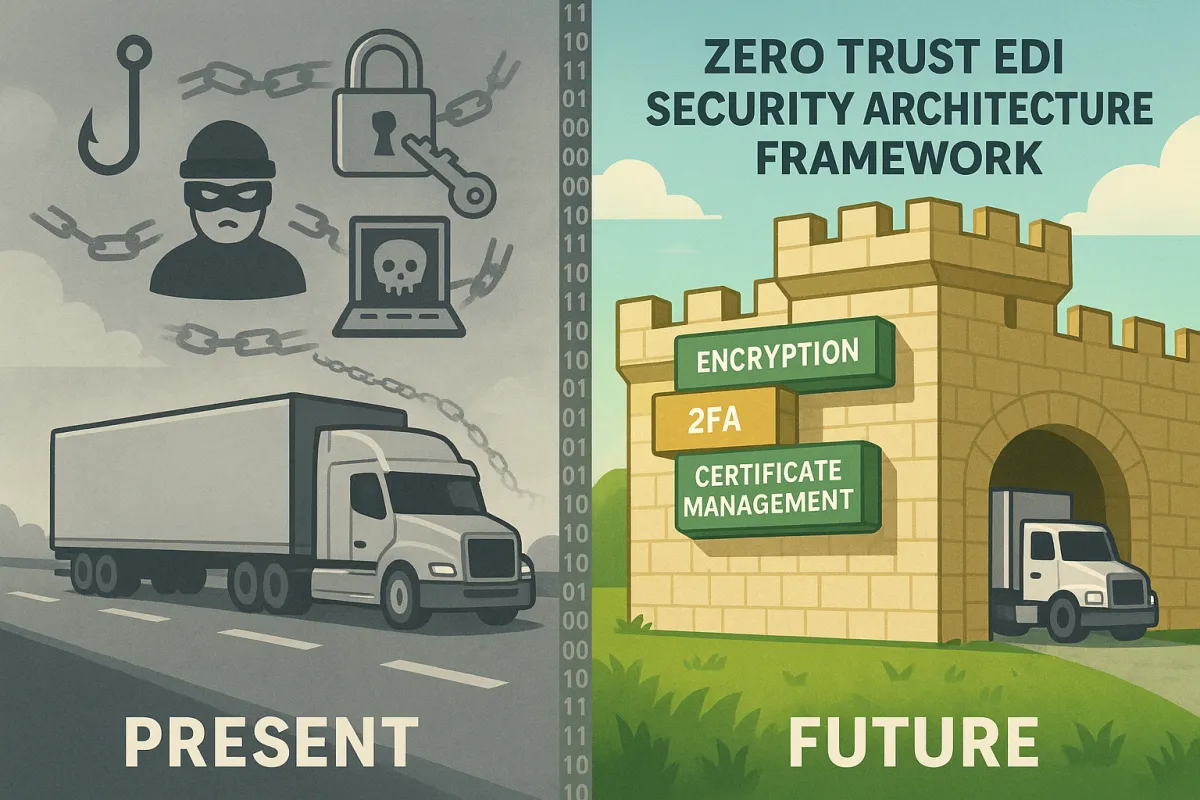
The freight industry faces an unprecedented security crisis in 2026. Highway blocked 527,940 fraudulent inbound emails during Q1 2026, a 49.9% year-over-year increase. The network intercepted 71,801 spoofed phone calls and recorded 2,256 reported instances of identity theft, up 89.6% year over year. Meanwhile, carriers holding legitimate Motor Carrier numbers and previously clean operating histories were responsible for roughly 50% of all theft incidents, revealing how sophisticated these attacks have become.
The FBI issued a public service announcement on April 30, 2026, warning the US transportation and logistics industry of a sharp rise in cyber-enabled cargo theft, with estimated losses in the United States and Canada reaching nearly $725 million in 2025. What makes this surge particularly dangerous is how criminals now target EDI systems and trading partner networks to orchestrate their schemes. Your EDI security framework isn't just about protecting data anymore—it's about preventing financial crimes that can destroy your business.
How Criminals Exploit EDI and B2B Integration Vulnerabilities
Modern freight fraud operates through sophisticated cyber-enabled campaigns that specifically target EDI systems. Attackers first compromise freight broker or carrier accounts through phishing sites that install remote monitoring software, gaining persistent, undetected access. They then post fraudulent freight listings on load boards, tricking legitimate carriers into downloading malicious files, and accept real shipments under stolen carrier identities.
The attack vectors are multiplying rapidly. Deceptive pickup schemes — where criminals use fake identities, forged credentials and carrier impersonation to secure loads — jumped 31% year over year. But here's what makes EDI systems particularly vulnerable: EDI transactions flow through multiple vulnerability points that most security teams never monitor. Each step in the process — from purchase orders (850) to invoices (810) — presents opportunities for attackers who understand business logic exploitation.
Authentication weaknesses plague many EDI networks. Traditional setups often use static credentials that rarely change. Once compromised, these credentials can provide persistent access without triggering alarms. Worse, since at least 2024, cyber threat actors have gained unauthorized access to the computer systems of brokers and carriers — typically via spoofed emails, fake URLs, and compromised carrier accounts.
The FBI warns that cyber-enabled cargo theft has crossed into organized crime territory, with groups running multi-stage operations that combine credential theft, account compromise, identity fraud against federal carrier registries, and physical logistics manipulation. The modification of FMCSA registration records is a particularly significant escalation, as it weaponizes a government database to legitimize fraudulent operations and delay discovery.
The Zero Trust EDI Security Architecture Framework
Traditional EDI security models assume trading partners can be trusted once they're onboarded. That assumption is fatal in 2026. Zero-Trust security assumes no transaction is safe by default, requiring continuous verification from every established trading partner. This approach mitigates supply chain risks by enforcing strict identity validation and encryption at every connection point in the network.
Your zero trust EDI framework needs multiple security layers working together. Start with end-to-end encryption for all data transfers protects sensitive information during transmission. Secure protocols like AS2 (Applicability Statement 2) enhance security by ensuring that data is encrypted and signed before being sent. But encryption alone won't stop sophisticated fraud schemes.
Implement multi-channel verification to prevent criminal infiltration of legitimate transactions and freight diversion. Recognize that familiar names or email addresses alone do not confirm authenticity; validate unexpected communications through a two-factor authentication process. This means every EDI connection, every message, and every trading partner interaction gets verified independently.
For certificate management, certificates need regular rotation, proper validation, and secure storage. Many organizations neglect this fundamental requirement, leaving expired or compromised certificates in production environments. Your framework should automate certificate lifecycle management and immediately flag any anomalies.
Major EDI providers are adapting their security approaches differently. IBM Sterling B2B Integrator emphasizes on-premises control with extensive monitoring capabilities. Cargoson builds security into their cloud-native TMS architecture from the ground up, while OpenText focuses on hybrid deployments that bridge legacy and modern systems. Cleo takes an API-first approach to security, and TrueCommerce emphasizes managed services with built-in fraud detection.
Real-Time Monitoring and Fraud Detection Implementation
You can't fight 2026's fraud surge with traditional batch processing and daily reports. It's that network that makes the difference, Grace said, and it isn't possible without technology. "If you get one of us, you get all of us, because you're going to get a real-time alert. Everything is real-time around here. If you're a day behind—if you're not plugged in and getting real-time data—you could be tendering loads to a scammer using yesterday's data.
Deploy AI-powered monitoring that analyzes transaction patterns across your entire EDI network. Anomaly detection identifies unusual patterns that might indicate security issues. Sudden spikes in transaction volume, connections from unexpected IP addresses, failed authentication attempts, or data transfers at unusual times all warrant investigation. The key is setting up automated alerts that don't overwhelm your team with false positives.
Transaction monitoring should track every EDI exchange. Log who sent what to whom, when it happened, file sizes, and any errors or anomalies. Modern systems generate detailed audit trails that support forensic investigations in the event of incidents. But remember: these logs need protection themselves; tampering with logs is often an attacker's first move after gaining access.
Integration with TMS platforms is where real-time monitoring becomes actionable. MercuryGate's fraud detection capabilities can trigger immediate load holds based on carrier verification failures. Descartes MacroPoint's visibility platform helps identify GPS spoofing attempts. Transporeon's network effects multiply fraud detection across thousands of connected shippers and carriers.
Trading Partner Verification and Onboarding Security
The days of basic MC number checks are over. Fraud has moved from rules to process," said Michael Grace, vice president of customer risk management at Highway. "Just because you've run a thousand loads with a carrier doesn't mean the next one is safe. Your verification process needs continuous validation, not just initial onboarding checks.
Maintain thorough documentation — including photos of drivers, licenses, vehicles, license plates, cab numbers, truck numbers, Department of Transportation and Motor Carrier numbers, and contact and communication details — of all parties. This documentation aids investigative efforts and may help disrupt ongoing strategic cargo theft schemes.
Technology platforms are making verification more sophisticated. FreightValidate provides real-time carrier scoring based on multiple data sources. Carrier 411 now includes social media analysis and cross-referencing with law enforcement databases. Highway's platform powers real-time carrier verification through physical and digital footprints. In March, ITS became one of the first users of the platform's newest feature built to combat silent sales. GenLogs' platform now scans the internet for signals of MC numbers listed for illegal sale and sends real-time alerts when an authority attached to a carrier within the ITS network is identified.
Modern EDI platforms are integrating verification directly into their onboarding workflows. Orderful automates carrier credential verification before allowing EDI connections. SPS Commerce includes fraud scoring in their partner onboarding process. nShift requires multi-factor authentication for all new trading partners. Cargoson combines TMS and EDI verification into a unified security checkpoint that prevents fraudulent carriers from entering the network at any level.
Incident Response and Business Continuity Planning
When fraud hits your EDI network, speed determines everything. Just recently, a driver who's run the same route for years reached out to his ITS rep because there was a new drop-off location in the dispatch info," Jacobsen continued. "It turned out the carrier's email had been compromised, and that driver's close relationship with ITS saved the load. At the end of the day, you can't replace real relationships.
Your incident response plan needs specific procedures for EDI-related fraud. First, monitor FMCSA registration records for unauthorized changes to your carrier profile: Attackers modify carrier registration details to legitimize fraudulent operations under stolen identities. Establish a routine check of your FMCSA carrier profile for unauthorized changes to contact information, insurance records, or operating authority, and set up alerts where the registry allows it.
Document everything immediately. Have a clear plan in place to respond to EDI-related security incidents (e.g., data leaks, failed transmissions, partner compromise). Quick, coordinated responses reduce damage and help you meet reporting obligations. This includes preserving transaction logs, communication records, and any evidence of compromised credentials.
Business continuity requires redundant verification systems. If your primary EDI connection is compromised, you need backup verification channels that can handle transaction volume without exposing you to additional fraud risk. Simulate incidents periodically to test your response. Use your monitoring tools to detect unusual activity early.
Implementation Roadmap and Cost-Benefit Analysis
Estimated losses from supply chain crime incidents surged to nearly $725 million in 2025, a 60% increase from 2024, according to new data from Verisk CargoNet. Compare this to the cost of implementing comprehensive EDI security: most organizations spend less on their entire security framework than they would lose from a single major fraud incident.
Implementing good EDI security typically costs much less than recovering from security incidents. Proper encryption, access controls, and monitoring systems usually cost less than a single day of EDI downtime.
Start your implementation with a 90-day security assessment. Map every EDI integration point, catalog your trading partners, and document current security controls. Identify the highest-risk connections first—usually high-volume carriers or partners with access to sensitive data.
Month 1-3: Deploy real-time monitoring and anomaly detection. Implement multi-factor authentication for all EDI access points. Begin continuous carrier verification processes.
Month 4-6: Integrate fraud detection across your TMS and EDI platforms. Deploy automated incident response procedures. Train your teams on new security protocols.
Month 7-12: Expand verification requirements to all trading partners. Implement advanced threat detection using AI and machine learning. Conduct regular security assessments and penetration testing.
When comparing vendors, evaluate security as your primary criterion. MercuryGate provides strong integration with third-party security tools. E2open offers network-wide fraud intelligence sharing. Blue Yonder emphasizes AI-powered anomaly detection. Oracle TM and SAP TM focus on enterprise-grade security controls. Cargoson builds security into every layer of their platform architecture, treating fraud prevention as a core TMS function rather than an add-on feature.
The 2026 freight fraud surge isn't slowing down. The threat landscape has expanded dramatically over the past several years. Experts say the problem isn't stabilizing; it's evolving. Your EDI security framework needs to evolve faster than the criminals targeting it. Start building these protections now, before your organization becomes another statistic in next year's fraud reports.